About Me

My photo
An Investor and counsellor in Financial Market

Tuesday, January 22, 2019

Yuval Noah Harari: the myth of freedom

Should scholars serve the truth, even at the cost of social harmony? Should you expose a fiction even if that fiction sustains the social order? In writing my latest book, 21 Lessons for the 21st Century, I had to struggle with this dilemma with regard to liberalism.
On the one hand, I believe that the liberal story is flawed, that it does not tell the truth about humanity, and that in order to survive and flourish in the 21st century we need to go beyond it. On the other hand, at present the liberal story is still fundamental to the functioning of the global order. What’s more, liberalism is now attacked by religious and nationalist fanatics who believe in nostalgic fantasies that are far more dangerous and harmful.
So should I speak my mind openly, risking that my words could be taken out of context and used by demagogues and autocrats to further attack the liberal order? Or should I censor myself? It is a mark of illiberal regimes that they make free speech more difficult even outside their borders. Due to the spread of such regimes, it is becoming increasingly dangerous to think critically about the future of our species.
I eventually chose free discussion over self-censorship, thanks to my belief both in the strength of liberal democracy and in the necessity to revamp it. Liberalism’s great advantage over other ideologies is that it is flexible and undogmatic. It can sustain criticism better than any other social order. Indeed, it is the only social order that allows people to question even its own foundations. Liberalism has already survived three big crises – the first world war, the fascist challenge in the 1930s, and the communist challenge in the 1950s-70s. If you think liberalism is in trouble now, just remember how much worse things were in 1918, 1938 or 1968.
In 1968, liberal democracies seemed to be an endangered species, and even within their own borders they were rocked by riots, assassinations, terrorist attacks and fierce ideological battles. If you happened to be amid the riots in Washington on the day after Martin Luther King was assassinated, or in Paris in May 1968, or at the Democratic party’s convention in Chicago in August 1968, you might well have thought that the end was near. While Washington, Paris and Chicago were descending into chaos, Moscow and Leningrad were tranquil, and the Soviet system seemed destined to endure for ever. Yet 20 years later it was the Soviet system that collapsed. The clashes of the 1960s strengthened liberal democracy, while the stifling climate in the Soviet bloc presaged its demise.
So we hope liberalism can reinvent itself yet again. But the main challenge it faces today comes not from fascism or communism, and not even from the demagogues and autocrats that are spreading everywhere like frogs after the rains. This time the main challenge emerges from the laboratories.
Liberalism is founded on the belief in human liberty. Unlike rats and monkeys, human beings are supposed to have “free will”. This is what makes human feelings and human choices the ultimate moral and political authority in the world. Liberalism tells us that the voter knows best, that the customer is always right, and that we should think for ourselves and follow our hearts.

U
nfortunately, “free will” isn’t a scientific reality. It is a myth inherited from Christian theology. Theologians developed the idea of “free will” to explain why God is right to punish sinners for their bad choices and reward saints for their good choices. If our choices aren’t made freely, why should God punish or reward us for them? According to the theologians, it is reasonable for God to do so, because our choices reflect the free will of our eternal souls, which are independent of all physical and biological constraints.

This myth has little to do with what science now teaches us about Homo sapiens and other animals. Humans certainly have a will – but it isn’t free. You cannot decide what desires you have. You don’t decide to be introvert or extrovert, easy-going or anxious, gay or straight. Humans make choices – but they are never independent choices. Every choice depends on a lot of biological, social and personal conditions that you cannot determine for yourself. I can choose what to eat, whom to marry and whom to vote for, but these choices are determined in part by my genes, my biochemistry, my gender, my family background, my national culture, etc – and I didn’t choose which genes or family to have.

Hacked รข€¦ biometric sensors could allow corporations direct access to your inner world.
This is not abstract theory. You can witness this easily. Just observe the next thought that pops up in your mind. Where did it come from? Did you freely choose to think it? Obviously not. If you carefully observe your own mind, you come to realise that you have little control of what’s going on there, and you are not choosing freely what to think, what to feel, and what to want.
Though “free will” was always a myth, in previous centuries it was a helpful one. It emboldened people who had to fight against the Inquisition, the divine right of kings, the KGB and the KKK. The myth also carried few costs. In 1776 or 1945 there was relatively little harm in believing that your feelings and choices were the product of some “free will” rather than the result of biochemistry and neurology.
But now the belief in “free will” suddenly becomes dangerous. If governments and corporations succeed in hacking the human animal, the easiest people to manipulate will be those who believe in free will.
In order to successfully hack humans, you need two things: a good understanding of biology, and a lot of computing power. The Inquisition and the KGB lacked this knowledge and power. But soon, corporations and governments might have both, and once they can hack you, they can not only predict your choices, but also reengineer your feelings. To do so, corporations and governments will not need to know you perfectly. That is impossible. They will just have to know you a little better than you know yourself. And that is not impossible, because most people don’t know themselves very well.
If you believe in the traditional liberal story, you will be tempted simply to dismiss this challenge. “No, it will never happen. Nobody will ever manage to hack the human spirit, because there is something there that goes far beyond genes, neurons and algorithms. Nobody could successfully predict and manipulate my choices, because my choices reflect my free will.” Unfortunately, dismissing the challenge won’t make it go away. It will just make you more vulnerable to it.
It starts with simple things. As you surf the internet, a headline catches your eye: “Immigrant gang rapes local women”. You click on it. At exactly the same moment, your neighbour is surfing the internet too, and a different headline catches her eye: “Trump prepares nuclear strike on Iran”. She clicks on it. Both headlines are fake news stories, generated perhaps by Russian trolls, or by a website keen on increasing traffic to boost its ad revenues. Both you and your neighbour feel that you clicked on these headlines out of your free will. But in fact you have been hacked.
Propaganda and manipulation are nothing new, of course. But whereas in the past they worked like carpet bombing, now they are becoming precision-guided munitions. When Hitler gave a speech on the radio, he aimed at the lowest common denominator, because he couldn’t tailor his message to the unique weaknesses of individual brains. Now it has become possible to do exactly that. An algorithm can tell that you already have a bias against immigrants, while your neighbour already dislikes Trump, which is why you see one headline while your neighbour sees an altogether different one. In recent years some of the smartest people in the world have worked on hacking the human brain in order to make you click on ads and sell you stuff. Now these methods are being used to sell you politicians and ideologies, too.
And this is just the beginning. At present, the hackers rely on analysing signals and actions in the outside world: the products you buy, the places you visit, the words you search for online. Yet within a few years biometric sensors could give hackers direct access to your inner world, and they could observe what’s going on inside your heart. Not the metaphorical heart beloved by liberal fantasies, but rather the muscular pump that regulates your blood pressure and much of your brain activity. The hackers could then correlate your heart rate with your credit card data, and your blood pressure with your search history. What would the Inquisition and the KGB have done with biometric bracelets that constantly monitor your moods and affections? Stay tuned.
Liberalism has developed an impressive arsenal of arguments and institutions to defend individual freedoms against external attacks from oppressive governments and bigoted religions, but it is unprepared for a situation when individual freedom is subverted from within, and when the very concepts of “individual” and “freedom” no longer make much sense. In order to survive and prosper in the 21st century, we need to leave behind the naive view of humans as free individuals – a view inherited from Christian theology as much as from the modern Enlightenment – and come to terms with what humans really are: hackable animals. We need to know ourselves better.
Of course, this is hardly new advice. From ancient times, sages and saints repeatedly advised people to “know thyself”. Yet in the days of Socrates, the Buddha and Confucius, you didn’t have real competition. If you neglected to know yourself, you were still a black box to the rest of humanity. In contrast, you now have competition. As you read these lines, governments and corporations are striving to hack you. If they get to know you better than you know yourself, they can then sell you anything they want – be it a product or a politician.
It is particularly important to get to know your weaknesses. They are the main tools of those who try to hack you. Computers are hacked through pre-existing faulty code lines. Humans are hacked through pre-existing fears, hatreds, biases and cravings. Hackers cannot create fear or hatred out of nothing. But when they discover what people already fear and hate it is easy to push the relevant emotional buttons and provoke even greater fury.
If people cannot get to know themselves by their own efforts, perhaps the same technology the hackers use can be turned around and serve to protect us. Just as your computer has an antivirus program that screens for malware, maybe we need an antivirus for the brain. Your AI sidekick will learn by experience that you have a particular weakness – whether for funny cat videos or for infuriating Trump stories – and would block them on your behalf.
You feel that you clicked on these headlines out of your free will, but in fact you have been hacked.
Pinterest
 You feel that you clicked on these headlines out of your free will, but in fact you have been hacked. Photograph: Getty images
But all this is really just a side issue. If humans are hackable animals, and if our choices and opinions don’t reflect our free will, what should the point of politics be? For 300 years, liberal ideals inspired a political project that aimed to give as many individuals as possible the ability to pursue their dreams and fulfil their desires. We are now closer than ever to realising this aim – but we are also closer than ever to realising that this has all been based on an illusion. The very same technologies that we have invented to help individuals pursue their dreams also make it possible to re-engineer those dreams. So how can I trust any of my dreams?
From one perspective, this discovery gives humans an entirely new kind of freedom. Previously, we identified very strongly with our desires, and sought the freedom to realise them. Whenever any thought appeared in the mind, we rushed to do its bidding. We spent our days running around like crazy, carried by a furious rollercoaster of thoughts, feelings and desires, which we mistakenly believed represented our free will. What happens if we stop identifying with this rollercoaster? What happens when we carefully observe the next thought that pops up in our mind and ask: “Where did that come from?”
For starters, realising that our thoughts and desires don’t reflect our free will can help us become less obsessive about them. If I see myself as an entirely free agent, choosing my desires in complete independence from the world, it creates a barrier between me and all other entities. I don’t really need any of those other entities – I am independent. It simultaneously bestows enormous importance on my every whim – after all, I chose this particular desire out of all possible desires in the universe. Once we give so much importance to our desires, we naturally try to control and shape the whole world according to them. We wage wars, cut down forests and unbalance the entire ecosystem in pursuit of our whims. But if we understood that our desires are not the outcome of free choice, we would hopefully be less preoccupied with them, and would also feel more connected to the rest of the world.
People sometimes imagine that if we renounce our belief in “free will”, we will become completely apathetic, and just curl up in some corner and starve to death. In fact, renouncing this illusion can have two opposite effects: first, it can create a far stronger link with the rest of the world, and make you more attentive to your environment and to the needs and wishes of others. It is like when you have a conversation with someone. If you focus on what you want to say, you hardly really listen. You just wait for the opportunity to give the other person a piece of your mind. But when you put your own thoughts aside, you can suddenly hear other people.
Second, renouncing the myth of free will can kindle a profound curiosity. If you strongly identify with the thoughts and desires that emerge in your mind, you don’t need to make much effort to get to know yourself. You think you already know exactly who you are. But once you realise “Hi, this isn’t me. This is just some changing biochemical phenomenon!” then you also realise you have no idea who – or what – you actually are. This can be the beginning of the most exciting journey of discovery any human can undertake.
here is nothing new about doubting free will or about exploring the true nature of humanity. We humans have had this discussion a thousand times before. But we never had the technology before. And the technology changes everything. Ancient problems of philosophy are now becoming practical problems of engineering and politics. And while philosophers are very patient people – they can argue about something inconclusively for 3,000 years – engineers are far less patient. Politicians are the least patient of all.
How does liberal democracy function in an era when governments and corporations can hack humans? What’s left of the beliefs that “the voter knows best” and “the customer is always right”? How do you live when you realise that you are a hackable animal, that your heart might be a government agent, that your amygdala might be working for Putin, and that the next thought that emerges in your mind might well be the result of some algorithm that knows you better than you know yourself? These are the most interesting questions humanity now faces.
Unfortunately, these are not the questions most humans ask. Instead of exploring what awaits us beyond the illusion of “free will”, people all over the world are now retreating to find shelter with even older illusions. Instead of confronting the challenge of AI and bioengineering, many are turning to religious and nationalist fantasies that are even less in touch with the scientific realities of our time than liberalism. Instead of fresh political models, what’s on offer are repackaged leftovers from the 20th century or even the middle ages.
When you try to engage with these nostalgic fantasies, you find yourself debating such things as the veracity of the Bible and the sanctity of the nation (especially if you happen, like me, to live in a place like Israel). As a scholar, this is a disappointment. Arguing about the Bible was hot stuff in the age of Voltaire, and debating the merits of nationalism was cutting-edge philosophy a century ago – but in 2018 it seems a terrible waste of time. AI and bioengineering are about to change the course of evolution itself, and we have just a few decades to figure out what to do with them. I don’t know where the answers will come from, but they are definitely not coming from a collection of stories written thousands of years ago.
So what to do? We need to fight on two fronts simultaneously. We should defend liberal democracy, not only because it has proved to be a more benign form of government than any of its alternatives, but also because it places the fewest limitations on debating the future of humanity. At the same time, we need to question the traditional assumptions of liberalism, and develop a new political project that is better in line with the scientific realities and technological powers of the 21st century.
Greek mythology tells that Zeus and Poseidon, two of the greatest gods, competed for the hand of the goddess Thetis. But when they heard the prophecy that Thetis would bear a son more powerful than his father, both withdrew in alarm. Since gods plan on sticking around for ever, they don’t want a more powerful offspring to compete with them. So Thetis married a mortal, King Peleus, and gave birth to Achilles. Mortals do like their children to outshine them. This myth might teach us something important. Autocrats who plan to rule in perpetuity don’t like to encourage the birth of ideas that might displace them. But liberal democracies inspire the creation of new visions, even at the price of questioning their own foundations •

Monday, January 21, 2019

A Trio of Uncertainties for 2019

The markets took a wild ride in 2018 and uncertainty is one of the biggest drivers for volatility. We have another unpredictable year ahead with economic, national and geopolitical uncertainty.

1. U.S. Political Uncertainty

There are two major U.S. current events you’ll want to keep an eye on: if the Fed continues to raise rates and the ongoing government shutdown.
The Fed raised rates on Dec. 19 which was expected, but uncertainty over whether the Fed would pull back from a tighter policy path, whether they would continue with rate hikes and Jerome Powell’s comment on the Fed not changing its strategy for shrinking the balance sheet all caused the markets to drop to the year’s lows.
Fast forward to Jan. 4 when stocks soared after Powell made an appearance at the American Economic Association conference where he said the Fed can adjust policy quickly and flexibly if the they see problems and would not hesitate to change their course including the balance sheet. Powell stated, “We’re listening carefully with sensitivity to the message that the markets are sending and we’ll be taking those downside risks into account as we make policy going forward.” According to Bloomberg, there is a higher probability of a rate cut than a hike for the U.S. toward the end of 2019 (see below).

Source: Bloomberg
In addition to doubt surrounding the Fed, the now weeks-long government shutdown is adding additional uncertainty into the markets. Parts of the U.S. government have been shut down for over two weeks after Trump refused to sign a bill that excluded substantial spending to continue construction of a border wall.
The government shutdown has left hundreds of thousands of government workers without pay. The operations of nine departments have been affected by this shutdown, one being the Internal Revenue Service (IRS) with only 12 percent of the agency’s employees working right now.
During a shutdown—and please sit down for this if you are not already—the IRS generally does not pay tax refunds which could delay billions of dollars to those expecting one this year. According to The Wall Street Journal, the IRS paid $12.6 billion in refunds by Feb. 2, 2018, and by Feb. 16 they paid $101.2 billion in refunds. But have no fear, if you owe money you are still expected to pay up!
Trump is intent on keeping the government shut down for as long as he has to and has even said he would resort to declaring a national state of emergency to build a wall along the border of U.S. and Mexico. House Democrats have threatened to sue Trump should he declare a national emergency to build it. Serious uproar will ensue if this shutdown continues.

2. Geopolitical Uncertainty

Geopolitical uncertainty is also affecting the markets. One of the biggest events currently transpiring is the U.S.-China trade war.
The U.S.-China trade war posed a constant disruption to markets for nearly all of 2018. President Trump has demanded that Beijing stop requiring U.S. firms to partner with Chinese firms when they want to do business in China, and Trump believes China has stolen intellectual property of U.S. firms and Trump wants an end to it.
When Trump and Chinese President Xi met for talks in Buenos Aires in December they agreed to a cease-fire of tariffs on billions of goods which go into effect on Jan. 1. They also agreed to a 90 day cease-fire to ease trade tensions until March 1. However, even with the cease-fire, ongoing tensions already damaged the profits of many companies. Apple recently reported the sales of iPhones in China were dropping, bringing down the company’s profits substantially. Apple is now down 30 percent from its highs this year.
It is clear that there is a growth slowdown across the global economy. China’s economy is growing at its slowest pace in a decade. Both the U.S. and China are hurting from this trade war so it is in the best interest of both countries to come to an agreement. On Dec. 29 Trump and Xi spoke on the phone and Trump reported that “big progress was being made”.
On Jan. 4 it was announced the Trump Administration and China will continue their talks in Beijing today to end punishing tariffs and strike a trade deal. If trade negotiations go wellcompanies who are intertwined with China would benefit.

3. Economic Uncertainty

A very healthy December jobs report was released on Friday. It was expected that December would add 177,000 jobs, but the report showed that 312,000 jobs were added and that there was the largest increase in payrolls since February. These results blew expectations out of the water.
One of the biggest concerns for investors is the growth slowdown, and with the ISM reporting last Thursday that the manufacturing activity slid to 54.1 (a reading of above 50 means the economy is expanding), it signaled our economy is still expanding but is in a growth slowdown. When the jobs report came out on Friday it signaled hope for the economy giving a boost to the markets. This provides hope for investors—if the economy is still expanding and there is a strong labor market, how can we be in the midst of a recession?
The last event to really keep an eye on is fourth quarter earnings season. The majority of companies within the S&P 500 will report their earnings starting in late January through February.

Source: Bloomberg L.P., Financial Sense Wealth Management
Last season, companies who reported negative results were severely punished while companies who reported positive results saw flat to little price appreciation. Last earnings period, price reactions for stocks were based on the revenue stories. The fourth quarter expectation bar was lowered after last season.
This season will focus again on the margin outlook of companies. The beacon of hope for companies reporting will be that profit expectations are lower which will make it “easier” to beat estimates. This could cause near term relief for equities.
Last quarter EPS growth came in around 26 percent, and this quarter the projections suggest for earnings to moderate to 16 percent year-over-year.
Bottom line: There are a lot of events to keep an eye on. As far as U.S. political uncertainties are concerned, keep a watchful eye on what happens with the government shutdown and how the Fed reacts to the economy. The main geopolitical uncertainty to keep on your radar is the U.S.-China trade war as the outcome will affect the global economy including the U.S. markets. The tariffs could substantially change companies' profit margins within the U.S. which in turn could significantly hurt our economy.
The U.S. remains the best house in a bad neighborhood. The job report data and ISM report coming in at 54.1 leads us to believe the economy is still doing well, but we are showing signs of a growth slowdown. National, geopolitical and economic uncertainty create a mix for great volatility in the markets. I’d advise you to keep an eye on these major events as they’ll determine how 2019 will pan out.

Friday, January 18, 2019

The Biggest Threat To Industrial Metals In 2019

Mine

Global markets plummeted this week on China slowdown worries, dragging industrial metals prices along and increasing future demand concerns, which has prompted analysts to question whether Beijing is doing enough to address the country's economic contraction.
BMO analyst Colin Hamilton said in a note to investors Friday there were many questions in the metals market raised by the trend in China of positive fiscal spending statements, but weak consumer-led data points.
One of the main questions, he wrote, is whether the Chinese government is doing what’s needed to stop the downward trend.
“This really is the big question for the current year, and the jury is still out,” Hamilton said. “We anticipate the measures taken will start to yield results towards the end of the first quarter.”
One of the main questions is whether the Chinese government is doing enough to address the country's economic contraction.
Beijing has adopted a series of fiscal and monetary stimulus measures since the summer, but a factory survey this week showed China’s manufacturing sector contracting — the latest in a string of data indicating that growth continues to slow down.
The country’s central bank has announced it would inject $117 billion into the banking system by cutting the share of deposits that commercial banks must hold in reserve, in an effort to boost lending.
Kevin Hassett, chairman of the White House Council of Economic Advisers, cautioned Thursday that more U.S. companies can be expected to lower earnings forecasts as the softer Chinese economy cuts into their sales.
Despite the gloom and doom, BMO Metals believes it’s “highly unlikely” for 2019 to become the year China’s debt crisis comes home to roost and growth slumps. “Risks are rising; however, we think the country still has enough wiggle room to avoid systemic risk,” Hamilton noted.
Battery Metals
Some of the end-use areas in which the analyst expects better demand growth over 2019 are, in fact, those exposed to Chinese infrastructure. These include high-speed rails, UHV lines, electric vehicles’ charging stations, and, especially, packaging and machinery.
In terms of the so-called battery metals, BMO warns that China’s decision to lower many of its EVs subsidies for 2019 by about 30% compared to last year, is nothing but bad news for nickel, though it expects the impact on penetration rate forecasts to be limited.
The BMO analyst concludes its report by noting that metals producers may surprise this year, as cash-rich miners have the potential to show better productivity at existing assets and lower like-for-like costs.

Thursday, January 17, 2019

Automakers Go All-In On Electric Vehicles

EV

Global automakers are going all-in on electrification with plans to spend a combined $300 billion on EVs over the next decade, according to a Reuters analysis.
The rush towards EVs comes as environmental and climate regulations begin to tighten around the world, while technological improvements have made EVs cheaper than ever.
Among global automakers, Volkswagen has the most ambitious vision. VW, the world’s largest automaker by sales, announced plans in December to spend $34 billion on e-mobility initiatives and $57 billion on battery procurement. The combined $91 billion in planned spending on EVs over the next decade is unmatched by any other global car company. VW will unveil 50 battery electric models by 2025, along with 30 hybrid election models. And over time, the Germany automaker will offer electric versions of all of its 300 models.
The EV push comes at a tricky time for the global auto industry, which has recently run into trouble. Overall auto sales screeched to a halt in China last year, a major sign of an economic slowdown. As the world’s largest car market, the 6 percent contraction in sales in China in 2018 has inflicted economic pain on automakers around the globe. According to RBC Capital Markets, the global auto industry saw sales dip by 2.9 percent in the third quarter of 2018, followed by a 4 percent decrease in the fourth quarter. That marked the first time global auto sales fell in two consecutive quarters since 2009 during the depths of the financial crisis. Goldman Sachs predicts that car sales in China will decline by another 7 percent this year as the economy slows and the effects of the trade war linger.
However, within that contraction is a notable development. Even as overall car sales sink, the sale of EVs and hybrid vehicles in China is expected to jump by a third to 1.6 million, according to Bloomberg and the China Association of Automobile Manufacturers. In fact, China is aggressively shifting towards EVs, and the fact that it will attract close to half – roughly $135 of the $300 billion in planned spending on EVs over the next decade – is clear evidence that China has become a leader in electrification. China has a mix of state-enforced mandates, credits and incentives that have the combined effect of accelerating EV adoption.
This two-track trend – surging sales of EVs but weak overall sales of cars – is also unfolding elsewhere. Sales have also been stagnant in Europe and the United States. In the U.S., motorists have abandoned passenger sedans and instead have shifted back towards heavier SUVs, egged on by cheap gasoline prices. The shifts in consumer tastes have led to disruption for car companies. GM announced a series of plant closures related to a slowdown in sales, particularly for smaller passenger vehicles.
At the same time, even as sales of EVs are still small, they are rising quickly, surging more than 80 percent in the U.S. last year.
But we are still in the early stages of this energy transition. The New York Times reports on how EVs will be a point of particular focus at the North American International Auto Show in Detroit this week. GM is set to announce a new EV model under its Cadillac brand, intended to be a luxury rival to Tesla. On Monday, VW announced plans to invest $800 million to build a new EV model at its plant in Chattanooga, Tennessee. The new initiative would add 1,000 jobs and the EV would begin production in 2022.
These are just a few examples of the dozens of new EV models that are expected to be rolled out over the next few years.
In a sign of the times, even ExxonMobil is reportedly considering an investment in an electric vehicle recharging infrastructure company. That may not seem like a bombshell news report, but it is notable because Exxon has been one of the most conservative oil majors in regards to the clean energy transition. Some of its competitors, including Royal Dutch Shell, BP and Total, for instance, already have their hands in electric vehicles, renewable energy or utilities in some form or another.
Exxon has steadfastly resisted this epochal transition and has stubbornly laid out a multi-decade oil and gas vision. As such, a small foray into EV infrastructure, as trivial as it might seem, is evidence that even the most conservative oil executives see the writing on the wall.

Wednesday, January 16, 2019

For emerging markets, a more fearful Fed is a less frightful one.

When America’s stockmarket sneezes, Chinese policymakers catch a break.


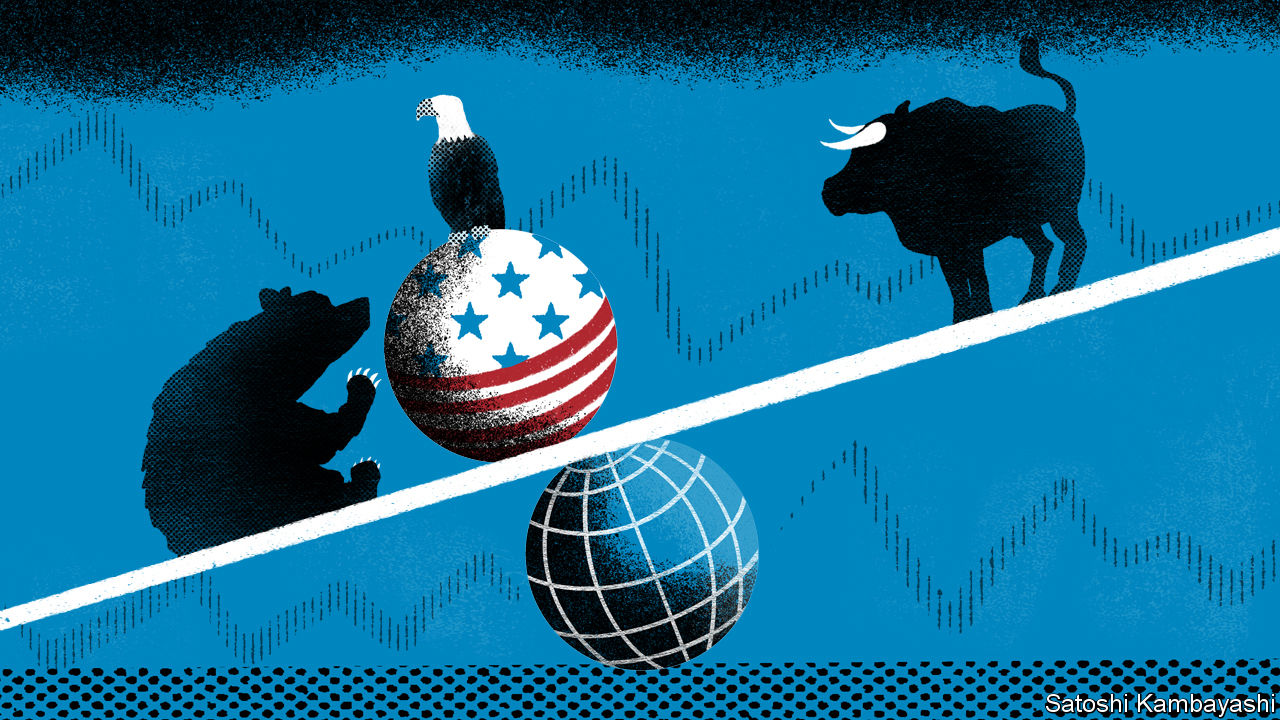
Spare a thought for emerging markets. When America’s economy falters, they often share the pain, because America is an indispensable market for their goods. But when America’s economy prospers, they can also suffer, because the Federal Reserve will raise interest rates, lessening demand for emerging-market assets.
This catch-22 was vividly illustrated in 2018. America’s economy expanded robustly. But this boost to global demand was overshadowed by the Fed’s response to it: four rate increases that wreaked havoc on overvalued currencies and overstretched economies in the emerging world. An index of emerging-market equities compiled by msci fell by almost 17% over the year.
Emerging markets were therefore relieved by reassurances offered by Jerome Powell, the Fed’s chairman, on January 4th. He emphasised that American inflation remained “muted”, that the Fed will be “patient”, and that it will listen “sensitively” to financial markets, which have turned skittish of late. He reminded his audience of how “nimbly” the Fed bent to the markets in 2016. It entered that year expecting to raise rates four times, but ended up waiting until December to raise them even once. A notable side-effect was that emerging-market shares ended that year 9% higher than they had begun it.
Can emerging markets look for a similar recovery in 2019? One reason to hope for the best is that the worst has already happened. The currencies that looked most overpriced a year ago have already plummeted. The widest trade gaps have narrowed. A year ago Turkey’s lira was well above fair value (which has been estimated as 5.5 to the dollar by the Institute of International Finance, or iif, a bankers’ think tank). It fell far below that level in August and is now back in line with it. Depressed imports and more competitive exports mean Turkey has run a current-account surplus three months in a row.
Also encouraging are signs of progress in talks on trade between America and China. In a tweet on January 8th, President Donald Trump said they were “going very well”. The volatility in America’s stockmarket may have alerted the White House to the risks of further raising or expanding tariffs on China’s goods. When America’s stockmarket sneezes, Chinese policymakers catch a break.
But threats still abound. One lies in overreacting to Mr Powell’s comments. For months the financial markets have been expecting the Fed to take a pause between rate increases. Now that Mr Powell seems open to the idea, the markets have jumped to the conclusion that he will stop hiking altogether, points out Robin Brooks of the iif. Futures markets have priced in an 86% chance that the federal funds rate will end the year no higher than it is today, according to the Chicago Mercantile Exchange.
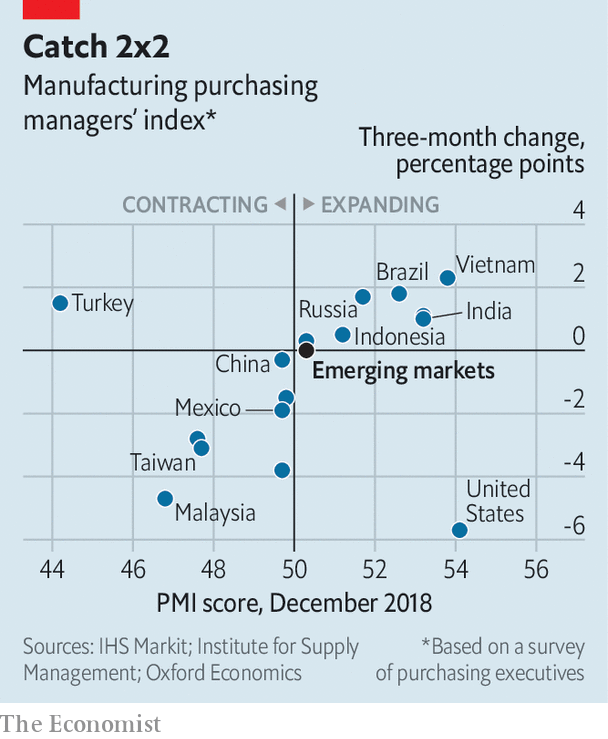
A second danger lies in the other clause of that emerging-market catch-22. When the Fed turns hawkish, it hurts emerging markets. But when, as now, the Fed turns doveish, it is usually because growth is faltering—which also hurts emerging markets. The Institute of Supply Management’s monthly index of American manufacturing, which is based on surveys of purchasing managers, fell by 5.2 points in December. Two similar purchasing managers’ indices (pmis) in China fell below the level of 50 that supposedly separates expansion from contraction. That has raised fears of a global economic stagnation as synchronised as the expansion of 2017.

For the moment, those fears seem overblown. The pmi for the emerging world as a whole, published by J.P. Morgan and ihs Markit, suggests that manufacturing is still expanding, albeit more slowly than it was in early 2018 (see chart). And although an index below 50 is supposed to indicate a contraction, the threshold in practice seems lower. The emerging-market manufacturing pmi would have to fall below 48 before industrial production would be expected to shrink, year on year, according to Capital Economics.

Two-star growth

Keeping track of emerging-market growth is not easy. Many countries report quarterly gdp figures with a long lag and some do not report them at all. More timely indicators, such as pmis, have shortcomings. Many are of recent vintage, which makes them hard to evaluate as proxies for growth. Arend Kapteyn and Pierre Lafourcade of ubs, a bank, have tried to fill in the gaps using some of the statistical techniques that also helped win the 2009 Netflix prize, an award the company offered to anyone who could help it to predict viewers’ tastes in films based only on the star ratings those viewers had given to films in the past.
The ubs model suggests that the blockbuster growth of late 2017 and early 2018 has indeed flopped in more recent months. Emerging markets probably grew at an annual rate of less than 4% in the last quarter of 2018, compared with a pace of 5.7% in the first half of the year. The level of growth is as low as in late 2015, according to the model, and the drop in growth is comparable to the downswing in 2012.
The two economists attribute the slowdown largely to trade, but not necessarily to the trade war. Exports and other “external” contributors to growth turned sour as early as March 2018, before America imposed punitive tariffs on China for encroaching on its intellectual property. Having grown so robustly in 2017, trade was always going to plateau. “If that’s all that’s going on…then we should start to bottom out soon,” they write.
But that consoling thought assumes, of course, that the trade war does not flare up again. Whatever economic grievances America bears against China, a re-escalation would damage the chances of global growth stabilising at a respectable level. As Yossarian, the protagonist of “Catch-22”, points out, “it doesn’t make a damned bit of difference who wins the war to someone who’s dead.”

Tuesday, January 15, 2019

How economics is trying to fix its gender problem

An annual convocation hears evidence of sexism within the profession.


Female economists are rare. So every year, after the meeting of the American Economic Association (aea), a group flock together. On January 6th, before the junior women seeking mentoring arrived, their seniors were asked to keep the tone positive, and to save discussion of their worst experiences of sexism for later, in the bar. What followed included inspiration (when submitting papers, aim high) and tips on how to get published, get tenure and work out who is likely to help your career.
The scheme is just one of a growing number aimed at raising the share of women among academic economists. Others were on display at the aea conference, including some that drew on economists’ own intellectual toolkit. Donna Ginther of the University of Kansas, for example, presented results showing that participation in the mentoring workshop extends a woman’s network of collaborators, and that she thus publishes more. Another study cited at the conference, by Leah Boustan and Andrew Langan of Princeton University, finds that departments with more female phdstudents tend to have a greater awareness of gender bias and less of the aggressive questioning in seminars for which economics is notorious.
Kasey Buckles of the University of Notre Dame (and one of the mentors) recently reviewed the evidence on what increases the share of women in an economics department. She highlighted a randomised control trial at the University of Wisconsin-Madison which found that workshops on gender bias for faculty responsible for hiring raised the share of women among new hires by 18 percentage points.
Other researchers are studying the obstacles to women’s promotion. Earlier work by Heather Sarsons of the University of Toronto showed that women get less credit in tenure decisions for papers written with men than men do. And Heather Antecol of Claremont McKenna College, Kelly Bedard of the University of California, Santa Barbara and Jenna Stearns of the University of California, Davis, have shown that giving parents extra time before they must prove themselves worthy of promotion disadvantages women, as fathers tend to use the time to get more research done while mothers use it for child care.
At the aea meeting Erin Hengel of the University of Liverpool presented results showing that papers by women in the most highly regarded journals were cited more often than those with a man among the authors. That, she concluded, suggests that women’s research is held to a higher standard when editorial boards decide what to publish. Also presented was a study by Lorenzo Ductor of Middlesex University, Sanjeev Goyal of the University of Cambridge and Anja Prummer of Queen Mary University London that found that women have smaller and more clustered networks of co-authors, which the authors think may reflect women’s aversion to risk in a relatively hostile environment. A third piece of research, by Anusha Chari of the University of North Carolina and Paul Goldsmith-Pinkham of Yale University, found that women’s under-representation at the National Bureau of Economic Research’s summer institute, an important economics conference, could be explained by their lower submission rates.
The aea itself is trying to gather evidence on the profession’s problems. It is running a “climate survey”, asking members questions such as whether they have felt demeaned or experienced harassment. The results are due in April. But even if they are damning, some worry that senior male economists will dismiss evidence of widespread discontent, perhaps by pointing to the potential for bias if aggrieved women are more likely than others to respond. By January 4th the response rate was just 16%.
And if sceptics can be won round, the aea must then decide what to do. A newish code of conduct states that economists have a “professional obligation to conduct civil and respectful discourse in all forums”, and that it aims to create a “professional environment with equal opportunity and fair treatment for all economists”. But it mandates no penalties for breaches.
Recent revelations have raised the question of whether it should. The aea faced calls to remove Roland Fryer of Harvard University from its executive committee after the New York Times reported on allegations against him of sexual harassment. Another case in which a pre-tenure woman accused a senior economist from a different institution of groping her raised the question of whether the aeashould be able to strip someone of membership. But the aea has no bylaws allowing them to unelect or expel a member, and doing so could expose them to litigation.
Hopefully, none of the women in the mentoring session will face anything so serious. Martha Bailey of the University of Michigan, who convened the workshop, felt a warm glow as the young women told her that they felt valued, a couple of them for the first time since they had become professional economists. Many at the aeaconference shared the feeling that the status quo was unacceptable. But there was hope, too—that more male economists would become aware of imperfections in the labour market closest to home. As Rohini Pande of Harvard University put it, “this cannot just be the work of women.”