About Me

My photo
An Investor and counsellor in Financial Market

Thursday, February 07, 2019

The market for cyber-insurance is growing

But computer risks are harder to handle than physical ones


It sounds as if it was named by a seven-year-old boy and looks like a film set. Housed in a sleek black truck, ibm’s “x-Force Command Cyber Tactical Operations Centre” travels from city to city, simulating the experience of falling victim to a cyber-attack. Rows of desks sport monitors and keyboards in a room dominated by three giant video-screens. A control room houses server equipment that allows ibm’s staff to simulate a corporate network—and then throw all manner of digital mischief at it. Teenagers “understand what’s going on straight away”, says Caleb Barlow, who runs the show. Board members at big companies enjoy a visit, too: “It’s so different from what they usually do.”
But their interest is not merely recreational. Companies are increasingly worried about the threats lurking in their computer systems. A survey in 2018 by kpmg and Harvey Nash, a firm of headhunters, found that only a fifth of it bosses thought their firm was well prepared for an attack.
That gloomy assessment is borne out by high-profile hacks. In November Starwood, a hotel chain owned by Marriott International, reported that half a billion customer records had been stolen. Magecart, a hacker group, is the chief suspect in the theft of the credit-card information of customers of Ticketmaster, an American firm, Newegg, a computer retailer, and British Airways. In 2017 WannaCry and NotPetya, two malware programs, scrambled files in organisations across the world. Maersk, a Danish shipping firm, said it had suffered costs of $300m. Snafus can be as damaging as attacks. In April tsb, a British bank, botched a computer upgrade and locked millions of customers out of their accounts.
Such mishaps are feeding a fast-growing market for specialist cyber-insurance. Solid numbers are in short supply, but Munich Re, a reinsurer, reckons that a market that wrote $4bn of premiums in 2018 could be writing $8bn-9bn by 2020. Rob Smart of Mactavish, a firm that works with big British insurers, says that “almost all” the firms’ clients have inquired about cyber-insurance in the past couple of years. Insurers are scrambling to hire scarce specialists. Two former directors of gchq, Britain’s electronic-spying organisation, have found jobs advising the industry.
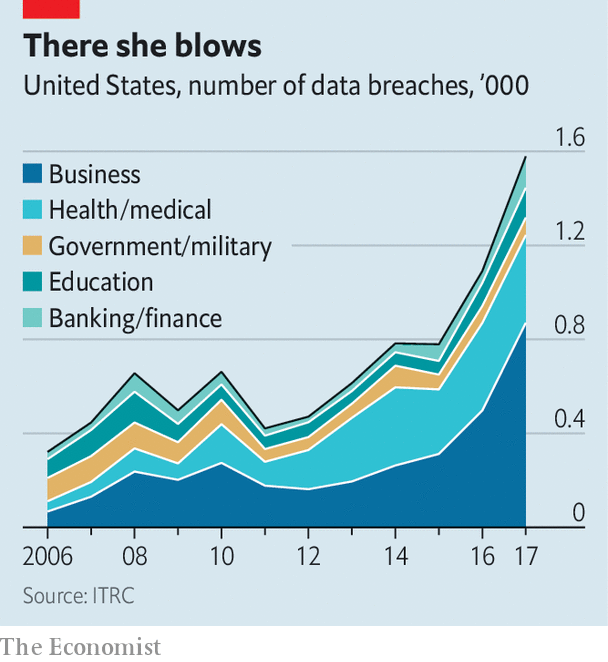
The market is most developed in America, says Robert Hannigan, one of those ex-gchq bosses, thanks in part to Californian laws passed in 2003 that compel firms to confess to large data breaches. These have been copied by other states. But Europe is catching up, says Joseph Ahern of the Association of British Insurers, partly because of privacy and reporting laws that are now stricter than America’s. The need for robust insurance will only grow as companies become more reliant on computers, hackers get more cunning and regulators take an increasingly dim view of lax security. But the unique nature of cyber-risks makes them hard for the insurance industry to handle. In the worst case, they could blow up the nascent market altogether.
The policies on offer so far tend to vagueness, says Mr Smart, and vary widely regarding which risks are covered. That makes companies skittish, he says, and some big clients have decided not to buy insurance as a result. As the industry matures, no doubt policies will become clearer and more standard. But other problems are potentially longer-lasting.
That of working out who was behind a particular hack has already made the news. Mondelez, an American food company hit by the NotPetya malware, is suing Zurich, a big insurance firm, for refusing to pay out under a general insurance policy. Zurich cites an exclusion clause for losses related to war, on the ground that the NotPetya attack is thought to have been carried out by Russia. Even a technologically sophisticated government would have trouble proving such a claim to the standard demanded by a court, says Andrew Coburn of Risk Management Solutions, a consultancy. But if Zurich does win, it could cast a chill across the entire market—unless insurers accept that cyber-insurance may involve shouldering the sorts of risks they have previously sought to avoid.
At the same time, cyber-security risks are inherently tricky to price. All software contains bugs, some of which will cause security weaknesses. But many lurk unknown until a hacker starts exploiting them. Cyber-risks are so new that insurers have only limited data, and the pace of technological change means that what they have quickly goes stale. “In a flood, we know the ways in which water can damage things,” says Shannan Fort of Aon, an insurance broker. “And that’s not likely to change in the next five to ten years. But the way we use technology has changed fundamentally just over the past decade.”
Perhaps the biggest difficulty for insurers is that the risks posed by cyber-attacks are not independent of each other. If an oil refinery in Texas floods, that does not mean one in Paris is any more likely to do so. Insurers build that independence into their risk models, and depend upon it in their calculations of the maximum they may have to pay out in a single year. But a newly found flaw in software can make all users vulnerable simultaneously. Insurers fret that a single big attack could hit many of their clients at once. In the worst case, the value of claims might be more than they could meet.
The WannaCry malware of 2017 illustrates the point. Armed with a software vulnerability stolen from the National Security Agency, gchq’s American counterpart, it infected a quarter of a million computers in 150 countries in just a few days. Its spread was slowed only by luck. Marcus Hutchins, a security researcher later arrested on an unrelated matter, gained access to the malware’s control system that allowed him to shut it off. Whether the industry can figure out a way to deal with such “risk aggregation” is an open question. As one insider says, it “sort of breaks the whole concept of insurance a bit”.


Wednesday, February 06, 2019

Mukesh Ambani wants to be India’s first internet tycoon

Thanks to his ambitions, Indians are getting online faster than ever
For  a glimpse of how the internet is taking hold in India, catch one of Mumbai’s double-decker buses. Even at rush hour, when people pack so tightly into the ancient vehicles that it is difficult for the conductors to collect fares, and stragglers hang out of the open door, commuters still find space to get out their mobile phones. Dozens of tiny screens glow with WhatsApp messages, news and gossip sites, Bollywood films and Hindi serials.
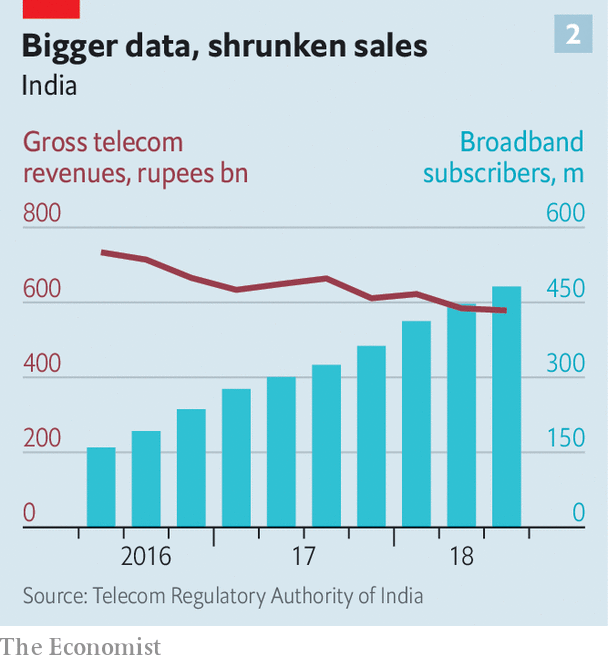
Just three years ago there were only about 125m broadband internet connections in India; by last November the number had reached 512m. New connections are growing at a rate of 16m per month, almost all on mobile phones. The average Indian phone user now consumes more mobile data than most Europeans.
If any one person can take credit for this spectacular growth, it is Mukesh Ambani, India’s richest man. With his service, Jio, a mobile network launched in 2016 offering cheap, high-speed data, he has upended Indian telecoms and changed his country. Much of his fortune comes from a chemicals and refining business inherited from his father; his conglomerate, Reliance Industries Limited (ril), is one of India’s biggest. Unlike other phone firms, which make their money from call charges, Jio from the start gave phone calls and text messages away freely alongside data.
Now Mr Ambani seems to want to go further and become an Indian Jeff Bezos or Jack Ma, using Jio as a launch pad—the platform now has a whopping 280m users. One prong of this will be online shopping; on January 18th he announced that Jio would join up with ril’s retail arm, which has nearly 10,000 outlets across the country, to launch a new e-commerce platform, taking on both Amazon and Flipkart, a local firm last year bought by Walmart for $16bn. More digital services, and content creation, are in the offing.
Both foreign and local competitors grumble about the circumstances of Jio’s birth. The radio spectrum it uses was initially reserved for data-only services, and bought in a government auction in 2010 by an unknown company called Infotel Broadband Services. Mere hours afterwards, the company was bought by ril. In 2013 the company won the right to run voice services on its 4g spectrum, using voip(Voice over Internet Protocol), after the government ordered the regulator to change its rules. When Jio was launched in 2016 it had had plenty of time to prepare. Rivals complain that they would have paid more attention in 2010 had they known Reliance would back the venture.
So as not to limit the market to people who can afford smartphones, Jio also launched its own 4g feature-phone, the JioPhone, which it says is “effectively free”. Customers pay only a refundable deposit of 1,500 rupees ($21) for the device, with which they can use WhatsApp, watch YouTube and take pictures. As Mr Ambani said last year, for most users their Jio connection “is not only their pehla [first] phone but also their pehla radio and music player, pehla tv, pehla camera and pehla Internet”.
Data in India now cost less than in any other country. On average Jio’s users each download 11 gigabytes each month. Finns, the world’s hungriest consumers of cellular data, gobble 14 gigabytes. Jio users watch 17.5 hours of mobile video a month, far more time than they spend watching tv.

Astrological development

Fast-rising consumption is provoking changes, many for the good. Yogendra Mertiya, who runs a farmers’ collective in rural Rajasthan, says the internet is subtly altering the village he lives in. “Rajasthan is a feudal sort of a state, and on the face of it everything looks like it did ten years ago, but actually there are huge social changes,” he says. Lower-caste men these days can check their horoscopes online, instead of having to visit the local Brahmin astrologer, for example. Women who are scarcely allowed to leave home are able to search for information online. Politicians calling for the prohibition of alcohol have been able to win votes by appealing to female voters through their phones. Enterprising young people can become local celebrities by building what Mr Mertiya calls “a small following” of “perhaps a million subscribers” on YouTube. A Bollywood channel of songs and clips, t-Series, seems set to soon become YouTube’s most-subscribed.
Not all the effects are positive. Rumours and spam spread through WhatsApp messages have become a public menace, in some cases even inciting lynchings. Another problem, at least in the eyes of the government, is the spread of pornography. In September a court ordered telecoms operators to block 827 porn sites to stop children being exposed. That so many men seem to like watching it in public places may have weighed on the judges’ minds.
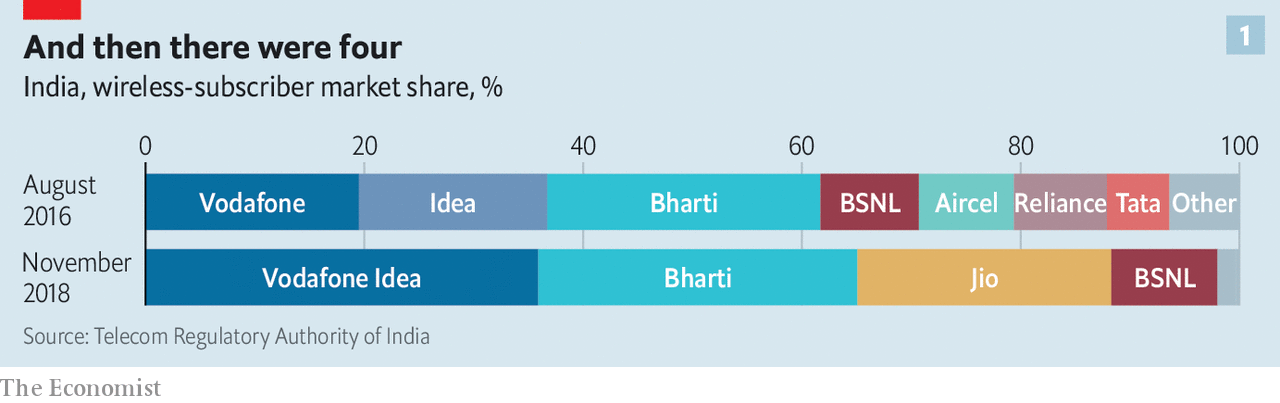
So India is being transformed. But will the bet pay off for ril and its shareholders? So far ril has spent a massive $32bn on Jio, with limited return. Mr Ambani’s firm has certainly succeeded in ejecting competitors. Since its entrance, six firms have gone out of business, including the one owned by his brother Anil, rCom. India’s telecoms industry has shrunk to four big companies (see chart 1). Bharti Airtel, previously the market leader, now relies on its enterprise and African businesses to keep it afloat. Vodafone has merged with another firm, Idea, and the new group is selling assets and raising capital to cover its cashflow deficit.
 

Squeezing out competitors has not yet translated into juicy profits for Jio. Since the middle of 2016 total revenue earned in Indian telecoms has shrunk by 21%, even as connectivity has soared (see chart 2). According to ril, Jio made a profit of 25bn rupees in the latest quarter. Bernstein, an equity-research firm, has suggested that its treatment of depreciation and amortisation is unusual in the industry and may understate its costs. Jio says its method adheres to Indian accounting standards.


And by some targets it set earlier, Jio seems to be doing less well than it had hoped. In 2017 it said that by 2020 it aimed to capture a 50% revenue share of a market it said would grow by 50%. Today Jio’s share is around 26% of an industry it has made smaller in revenue terms. It has all come at a big cost to ril and its shareholders. According to Credit Suisse, a bank, by 2018 capital investment in Jio reached about 700bn rupees a year. The conglomerate’s debts have risen to around 3trn rupees, close to its annual revenue of 4.3trn rupees.
For India’s telecoms industry to be profitable again, prices need to go up by about 50-70%, reckons one analyst. Competitors are holding on, assuming that will happen, and ril’s share price has risen by 28% in the past 12 months on hopes Jio can cash in later. But it is hard to predict Mr Ambani’s next moves. His ambition to become a tech tycoon goes beyond making money in telecoms. As well as the new e-commerce platform around Jio, ril separated its fibre-optic cables and towers from Jio last December to create a new firm that is preparing to provide wired broadband to homes. Other digital services would follow, such as web-hosting for firms. ril has also invested in content creation, and has bought rights to distribute cricket matches and Disney films on its “Jiotv” platform.
All this will bring Mr Ambani into direct competition with big e-commerce firms already investing heavily in India, including Google, Amazon and Flipkart. Their appetite for India’s market has been whetted by Jio’s connectivity explosion, but their executives will be worried that the government may favour Jio, a local champion. On January 18th Mr Ambani argued that the government should prevent data colonisation; Indians’ data, he said, must not be controlled by global corporations.
Foreign e-commerce firms are already banned from holding inventory in India. In December they were also banned from selling products from firms in which they have an equity stake (a common workaround). Incumbent telecoms firms, too, have seen many recent regulatory decisions (such as one on whether rules on predatory pricing apply to Jio) go against them.
Mr Ambani will need to keep regulators happy if ril is to earn decent returns on its investment in Jio. Even if he fails in that, he will have helped hundreds of millions of Indians get a first taste of the internet. One recent Indian social-media craze was sharing grainy pictures from the weeklong wedding for Mr Ambani’s daughter in December, where the entertainment featured BeyoncĂ©. A few years ago, Mumbai’s hard-pressed bus commuters would have had no idea of the extravagance in their midst.

Tuesday, February 05, 2019

How Tech Is Decentralizing The Energy Industry

Power

The energy sector is in the midst of a technological revolution. From blockchain and the Internet of Things to decentralized power grids, energy tech is having its day in the sun, and it’s clear that the next few years are set to transform the entire industry.
Faced with global warming, high-profile oil spills, and the industry’s seemingly undying love for dirty-burning fuels, the general public seems to have finally lit a fire under the powers that be, and new regulatory standards are forcing the industry to adopt or die.

But it makes sense. Not only will the sector’s tech revolution help save the planet, it will also help supermajors cut costs and cash in on the unavoidable shift towards cleaner energy trends.
Major companies such as Facebook, Apple and Google are already moving to renewables, with the tech trio aiming to be 100 percent free from fossil fuels within the few years. And that’s only the beginning.
As renewable energy becomes more affordable, however, oil supermajors will have to innovate to remain relevant. Whether that means investing in alternatives such as biofuel or cutting costs in the supply chain, Big Oil is being forced to make some major changes.
Blockchain meets Big Oil
Blockchain technology sent ripples through every major industry, and energy is no exception.
In its efforts to cut costs, the industry is finally beginning to embrace the technology in many ways.
Still using paper contracts, dated tech and basic trading platforms, revamping Big Oil’s back office stands to save the industry a whole lot of money going forward.
Every day, billions of barrels of oil trades hands, moving through producers, suppliers, contractors, subcontractors, refiners, and retailers. Keeping up with the process accurately and without taking some losses in the process is practically impossible.
In fact, according to Hernando de Soto, a well-respected economist and blockchain advocate, “Some 5 billion persons and 20 trillion dollars have been shut out of the economy due to disputed assets.”
It’s a global endeavor, after all.
It’s no secret that supply chain management could use an overhaul. And this is where blockchain technology can really shine.
With the Internet of Things (IoT), smart sensors and blockchain technology, oil can be tracked from the ground to the gasoline pump, accounting for every single drop of crude in the process.
Smart sensors can measure the volume, temperature and location of each barrel of oil, relaying that data through the IoT, and applying it to a blockchain, allowing traders, management and even individuals to monitor the journey to ensure the quality and environmental impact of the product.
And the finance side of things is no different.
As a member of the Ethereum Alliance, London-based Vakt is already attracting a lot of attention in the field, with supermajors such as BP, Shell, Total, Chevron, and more, as well as trading houses like Mercuria and Koch Supply and Trading jumping on board.
The platform, powered by JP Morgan’s Quorum blockchain, went live last year and aims to improve the security of trades, increase efficiency and create new financial opportunities within the sector.
More revolutionary than Big Oil’s cost-cutting, however, is technology’s ability to remove some of the power (literally) from the hands of massive corporations…
Decentralizing Energy
Lining the pockets of oil supermajors is great, I suppose, but the real impact of technological innovation in the energy industry is only beginning to be felt.
Solar and wind power are increasingly within the reach of the every-man, and with the advent of micro-grids, small, neighborhood-scale energy solutions are beginning to take root, cutting utilities companies out of the mix.
Startups such as Brooklyn-based LO3 Energy are using blockchain technology to create a peer-to-peer energy trading platform, allowing users within their micro-grids to buy and sell clean energy to one another, without the influence of industry majors.
And the movement is spreading.
In the heart of Australia’s ‘coal country,’ the Latrobe Valley Microgrid Program is slowly replacing electricity generated by coal with peer-to-peer solar energy. With the help of government subsidies, solar panels are popping up across the region, and businesses are sharing their resources, saving an estimated $10,000 per year in energy costs in the process.
The Massachusetts Institute of Technology’s Digital Currency Initiative is looking to take this one step further, targeting the 1.2 billion people across the globe without access to electricity.
The Digital Currency Initiative’s proposition states:
“Technologies such as distributed ledger technology, digital currencies, smart contracts, smart power meters and kill switches, can be combined to create a unique financial and ownership structure that could overcome the uncertainty lenders face in financing solar microgrids.”
To achieve this, DCI suggests that for-profit lenders could fund these projects, and “would effectively be backed by inflows of digital-currency payments to the cooperative, both from shareholders -- a portion of whose payments automatically go to repaying the loan -- and from external businesses and households, which would consume excess power produced by the grid.”
Conclusion
While these decentralized initiatives are still in their infancy, they offer potential solutions to some of the world’s most pressing problems.
But will Big Oil and the governments that effectively fund them allow these developments to progress?
Regulation on these projects still remains in a sort of gray area. Because the tech is new, there is no precedent, and lobbyists could spoil the party before it even begins.
Already, it’s illegal in many U.S. states to even collect rainwater for personal use– will governments take the same stance on solar energy?
I guess we’ll have to wait and see.
By Michael Kern

Monday, February 04, 2019

This Gold Deal Could Be A Boon For The Mining Industry

Gold Deal

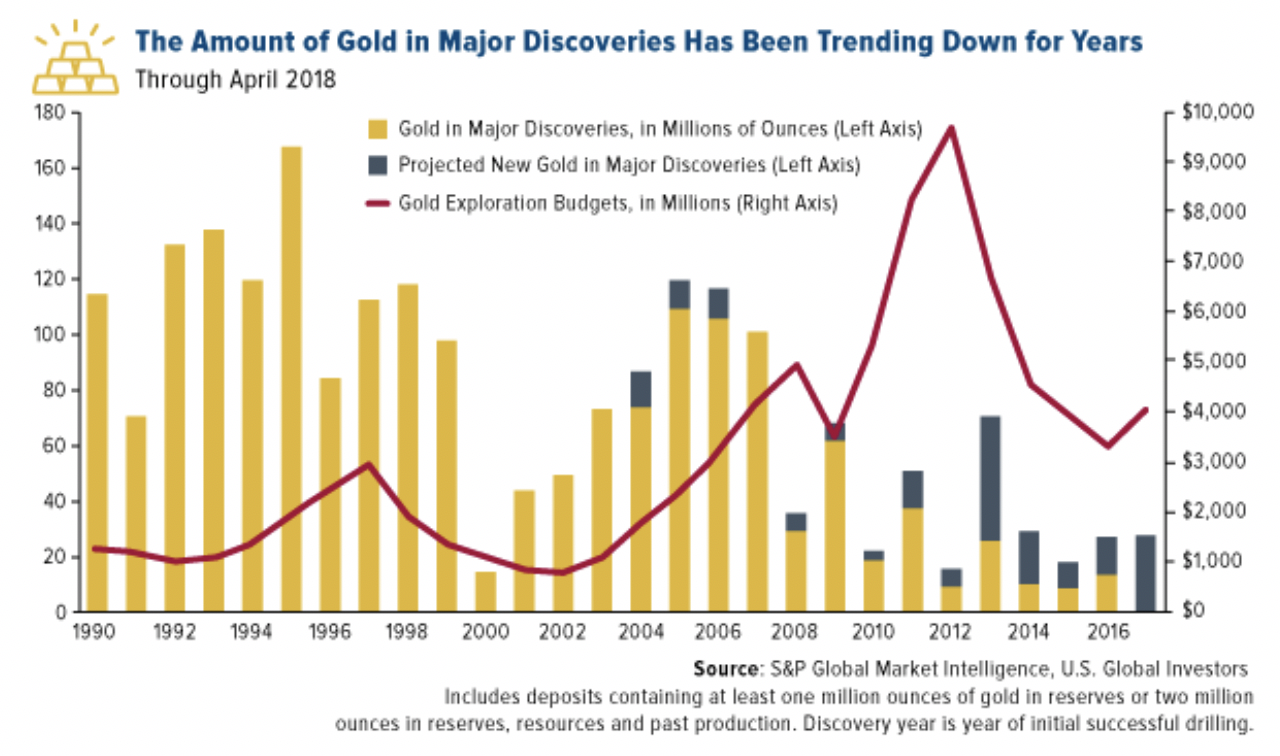
Consolidation season has finally arrived in the goldfields, just as many experts and analysts have been predicting for some time now. With exploration budgets having been slashed since their 2012 peak, and because there are today fewer and fewer ounces of gold available to be mined, one way forward for producers of all sizes will be to ramp up mergers and acquisitions (M&A) activity.
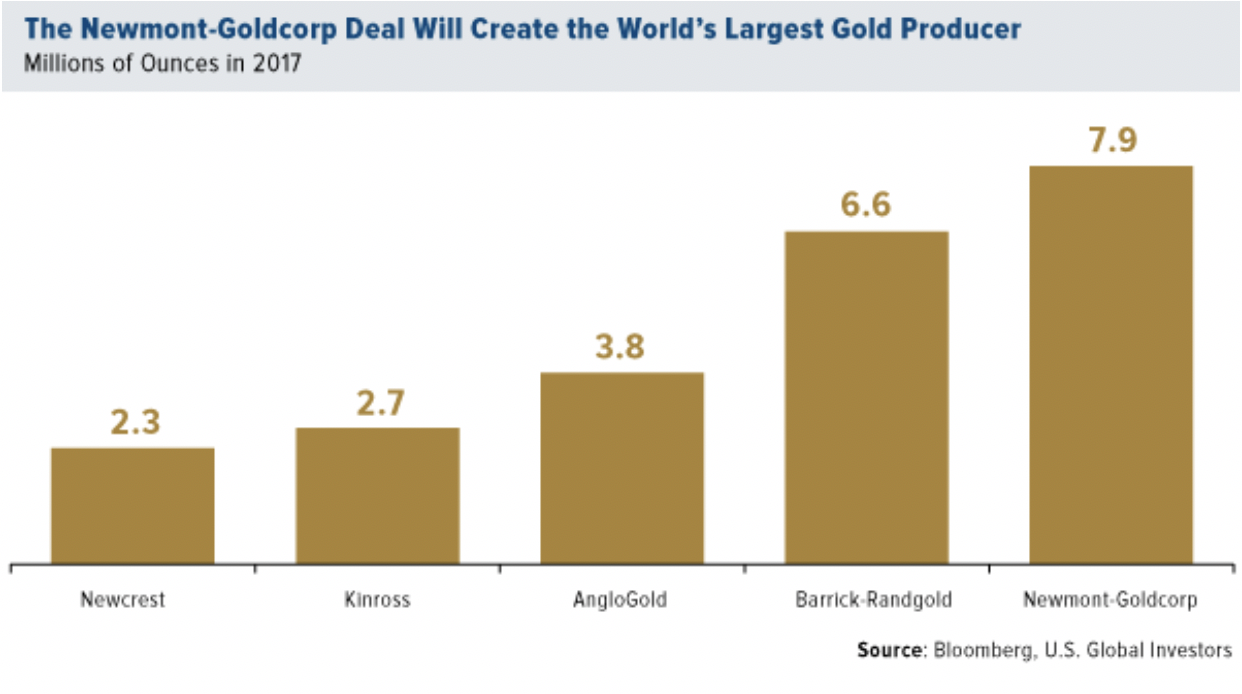
You might have heard that Newmont Mining will be buying Goldcorp in a massive $10 billion deal. The resultant company, to be headquartered in Denver, will be the world’s largest gold producer by a number of ounces mined—larger even than what’s being called “New Barrick,” after the $6.5 billion merger of industry giants Barrick Gold and Randgold Resources, announced back in September. Whereas Barrick-Randgold produced a combined 6.6 million ounces of gold in 2017, Newmont-Goldcorp was responsible for as much as nearly 8 million ounces.
(Click to enlarge)
I see this news as positive overall for the metals and mining industry, which has long signaled the need for consolidation. As I explained in a Frank Talk Live segment back in October, it’s when an industry has found a bottom that you start to see big M&A deals. A couple of years ago, the very talented people at Visual Capitalist showed in an infographic that mining M&As peaked in the aftermath of the financial crisis.
A Positive Case Study in M&As: Domestic Airlines
This tacit rule applies not just to metals and mining but also to most other industries. Look at domestic airlines. It’s easy to forget now that between 2005 and 2008, more than two-thirds of U.S. airlines were operating under Chapter 11 bankruptcy protection. A huge wave of consolidation followed, giving us the “big four” carriers—Delta, American, United and Southwest. Profits surged to new highs.
This year, according to the International Air Transport Association (IATA), global airlines should see their 10th straight year of profitability, and fifth straight year where “airlines deliver a return on capital that exceeds the industry’s cost of capital, creating value for its investors.”
Consolidation Could Speed Up the Closer We Get to “Peak Gold”
So will gold miners follow suit and consolidate (more so than they already are)? And will this lead to a similarly sustained period of outstanding profitability?
No one can say for sure, of course, but my guess is that we’ll continue to see more and more deals the closer we get to the idea of “peak gold.” As I’ve shared with you before, the yellow metal is getting exponentially more difficult and costly to mine. The “low-hanging fruit” has likely already been plucked, so to speak. Exploration budgets have been slashed, and the days of 20- and 30-million-ounce gold deposits could be behind us, to say nothing of 50-million-ounce discoveries.
(Click to enlarge)
To replenish their own reserves, big-name miners such as New Barrick and Newmont might decide to absorb smaller-cap junior producers with provable mines instead of spending higher and higher costs to scour the world for progressively harder-to-find deposits.  
Says Michael Siperco of Macquarie Research, the Barrick-Randgold and Newmont-Goldcorp deals could “spark a wider consolidation in the industry, where too many gold companies are chasing too few assets.”
By Frank Holmes

Friday, February 01, 2019

Americans Are Not Ready For A Recession

Money
The brutal reality is that most Americans are not prepared for the next economic downturn or recession. The government shutdown is highlighting just how much Americans rely on others as opposed to themselves, and how little they have saved for an emergency.
According to the newest op-ed article by Market Watch, the government shutdown is perfectly proving that Americans are not prepared for a financial disaster of any kind, let alone an economic recession. Many have long assumed that the government (which as we all know is almost $22 trillion in debt) will be using their money (stolen funds aka, taxation) to bail out those who get themselves into trouble. But the shutdown is proving just how little the government actually does and just how financially illiterate many Americans have allowed themselves to become.
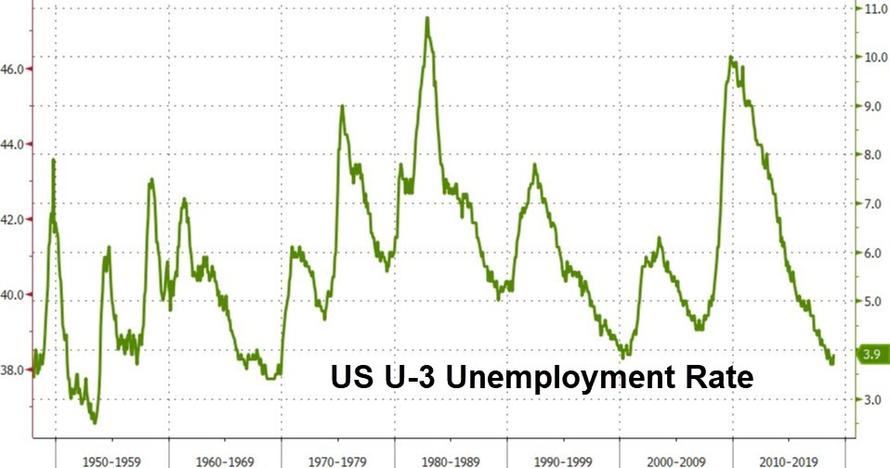
Almost 60 percent of Americans have less than $1000 in savings for a rainy day fund or an immediate emergency. It’s been ten years since the Great Recession left many Americans jobless with no money, and it appears most have learned nothing. The government shutdown serves as a painful warning and preview for what will happen once unemployment rises from 50-year lows.  Americans are far too dependent on others, including the government, for their survival.
Within just a few weeks into the government shutdown, people are struggling to cope. We hear stories about people turning to food banks to feed their families. We hear stories about people who are in dire straits because they can’t get loans. We hear stories about people who can’t pay their mortgages. That’s not even one month into the shutdown. –Market Watch
Most Americans live paycheck to paycheck, including those who work for the government.  Many won’t live below their means in order to save and it certainly seems that most citizens have picked up the government’s spending habits. They have also stopped saving for themselves. According to a recent GoBankingRates survey, only 21 percent of Americans have more than $10,000 in savings, with nearly 60 percent having less than $1,000 in savings. Almost 32 percent of Americans have nothing saved up at all.
And something most don’t want to hear is that every economic cycle will end and hit a low again despite the rosy attestations of those who wish to keep confidence high. There is nothing in history that suggests that extremely low unemployment can be maintained for an extended period of time. Indeed, it is precisely at the end of an economic cycle that low unemployment rates tend to reverse rather suddenly.
(Click to enlarge)
There is one way to prepare for a recession and it’s to end dependence on debt and save some money for an emergency. Without the shackles of credit card debt, student loan debt, and car payments, Americans could not only save more, but their money would go much further as no one has already claimed it in the form of debt repayment.
Brandon Smith, Founder of Alt-Market.com, had an excellent follow-up comment...
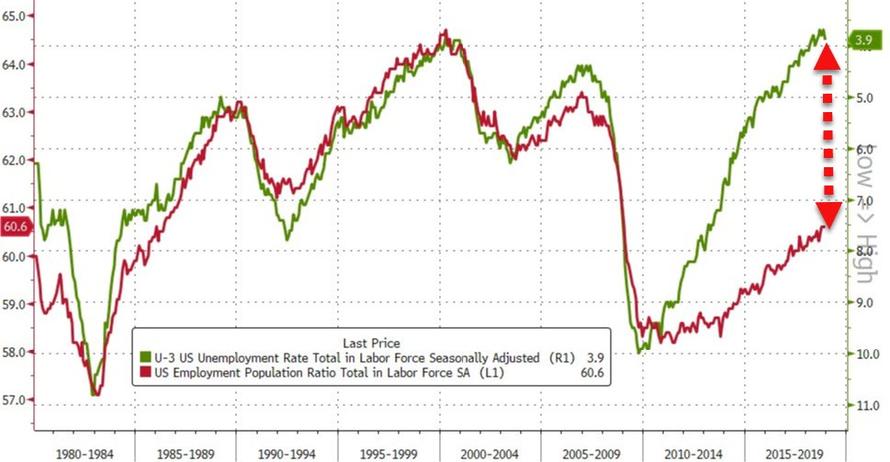
The reason why issues like the government shutdown are having such an immediate effect on Americans is partly due to the illusion of "high employment" in the U.S.  While the unemployment rate APPEARS to be extraordinarily low today, the reality is that it is a rigged number that does not account for over 95 million people who are without work but not counted by the BLS. 
(Click to enlarge)
The statistic also does not account for underemployment and low wages.  What this means is, many people who have an income are likely helping to pay for family and friends without an income, and, low wages that don't keep up with inflation are translating to ever increasing personal debts.  With the government being one of the largest employers in the U.S, removing this revenue source even for a month is starting to cause panic. 
Consider for a moment, how many people are dependent on a government employee for their day to day survival?  Far too many...

Thursday, January 31, 2019

Saudi Arabia Plays Both Sides Of Russia-U.S. Spat

Desert
Saudi Arabia is putting itself in a potentially dangerous geopolitical position as it seeks to continue its decades' long relationship with Washington while at the same time forging new ties, mostly based on oil markets cooperation, with Moscow.
The latest installment in this Saudi narrative came on Tuesday when Saudi Aramco said at the yearly World Economic Forums in Davos, Switzerland that it’s looking to acquire natural gas assets in the U.S. and is willing to spend “billions of dollars” there as it aims to become a global gas player. Saudi Aramco has recently diversified its holdings in many countries by investing in downstream assets, including currently owning the Motiva complex in Texas, the biggest oil refinery in the U.S.

Saudi Aramco Amin Nasser told Reuters at the forum that it intends to invest another $10 bn in the Motiva complex. He added, “We do have appetite for additional investments in the United States. Aramco’s international gas team has been given an open platform to look at gas acquisitions along the whole supply chain. They have been given significant financial firepower – in the billions of dollars.” Saudi Aramco has already indicated its interest in becoming a global gas and LNG player and one day exporting the fuel, but it has a long way to go put the infrastructure in place before they can come to fruition.
Playing both sides
However, despite Saudi Arabia’s close ties to U.S., dating back to the administration of Franklin Roosevelt during World War II and then afterwards when American oil industry know-how, management, best practices, and funds helped develop the Saudi oil industry and propelled it to where it is today, Riyadh has also been forming closer times with one-time adversary Moscow.
The growing ties with Russia were born of oil market necessity. The two sides agreed to put an oil production cut deal in place in 2016 to drain down then oversupplied markets, with a downward trajectory on oil prices that saw Brent crude futures plummet from around $100 per barrel in mid-2014 to breaking below the $30 per barrel price point by early 2016. Thus was born the OPEC+ group of oil producers, led by Russia and Saudi Arabia.
Since their first oil cut agreement in 2016, the two countries last year agreed once again to cut output to drain down oil inventories amid fears of a global oil demand slowdown due to the ongoing trade war between the U.S. and China, and weakness in emerging markets coming at the same time as record high production from the U.S., Russia and Saudi Arabia - the world’s top three oil producing nations.
The Russians and Saudi are now also considering tie-ups in gas, with Saudi Arabia looking to become a major investor in Russia’s fledgling but forward-thinking LNG sector that Russian President Vladimir Putin claims can one day compete with Qatar, Australia and the U.S. to be the top global LNG export leader. Therein lies the rub. As Riyadh and Moscow continue to boost their oil and gas interdependence both in terms of investment in each others’ sectors but also in terms of controlling global oil prices, the two sides will also increasingly forge an alliance geopolitically, which includes in the always violate middle-east where the U.S. and Russia are usually at odds, including being on opposite sides in the ongoing Syrian Civil War.
While it may be a number of years before it develops, there will come a time when Riyadh will be forced to choose sides between U.S. interests and Moscow’s growing regional hegemony ambitions and its increased influence in the middle east. At the end of the day, it’s a decision that no Saudi leader should be looking forward to (one that will likely fall on the shoulder of Saudi Crown Prince Mohammad bin Salman). It’s also a decision nonetheless that could dictate both global oil and gas markets and middle eastern regional stability for decades.

Wednesday, January 30, 2019

Key Indicators Suggest A Recession Is Closer Than We Thought

Globe

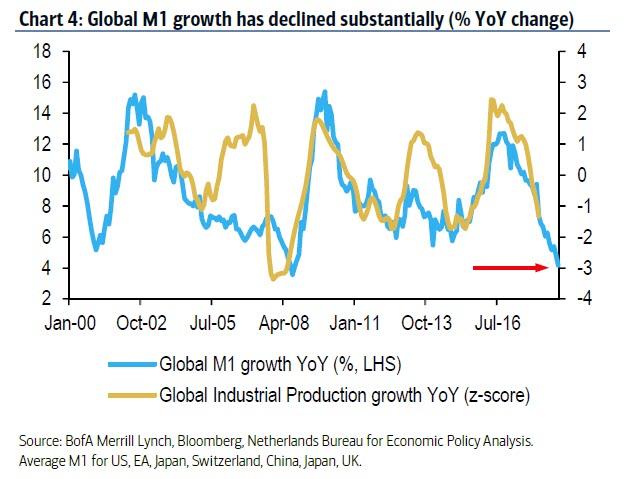
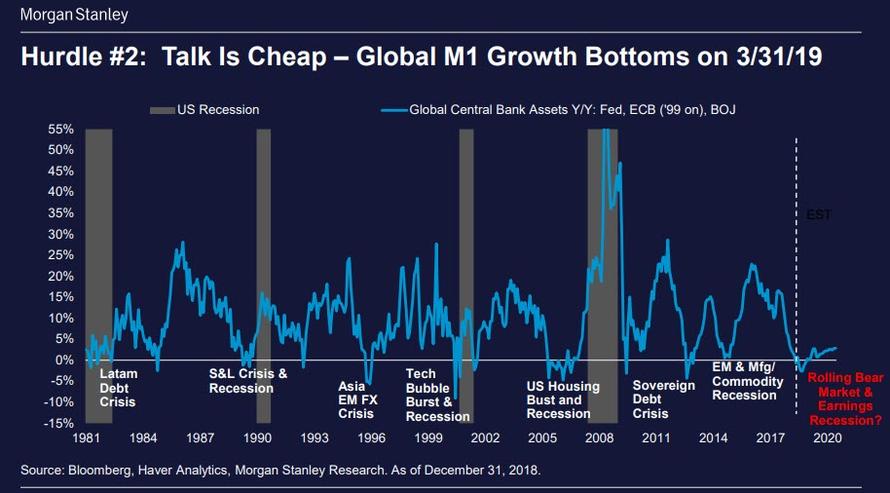
There is a  collapse of global money supply which has been declining rapidly over the last year and a half. In fact, global money supply growth (using M1) is now flirting with the lows seen in mid-2008. And while some economies, such as China, are now desperately trying to pivot back to supportive measures, BofA's Barnaby Martin recently warned that high global debt will constrain enthusiasm for engaging in further rounds of stimulus. Meanwhile, as the chart below suggests, lower money supply growth has always pointed to weaker global economic momentum going forward. In fact, if one uses Global Industrial Production growth as a proxy for the global economic expansion, or contraction, the World is now almost certainly in a recession; the only question is when will economists acknowledge it.
(Click to enlarge)
And just to confirm that the collapse in Global M1 growth is a major problem - perhaps the biggest for the global economy - Morgan Stanley showed the following chart which confirms that every time M1 has dipped negative - as central bank liquidity injection either slowed or went into reverse - there has been a financial crisis: whether the 2015 EM and Manufacturing Commodity Recession, the Sovereign Debt Crisis of 2011, the Global Financial Crisis and US Housing bubble burst of 2007/2008, the Tech Bubble burst of 2000 and so on.

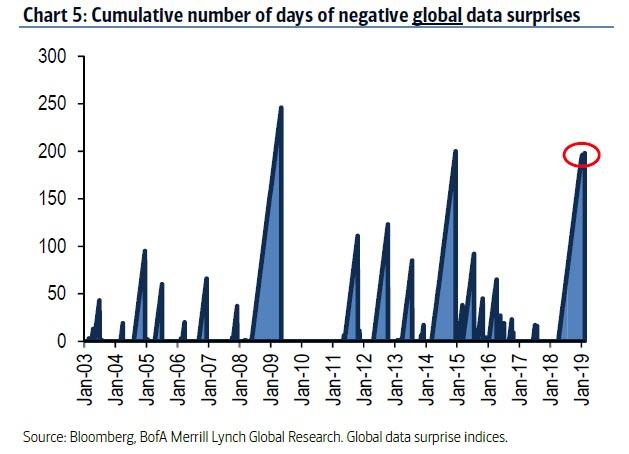
So yes, there is little doubt that global growth is slowing the only question is how forcefully. Today, courtesy of BMO, we present another chart which shows that the world economy is as of this moment almost certainly in a recession.
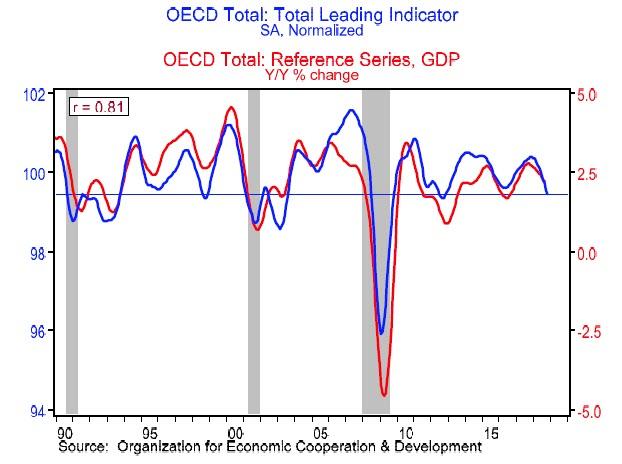
As economist Douglas Porter observes, the OECD’s leading indicator is a good guidepost of what is coming just around the corner, although it doesn’t lead broad GDP trends by much (perhaps a month or so). It was just released Monday, and dipped for the 11th month in a row—it peaked in December 2017—clearly signaling a cooldown.
What the chart clearly shows is that the last three cycles all ended when the leading indicator dropped to where it is now (even though there have also been two false signals in that timeframe—during the Asian crisis in 1998, and during the Euro crisis in 2012).
So the question what happens next will have to be answered by policymakers who have no choice but to try and push higher the blue line in the chart above. In other words, the fate of this cycle will be determined by how policymakers now respond, and how markets and consumer/business sentiment hold up in coming weeks.
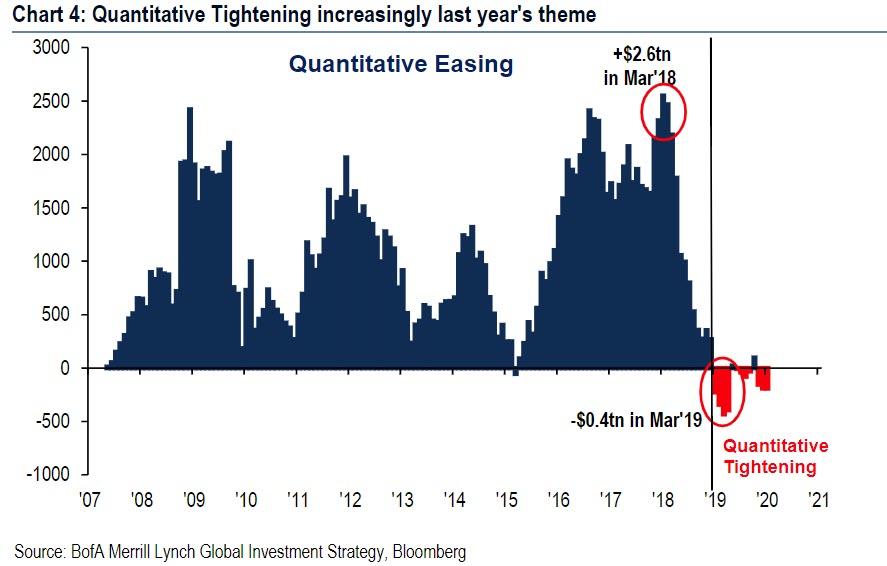
And since it is all up to central banks once again to boost liquidity, something they won't be doing during the current QT phase unless something drastically changes over the next 12 months...

... the above charts confirm that the key variable for the global economy is not whether the Fed stops hiking or starts cutting rates (although any further rate hikes will surely have an adverse impact on global liquidity), but whether the Fed - and other central banks - pause their balance sheet shrinkage, and once again start actively injecting liquidity into the global system, or soon enough we will be looking for the best description of "[insert here] crisis of 2019."

Tuesday, January 29, 2019

A.I. finds non-infringing ways to copy drugs pharma spends billions developing

Drug companies spend billions developing and protecting their trademark pharmaceuticals. Could artificial intelligence be about to shake things up? In a breakthrough development, researchers have demonstrated an A.I. which can find new methods for producing existing drugs in a way that doesn’t infringe on existing patents.
Called Chematica, the software platform does something called “retrosynthesis,” similar to the kind of reverse engineering that takes place when an engineer dissects an existing product to see how it works. In the case of Chematica, this process is based on a deep knowledge of how chemical interactions take place. It has around 70,000 synthetic chemistry “rules” coded into its system, along with thousands of additional auxiliary rules prescribing when particular reactions occur and with which molecules they’re compatible. An algorithm then inspects the massive number of possible reaction sequences in order to find another way to the same finish line.
“They effectively walk on enormous trees of synthetic possibilities, so it is a graph search problem they are trying to solve,” Bartosz Grzybowski at the Ulsan National Institute of Science and Technology (UNIST) in South Korea, told Digital Trends. “Akin to chess, every synthetic move these algorithms make is evaluated by scoring functions, which we developed over the years to tell the program whether it is navigating in the right synthetic direction.’”
The analogy to playing chess isn’t a frivolous one. Over the almost two-decades (!) that this work has been ongoing, the researchers have shown that the numbers of “positions” the A.I. must evaluate is similar to the number of possibilities that chess programs have to scrutinize.
“In principle, one can always argue that a human expert would also design this or that synthetic route,” Grzybowski continued. “That is absolutely possible given adequate amount of time, but Chematica does the job on typical timescales of [just a few minutes to one hour]. It’s like trying to multiple 468,383,83 x 25,405 with paper and pencil versus using a calculator.”
As exciting as the work is, however, don’t expect this to be anything that brings down the world of big pharma — if that’s what you’re hoping for. Chematica, which was bought by pharma giant Merck in 2017, is more likely to be used to help these companies better protect their intellectual property.
“[In our latest] paper we tackled three blockbuster drugs, very heavily guarded by patents — and yet a ‘stupid’ computer managed to find synthetic bypasses,” Grzybowski said. “Now, what if your competitors were to use such a tool? Could they bust your patents? Should you also use the tool? What if they come up with a better version? These sorts of question might point to an arms race in developing similar and competing software solutions.”
to hear the video visit: https://www.digitaltrends.com/cool-tech/ai-develop-drug-without-trademark/amp/

Monday, January 28, 2019

As China’s debt soars, the market for buying bad loans revs up

Where most see peril, a hardy few see profits

For many investors, debt in China is something to fear, a shadow over the world economy. But for a different breed, it looks more like a terrain of untapped profits. This dichotomy has been sharpened by a run of weak data in recent days. Worries about a sharp slowdown in China have rattled global markets. But for the opportunists, it is a time of plenty—a chance to snag assets from banks at a discount.
Both camps start from the same point. They see that debt in China has soared over the past decade and conclude that lending must be tamed. Yet there are clear economic downsides to doing so. Barely any progress has been made on reining in credit, but economic growth is already suffering. In the past few weeks business orders have declined, imports have fallen unexpectedly and weak price data have raised the spectre of deflation.
This, though, is where the small but hardy group of investors diverges from the mainstream gloom. To repair their balance-sheets, banks are under pressure to sell off failed loans, mostly channelling them through an array of state-owned “bad banks”. Outside buyers can then buy these assets and, with some work, earn good returns on them. Though they have little chance of collecting repayment from the original borrowers, they take possession of the collateral—almost always property—at knock-down prices.
It is a niche market, but, as with any product, the crucial variables are supply and demand, both of which have shifted in buyers’ favour. Chinese banks have long had plenty of lousy assets. They categorise more than 5% of their loans—nearly 5.6trn yuan ($830bn)—as either non-performing or “special mention”, meaning they might soon run into trouble. But they are now restructuring them at a faster clip to make room for the next wave. Last year they wrote off 988bn yuan in non-performing loans, up more than a third from 2017, according to official data. “They are preparing for tougher times ahead,” says Nicholas Zhu of Moody’s, a credit-rating agency. On top of that, regulators are getting stricter. They, for instance, now require that banks classify loans that are overdue for more than 90 days as non-performing, as is normal in developed markets.
On the demand side, buyers were, as recently as 2017, rushing to scoop up bad loans. Inexperienced investors such as peer-to-peer firms, flush with cash, thought they could turn an easy profit. They had not grasped the complexity of dealing with bad loans. “They were pricing them as if they could collect 100% of the market value of the collateral, which never happens in real life,” says Benjamin Fanger, founder of ShoreVest, a Guangzhou-based debt investor, and a rare veteran of China’s bad-loan market.
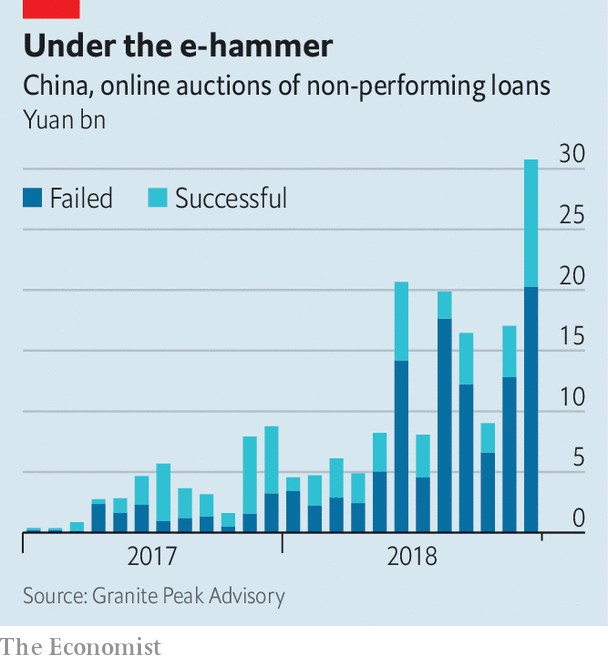
Many of these local investors have now exited. A bear market in stocks has dampened enthusiasm. And regulators have once again played a critical role, placing more restrictions on funds that invest ordinary savers’ cash. One measure of how fast the landscape has changed is the growing number of online bad-loan auctions that ended with no buyer. Though two-thirds of online auctions succeeded in 2017, just 41% did last year, according to Granite Peak Advisory, a consultancy based in New York (see chart).

At the same time a few big foreign firms have started dipping their toes in the water. Bain Capital, one of the world’s largest investors in alternative assets, has bought three portfolios of bad loans in China over the past two years, worth $650m in principal. Kei Chua, a managing director at the firm, recalls balking at the market in the early 2000s. It was so chaotic that several people would claim ownership of the same building. Times have changed: China now has, among other things, a system for checking claims on property. “It’s professional, it’s predictable,” he says. Given the amount of bad debt coming down the pipeline, at least the pipes themselves seem to be in reasonable shape.

Friday, January 25, 2019

Economists reconsider how much governments can borrow

The profession is becoming less debt-averse

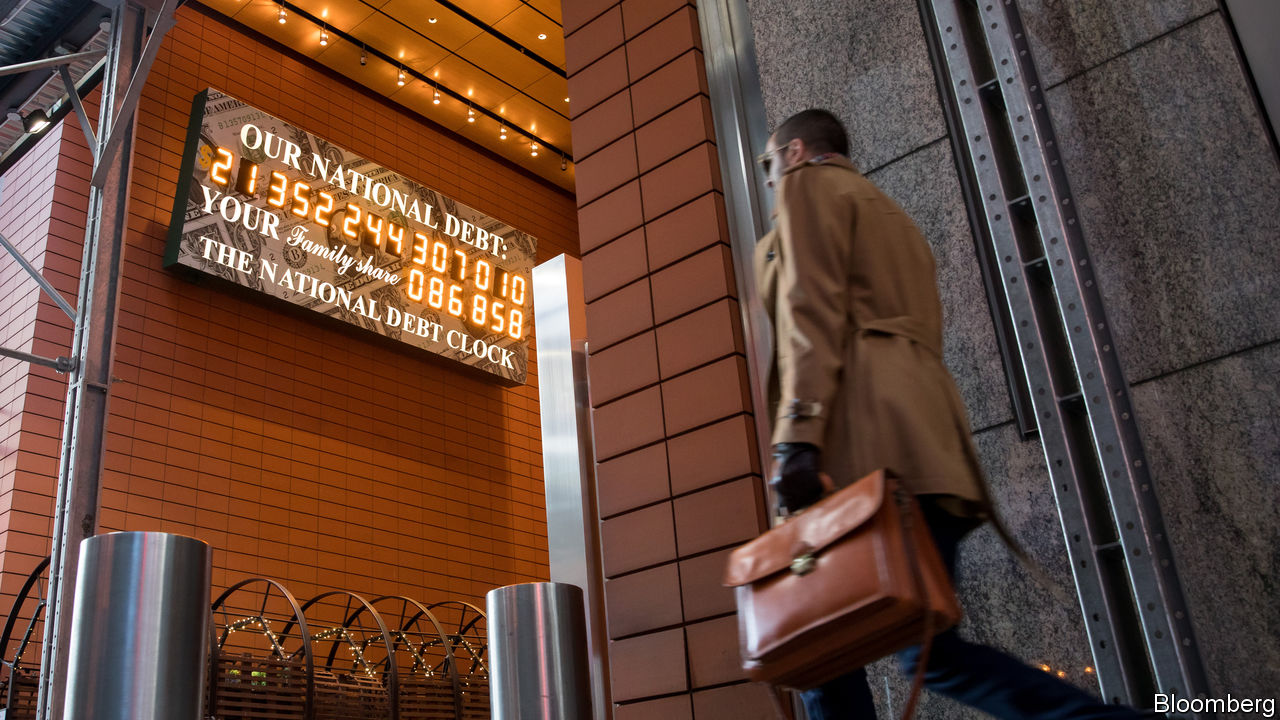
In the last three months of 2018 America’s federal government borrowed $317bn, or about 6% of quarterly gdp. The deficit was 1.5 percentage points higher than in the same quarter the year earlier, despite the fact that the unemployment rate fell below 4% in the intervening period. In cash terms America borrowed in a single quarter as much as it did in all of 2006, towards the peak of the previous economic cycle.
Such figures might once have sent the country’s deficit scolds into conniptions. But scolds are in short supply, at least within the halls of Congress. Republicans were the architects of President Donald Trump’s budget-busting tax plan. Some Democrats are less content than ever to tie their hands with the fiscal rules that Republicans routinely flout. Early this year progressive Democrats urged Nancy Pelosi, the speaker of the House of Representatives, to abandon “paygo” rules, which require that new spending be paid for with matching tax increases or offsetting spending cuts.
Even more surprising is the reaction among economists. Heterodox schools of thought have long questioned the view that government spending must be paid for by taxes. “Modern monetary theory”, which synthesises such views, is proving increasingly popular among left-wing politicians. The charismatic new congresswoman from New York, Alexandria Ocasio-Cortez, is a fan.
Orthodox economists have traditionally been more cautious. “Government spending must be paid for now or later,” wrote Robert Barro, of Harvard University, in a seminal paper published in 1989. “A cut in today’s taxes must be matched by a corresponding increase in the present value of future taxes.”
Interest-rate wobbles once sent shock waves across Washington. In 1993 James Carville, a Democratic political adviser, mused that if reincarnation existed he wanted to come back as the bond market. “You can intimidate everybody,” he quipped. More recently Carmen Reinhart of Harvard University, Vincent Reinhart of Standish Mellon Asset Management and Kenneth Rogoff, a former chief economist of theimfnow at Harvard, have published research that argues that periods in which government debt rises above 90% of gdp are associated with sustained slowdowns in economic growth.
But government borrowing looks less scary than it used to, and some mainstream economists are reconsidering the profession’s aversion to debt. They once feared “crowding out”—that government bonds would lure capital that would otherwise finance more productive private-sector projects. But real interest rates around the world have been falling for most of the past 40 years, suggesting that there are too few potential investments competing for available savings, rather than too many. Indeed, government borrowing could “crowd in” new private investment. Public spending on infrastructure might raise the returns to private investment, generating more of it.
That still leaves bills to be paid. Yet here, too, things are less clear cut than one might suppose. The experience of Japan, where gross debt as a share of gdp exceeds 230%, suggests that even very high levels of debt may not scare away creditors, at least in advanced economies that borrow in their own currencies. And in a recent lecture Olivier Blanchard, another former chief economist of theimf, pointed out that when the pace of economic growth exceeds the rate of interest on a country’s debt, managing indebtedness becomes substantially easier. In such cases debt incurred in the past shrinks steadily as a share of gdp without any new taxes needing to be levied. Debt might nonetheless rise if annual deficits are sufficiently large, as they are in America now. Even so, at prevailing interest and growth rates and with deficits continuing to run at 5% of gdp, it would take more than a century for America’s ratio of gross debt to gdp to reach the current Japanese level.
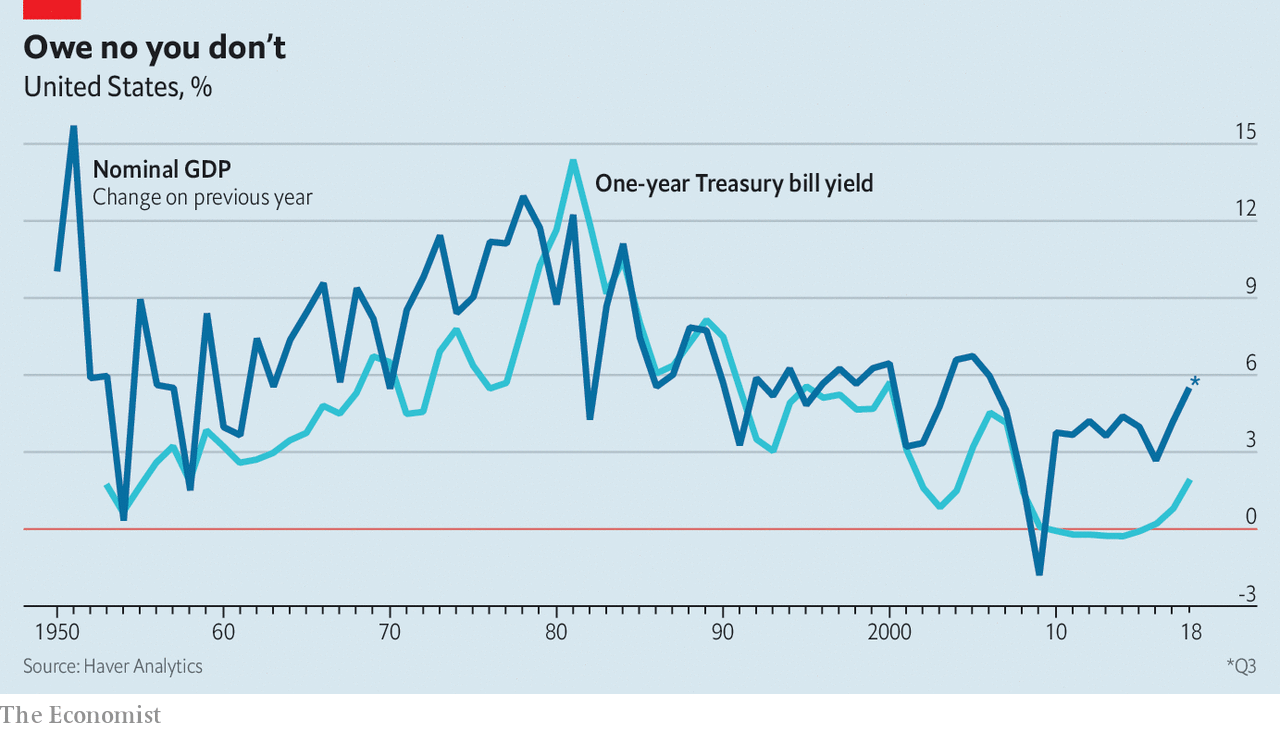
Of course, interest rates could rise. But most commonly growth rates tend to exceed the rate of interest. Since 1870, Mr Blanchard noted in his lecture, the average nominal interest rate on one-year usgovernment debt has been 4.6%, while the average annual growth rate of nominal gdp has been 5.3%. Growth rates have surpassed interest rates in every decade since 1950, except the 1980s. Nicholas Crafts of the University of Warwick wrote that the difference between growth and interest rates did more to reduce British debt loads in the 20th century than budget surpluses. Indeed, austerity-induced deflation in the 1920s frustrated attempts to pay down war debts.
In a pinch, governments have tools to manage unwieldy debt burdens. Ms Reinhart and Belen Sbrancia, of the imf, noted that financial repression was a critical debt-reduction tool in the decades after the second world war. During this period inflation pushed real interest rates (ie, adjusted for inflation) into negative territory. This effectively imposed a tax on savers that, owing to restrictions on the movement of capital, could not easily be avoided. Repression is not costless; it limits the extent to which capital flows towards its most productive uses. But it is unlikely to be devastating for a mature modern economy.

Bonds away

Governments cannot borrow without limit. Whether or not creditors mind, a government can throw only so much cash at its citizens before their spending exhausts the economy’s productive capacity and pushes up prices at an accelerating pace.
Yet for much of the past decade politicians have stimulated economies too little. Rich countries have spent far more time below their productive capacity than above it—at grave economic cost. An overdeveloped fear of public debt, nurtured by economists, is partly to blame. But experience suggests that governments face looser budget constraints than once thought, and enjoy more freedom to support struggling economies than previously believed. Economists, happily, are taking note.