About Me

My photo
An Investor and counsellor in Financial Market

Wednesday, February 13, 2019

The Lucrative Business Of Blind-Eye Banking

Shade

It’s a tough time to be a financial institution, especially in the developed world. Not only do banks and other financial services organizations have to face the heightened threat of sophisticated cybercriminals breaking into their vaults, but they also have to contend with unprecedented regulatory pressure to keep dirty money dealers at bay.
The year 2018 witnessed some landmark rulings with banks that were found guilty of failing or, in some instances, willfully failing to comply with the requirements laid out in the Bank Secrecy Act/Anti-Money Laundering (BSA/AML) handed near-record fines and penalties.
BSA/AML requires banks and related financial institutions to, among other things, demonstrate the ability to detect activity that’s indicative of money laundering, terrorist financing and other related crimes and report such activity to the Department of Treasury. Money laundering is a particularly egregious crime, with shady transactions reaching as much as $2 trillion a year according to estimates by the United Nations Office on Drugs and Crime (UNODC).
Banks that sleep at the wheel or simply lack strong management or reporting structure risk being slapped with hefty fines and in some cases jail time for those found guilty of directly abetting these crimes.
Here are some of the most memorable cases of senior bankers not doing nearly enough to stop money laundering schemes—and facing the full wrath of the law.
#1 JPMorgan
      Fine: $2.05B
JPMorgan’s $2.05 billion court settlement in 2014 will go down as one of the harshest in the history of the banking industry—and for good reason. For 15 years or so, the giant bank blatantly ignored red flags surrounding Wall Street financier Bernard Madoff’s fraudulent dealings. Madoff used his accounts at the bank to run a massive $65 billion Ponzi scheme, easily the largest ever uncovered in U.S. territory.
#2 HSBC
      Fine: $1.9B
One of Europe’s largest banks, HSBC Holdings was also caught napping at the wheel and failing to detect suspicious activity. The bank was found guilty of failing to monitor $670 billion in wire transfers that allowed Mexican and Colombian drug cartels to launder their ill-gotten proceeds.
#3 Commerzbank
      Fine: $1.45B
Germany’s fourth-largest bank by total assets is not a stranger to controversy when it comes to money laundering activity. According to a consent order with the New York Department of Financial Services, Commerzbank was found guilty of failing to share relevant information surrounding $250 billion-worth of fraudulent transactions conducted on behalf of Iranian and Sudanese entities subject to U.S. sanctions between 2002-2008.
#4 Standard Chartered
      Fine: $967M
One of the UK’s largest and most prestigious multinational banking institutions might just end up winning the ignominious title of one of the world’s most lucrative money laundering havens. In 2012, the bank was forced to cough up $667M in fines for violating U.S. sanctions against doing business with Iran. Two years later, StanChart was slapped with an additional fine of $300 million for the bank’s weak anti-money laundering controls. Apparently, that was merely the beginning of the bank’s troubles. Last year, reports emerged that the bank could face another $1.5B in extra fines for the same crime, which could take total fines somewhere in the vicinity of $2.5B.
#5 ING Group
      Fine: $900M
Perhaps you have noticed a recurring theme that the most elaborate money laundering schemes are conducted at some of the world’s largest financial institutions. This clearly shows that lack of adequate monitoring structures is an industrywide problem and not just underfunded organizations. In 2018, Netherlands-based  ING Group, one of the world’s largest banking and financial services companies, was fined $900M by the Dutch authorities after it acknowledged ‘‘serious shortcomings’’ for failing to prevent illicit payments being made by VimpelCom to a company owned by an Uzbek government official (VimpelCom is a Russian telecom that is now called VEON).
#6 Commonwealth Bank of Australia
       Fine: $700M
In June 2018, CBA made history for all the wrong reasons after paying the biggest civil penalty in Australian corporate history after admitting to not 1, 5, 10 or 20 but a staggering 53,000 breaches of money laundering laws that allowed drug syndicates to funnel millions in dirty cash to offshore accounts.
#7 Deutsche Bank
      Fine: $670M
Banks with international operations not only have to comply with strict AML laws back home but also on foreign soil. And, sometimes money laundering can take an unfamiliar face. In 2017, Deutsche Bank was found guilty by UK authorities of condoning a series of illegal mirror trades through its Moscow office that allowed Russian nationalities to expatriate funds from their country by purchasing shares at home using rubles then selling them in London using euros or dollars.

Tuesday, February 12, 2019

How Bad Is the China Slowdown? U.S. Companies Offer Some Answers

To gauge the scope of China’s economic slowdown, begin with forklifts.
The factory workhorses are a barometer of the manufacturing sector’s fitness. Changes in demand can ease or worsen concerns about China.
By that measure, EnerSys sees trouble.
The Reading, Pa., maker of batteries that power forklifts said those sales in China fell in the latest quarter after rising 10% or more earlier in the year.
“We’ve seen a slowdown,” said Michael Schmidtlein, EnerSys’ finance chief. “Given that forklifts are a good indicator of economic activity, their general economy has slowed, and maybe far greater than the authorities are indicating.”
Fourth-quarter results from U.S. companies highlight the many and varied ways that China’s cooling economy affects American business, and, in turn, offer a glimpse of what’s happening inside China. The indications are that slowing growth there is broad, if still modest.
For U.S. businesses, the repercussions extend well beyond slowing sales at companies with the biggest exposure to China’s vast economy.
Companies like EnerSys are struggling with weaker demand from export manufacturers in China, which are pulling back amid fears that trade tensions will worsen. Retailers and other companies catering to Chinese consumers face signs of weakness among the country’s growing middle class. They are buying fewer cars, phones and are traveling less.
Some analysts expect that China’s slowing growth, and its effects on U.S. companies, will worsen in the first quarter. A recent business-sentiment survey from Oxford Economics found that many North American and European businesses see elevated risks of a sharp global downturn, with many citing China’s economy and its policy response as significant risks.
“The expectation is that Q1 is going to be brutal,” said Brad Setser, former deputy assistant Treasury secretary for international economic analysis in the Obama administration, and now a senior fellow in international economics at the Council on Foreign Relations.
Chinese exports slowed in December and are likely to decelerate more sharply in the first quarter, Mr. Setser said, especially if trade tensions with the U.S. aren’t resolved: “The question is, will the trade truce plus China’s internal stimulus put China’s economy back on a stable path?”
U.S. and Chinese officials will meet this week for trade negotiations ahead of a March 1 deadline. President Trump in early December delayed plans to increase tariffs on $200 billion of Chinese goods to 25% from 10%, giving the two sides time to strike a comprehensive trade deal.
The uncertainty over the path of China’s economy has gripped the attention of U.S. executives and Wall Street analysts. They mentioned China 225 times during investor conferences and calls for current S&P 500 companies through the first full week of February—the most over the same period in at least a decade, according to a Wall Street Journal analysis of transcripts from FactSet.

General Motors Co.reported a 25% decline in the number of vehicles it sold in China in the fourth quarter compared with a year earlier—a grim turn in a year with a 9.8% sales drop. GM’s sales shrank faster than those of the industry as a whole, which declined 20% in the fourth quarter and about 6% for the year.
GM attributed its weaker performance largely to its lower-margin Wuling and Baojun brands in smaller Chinese cities, where a softening real-estate market has soured consumer sentiment. The company’s luxury Cadillac brand, however, rose 17% last year over 2017, driven by sales in China’s largest and most affluent cities.
One bright spot comes from continued spending by wealthy buyers.Estée Lauder Co s. said sales in the Asia-Pacific market, led by China and Hong Kong, rose 20% in the second half of last year. Chief executive Fabrizio Freda said in an earnings call last week that high-end beauty products are a relatively affordable luxury that younger Chinese shoppers keep buying, despite a decelerating national economy.
Jeweler  Tiffany & Co. , which rings up as much as 30% of its sales from Chinese consumers, said sales in China rose by more than 10% in the two-month holiday period ended Dec. 31.
Outside China, the prospects look less cheery. Analysts say most of Tiffany’s sales to Chinese consumers are from Chinese tourists shopping in Hong Kong, Europe and elsewhere. That business hasn’t held up as well. Chinese tourists bought less in the Americas and in Hong Kong in the quarter that ended in late October, the company said.
Tourism sales also slipped over the holiday period, Tiffany said in a mid-January report. The company traces softened tourist sales to a stronger dollar, which raises travel and overseas shopping costs for Chinese consumers.
Gene Ma, head of China research for the Institute of International Finance in Washington, D.C., said government rules to stem capital outflows, including tighter ATM withdrawal limits, likely depressed sales to Chinese tourists abroad, among other factors.
China’s girth
Despite slowing, China still posted economic growth above 6% last year, easily surpassing the U.S. and Europe.
The country’s 1.4 billion people and rising middle class bought nearly $52 billion worth of iPhones and other Apple Inc. products in the fiscal year that ended on Sept. 29. Rapidly expanding megacities such as Shanghai are dotted with Starbucks coffee shops, and new buildings ferry passengers on Otis elevators made by United Technologies Corp.
China’s size and rapid growth in recent years, together with the expansion of American businesses within its economy, mean even a modest slowdown can be felt along supply chains that stretch world-wide.
Chinese tourists pass a Tiffany & Co. store in Hong Kong.
Chinese tourists pass a Tiffany & Co. store in Hong Kong. PHOTO: KIN CHEUNG/ASSOCIATED PRESS
As more companies flagged economic weakness in China in their fourth-quarter results, investors and analysts have worked to untangle the impact on U.S. companies and economic sectors. Many companies disclose sales in Asia, and to a lesser extent in China, but exposure to the Chinese economy is much broader.
Companies such as Mastercard Inc., for instance, have no direct business within China’s domestic economy. Yet it can see the effect of slowing growth, Mastercard CEO Ajay Banga told analysts in a Jan. 31 conference call. “Given the size of the Chinese economy, it does impact the global economic picture.”
About a third of companies in the S&P 500 generate no direct revenue from China, according to estimates by FactSet, based in part on company disclosures. Another third generate at least 3% of sales in China. About 60 of the biggest U.S. companies generate 10% or more of sales there.
Many are technology andindustrial companies that sell components to manufacturers that make products in China for export elsewhere, limiting their exposure to a slowing Chinese economy.
“Everything is built in China but it doesn’t necessarily stay in China,” said Christopher Rolland, a semiconductor analyst at Susquehanna International Group. Sales numbers, he added, can be “an overrepresentation of true Chinese demand.”
Not all business problems in China are driven by tariffs or slower growth there. Tupperware Brands Corp. , which markets its plastic food containers through a network of individual sellers, last month said revenue and profit across several of its units were below internal projections. The company, in part, blamed weakness in China. The company’s shares fell 27% that day.
Doug Lane, who runs a boutique investment research firm, said other direct sellers haven’t mentioned similar problems in China. “When companies are reporting numbers below expectations, they tend to blame a lot of things,” he said.
Tupperware said it generated more than $200 million in revenue in China in 2018, or about 10% of its sales, through 6,700 independent retail locations. It declined to comment.
Under pressure
EnerSys, the Pennsylvania-based battery maker, is feeling pressure from all sides: a slowing Chinese economy, new government rules and the China-U.S. trade battle.
The company generates about 5% of its total sales in China and about 60% come from the Americas. But it makes some of its batteries in China, and the company competes with Chinese battery makers that sell backup power supplies.
EnerSys said sales in Asia in its most recent quarter fell 11% from the prior quarter. A government mandate prompted one of its largest Chinese customers to use more recycled batteries.
In response to slowing sales, EnerSys had planned to use a Chinese factory to produce more products for export to the U.S. That idea was scrapped when the U.S. imposed tariffs on batteries imported from China. EnerSys says now it will export from its Chinese factory to other countries.
The cooling Chinese economy has driven down the price of raw materials, including the lead used to make batteries, but it isn’t much of a silver lining.
“Our inputs are cheaper but the broad demand for our product is less,” said Mr. Schmidtlein, the EnerSys finance chief.
A General Motors Co. car dealership in Shanghai, China.
A General Motors Co. car dealership in Shanghai, China. PHOTO: QILAI SHEN/BLOOMBERG NEWS
Other companies are benefiting from lower-priced raw materials on the one hand, and getting pinched by U.S. tariffs on the other.
Masco Corp. , which makes Delta faucets and Hansgrohe shower heads, said it was poised to benefit from lower copper and zinc prices in the second half of last year. Masco also faces increased costs of about $150 million if the U.S. follows through on its threat to raise some tariffs on Chinese imports to 25% this year, the company said in its annual report filed Thursday.
If forklift demand is one rough gauge of economic growth, microchips are another. Consumer appetite for high-price electronics, including smartphones, has slowed. So has construction, which means fewer appliance sales. Both are bad news for semiconductor makers, whose chips span all those products.

Chinese manufacturers are cutting back orders of microchips to avoid being left with unsold goods, in case the U.S.-China trade dispute yields higher tariffs, and demand for Chinese-made goods falters.
“Industrial and consumer end markets have been especially weak in greater China,” Keith Jackson, chief executive of ON Semiconductor Corp., said.
“They’re risk averse. They’re not going to take any chances. They’re not going to hold inventory,” Thad Trent, the financial chief at Cypress Semiconductor Corp., said Jan. 16 at a conference. “We see customers waiting at the last minute to place orders.”
Chip makers link China’s slowing growth with the U.S.-China trade fight. “Trade is the problem why Chinese economy is weakening so much,” said Steve Sanghi, CEO of Microchip Technology Inc., which makes microcontrollers used in electronic and industrial components.
Some executives and analysts have said economic softness would dissipate if the trade issues were resolved. Others aren’t so sure.
“There are some underlying economic and end-demand issues in China that still need to be dealt with and resolved,” said John Vinh, a semiconductors analyst with KeyBanc Capital Markets Inc. “There is not potentially a quick fix as easy as resolving the tariff conflict.”

Monday, February 11, 2019

Is Lithium Poised For A Breakout?

Cars
It’s been a decade of lows for commodities after posting 7 declines in 11 years, but we’ve seriously underestimated lithium. It’s back with a vengeance in 2019.
The commodities market endured yet another annus horribilis, with just four commodities—natural gas, uranium, cocoa and wheat—recording any uptick at all. Last year’s 12 percent slide by the Bloomberg Commodity Index--spurred by 20 percent-plus declines by industrial bellwethers like West Texas Intermediate crude, steel and platinum—came in the wake of two years of modest gains.
Viewed against that kind of backdrop, lithium’s 50 percent correction that snapped a multi-year winning streak appears less vicious. It’s important to remember that prior to the crash, lithium had enjoyed a meteoric rise with prices doubling since the beginning of 2016 and nearly quadrupling over the past decade. The fact that much of the rally coincided with a sharp rise in the value of the U.S. dollar makes it all the more remarkable.
Investing in the commodity market can be a roller-coaster ride; what with the incessant boom-and-bust cycles driven by the ebb and flow in infrastructural spending, production ramps/cutbacks and stockpiling/destocking supplies. And just like other financial markets, trader sentiment plays a big role in determining trajectories.
Unfortunately, it’s the latter scenario that took center-stage during last year’s lithium crash. A furor around anticipated new supply especially from China’s new hard-rock projects and Chilean brine mines got out whack and derailed the market.
(Click to enlarge)
Source: Metallary
(Click to enlarge)
Source: Trading Economics
Tsunami of Oversupply?
The situation was not helped by Wall Street punters sounding the alarm over the dangers of oversupply …
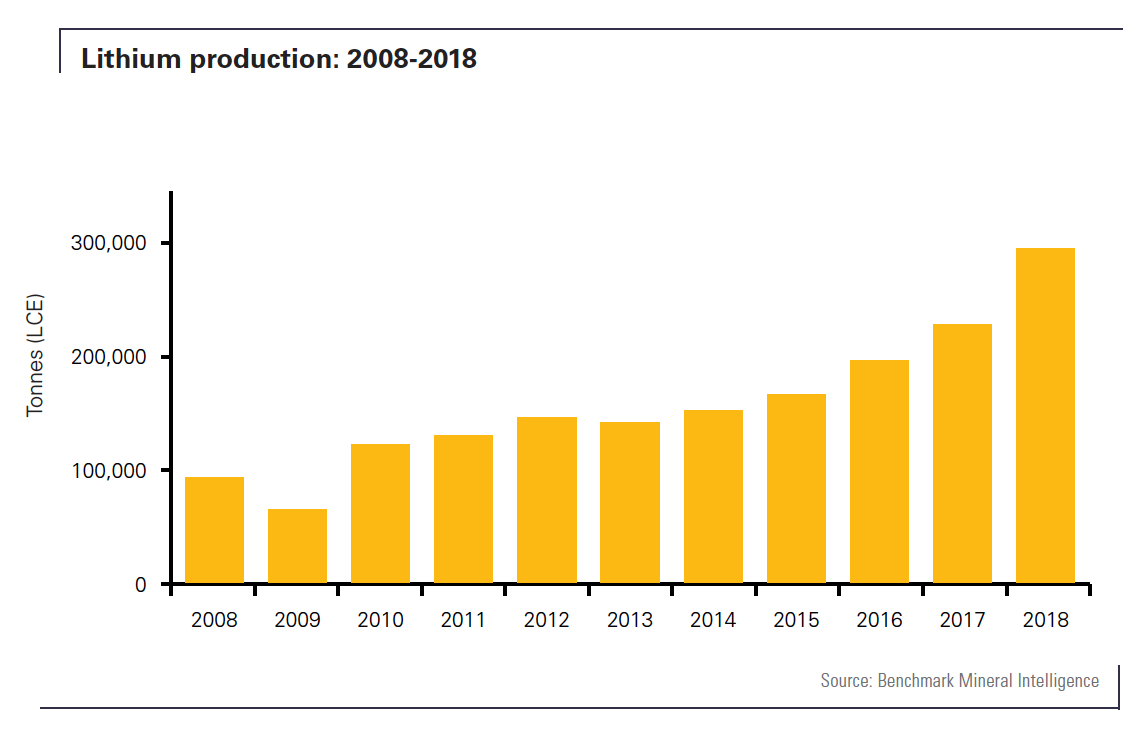
Shares of major lithium producers and explorers including Sociedad Quimica y Minera de Chile (NYSE:SQM), Albemarle Corp. (NYSE:ALB) and Orocobre Ltd (ASX:ORE) received a severe hammering in March after Morgan Stanley forecast that Chilean low cost brine producers could add as much as 200kt per year by 2025, while expansion of China’s and Australia’s hard-rock mines could pump in another half a million metric tonnes over the timeframe. That’s certainly a massive production ramp-up considering that global production in 2017 totaled just over 200kt.
In August, Macquarie Research provided the final straw after chiming in with a warning that the market was “sleepwalking into a tsunami of oversupply.”
The report put the final nail in the coffin of the decade-long lithium rally-- Fastmarkets reckons that prices for battery-grade lithium carbonate in China, by far the world’s largest consumer of high-grade lithium carbonate, tumbled 50.31 percent last year to 75,000-83,000 ($10,885-12,046) yuan per tonne from 158,000-160,000 ($22,932-23,222) yuan per tonne the previous year, as demand waned.
(Click to enlarge)
Source: Metal Bulletin
But maybe the bear camp rushed their fences this time…
While it’s undeniable that the carnage managed to exceed even Morgan Stanley’s decidedly pessimistic outlook for global lithium prices to drop 45 percent by 2021, the fundamentals suggest that the selloff was greatly overdone and such low prices cannot be justified by simple market forces of supply and demand.
According to London-based Benchmark Minerals Intelligence senior analyst Andrew Miller, the disconnect between lithium prices and the demand side of the equation has never been bigger.
Reality Check
A cross-section of materials experts have raised eyebrows at the negative assessment, criticizing the investment analysts for underestimating the rise in lithium demand and the complex nature of lithium mining and production ramps. According to them, both MS and Macquarie failed to account for just how big the gap between supply forecast and actual production can be.
And, they might be spot on.
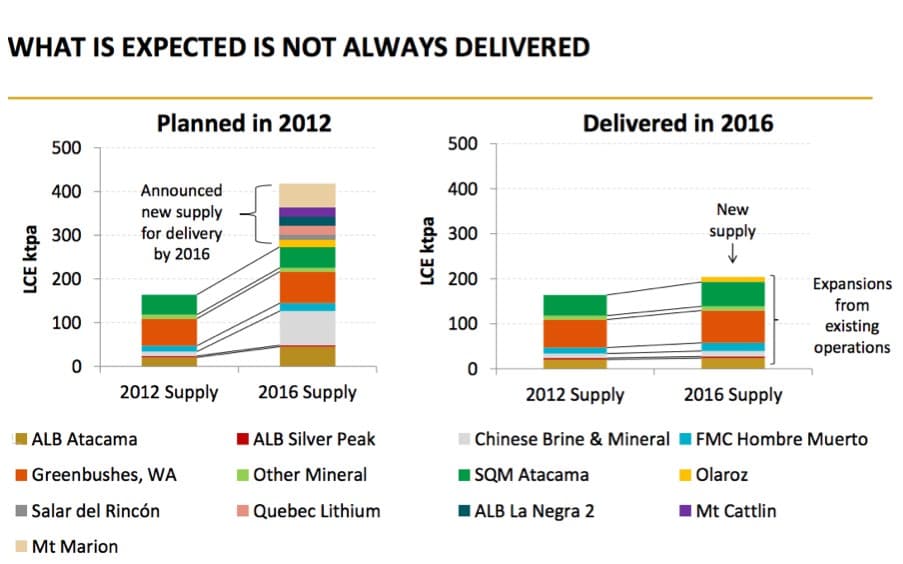
Supply expansions in 2018 came in much lower than predicted and the tsunami of oversupply forecast by the likes of Macquarie Research proved to be little more than changing tides in the lithium supply chain.
A good case in point is Brisbane-based Orocobre, which has become the poster child for just how challenging new brine mining can be. The company’s Salar de Olaroz project in Argentina took seven years to hit its stride but still came up short of production targets. Meanwhile, run-ins with the courts and regulators coupled with mutual accusations of license violations facing Chile’s lithium giants SQM and Albemarle at their Atacama brine projects further reinforce this point.
The screenshot below from Orocobre’s investor slide presentation is a sobering reminder to this reality.
(Click to enlarge)
Source: Mining.com
In terms of feedstock supply, SQM and Albemarle had laid out plans for increased production rates. But as is often the case with brine evaporation, the process has been hindered by seemingly endless production delays. SQM hit technical obstacles at its new brine conversion facilities that delayed its target capacity of 70,000 tpa LCE by end of 2018 while Albemarle continues to struggle to achieve full capacity at La Negra II.
The situation has not been much better in China—the ultimate lynchpin to the lithium bear thesis. Many Chinese brine producers in the Qinghai region had outlined plans to triple or quadruple capacities over the coming 3-4 years. A visit by Benchmark Minerals to these operations, however, has painted a dire picture—the technical challenges related to high magnesium concentrations in the region are nowhere near being comprehensively overcome. Across Qinghai’s 10 producers, only an additional 5,000-10,000 tonnes of lithium product found its way to the market, majority of which failed to reach technical grade specifications. This, in effect, means that much of what came online from the region was either reprocessed thus adding to costs or converted to lithium hydroxide in a bid to meet growing demand for nickel-rich cathode technologies.
Although tight credit in China forced some lithium buyers to destock and contributed to the glut, the predicted huge oversupply failed to materialize. Around mid-September, analysts at CRU estimated lithium surplus for 2018 at a relatively mild 22,000 tonnes against a demand of 277,000 tonnes.'
Source: Benchmark Minerals
2019: A Transition Year
So far, there is no clear data or evidence that that the lithium demand narrative is about to slowdown, let alone reverse. On the contrary, certain emerging trends in the industry suggest just the opposite.
The biggest near-term driver for lithium demand is the NCM trend. The shift towards cathodes that use huge amounts of lithium hydroxide is already underway, something that is expected to trigger a huge NCM (nickel-cobalt-manganese) ramp up. Benchmark Minerals estimates that 44 percent of mega-and-giga-factories will use lithium as a raw material by 2028 translating into 534,000 tonnes of additional demand.
That projection seems to resonate with Elon Musk’s ambitious target to build 20 gigafactories across the globe over the next decade. Miller sees 2019 as the tipping point where demand will eventually outstrip supply starting 2020.
Meanwhile, Roskill has predicted that the shift to higher-nickel-cathode materials will push many lithium producers to favor production of lithium hydroxide over lithium carbonate thus taking some pressure off the lithium carbonate supply side. The firm has forecast lithium demand to expand by a brisk 21 percent annual clip between 2018 and 2025 with demand expected to grow 13.5 percent in the current year.
But, of course, no lithium bull thesis would be complete without the EV angle.
Currently, the EV market accounts for about 47 percent of global lithium demand. That, however, is expected to drastically change as EV penetration rates coupled with the ongoing trend of electric vehicles using larger battery packs that yield longer ranges leading to electric mobility gobbling up 83 percent of lithium supply a by 2027.
Fastmarkets has predicted EV penetration to hit 15 percent by 2025 from 2 percent currently. EV demand has actually been beating estimates and is constantly being revised upwards to reflect this. The EV explosion is expected to drive a nearly six-fold increase in lithium demand for the forecast period.
(Click to enlarge)
Source: Infinity Lithium company presentation
Key lithium trends to watch in 2019 and beyond
  • Lithium carbonate prices will steady in 2019 before picking up steam starting 2020
  • Lithium hydroxide prices could soften a little bit after remaining resilient in 2018
  • China will become less important as a global price trend driver as demand rapidly builds up in other key markets
Miller advises investors to keep an eye on new spodumene production, particularly how quickly it can be integrated into the chemical and converter supply chain and turned into either lithium carbonate or hydroxide. A slower ramp is likely to lead to supply constraints and raise prices and vice-versa

Friday, February 08, 2019

The Coming Recession Will Be Different

For almost 40 years, we’ve lived in an era of low rates and easy money. It let governments and businesses worldwide run up piles of debt.
Global debt could easily reach $500 trillion in a few years. And yet everyone acts like that is normal and can continue.
Just like subprime mortgage debt triggered the last recession, corporate debt will trigger the next one. This will start a liquidity crisis and create havoc in all sorts of “unrelated” markets.
Investors will learn once again that all asset classes globally are correlated in a crisis. There will be few places to hide.

But then, as all recessions do, this recession will end. And recovery will begin, because that is what happens after recessions.
Except it will be different this time.

The Rise of the Far Left

Recovery from the Great Recession was the slowest on record. The next recovery will be even slower.
Debt is future consumption brought forward. We are now enjoying consumption and growth that won’t happen in the future.
Debt is a drag on future growth. And the amount of debt the world now has will be a monster drag on future growth.
Recessions always bring higher unemployment, on top of technology-driven job losses. This will worsen the current political tensions.
Humans want scapegoats. Many will blame markets and capitalism, when we have neither free markets or true capitalism.
The progressive left’s siren song will begin to play everywhere. They’ll promise guaranteed basic income, free college, free everything, etc.
If you haven’t already heard of the economic insanity called Modern Monetary Theory or MMT, you will.
It says we don’t need to worry about government debt. We should simply monetize it. Create and spend whatever we need for the common good.
They produce fancy equations and rationales, but monetization is the bottom line. It’s essentially what Alexandria Ocasio-Cortez and others in her world espouse.
They talk about raising taxes on the rich. But there’s simply not enough money to do what they propose—even if you take everything the rich have.
The arithmetic doesn’t add up. So they will add more debt and eventually monetize it. Which is exactly what Japan has done, and seemingly succeeded.

Politics Will Drive Everything

US government debt will easily reach $30 trillion within three years after the next recession.
Once we begin the next economic experiment, another recession will come shortly. Markets will be even more distresses. And the debt will soar to $40 trillion.
Pensions and government deficits will be completely upside down. And then the real fun will begin… quantitative easing on a scale that makes the Bernanke years look like an elementary school picnic. We will simply have no choice.
Now, the world will not come to an end.
Markets and most businesses will figure out how to survive. New businesses will keep launching. New technologies will thrive.
We will continue to need food, shelter, transportation, communication, and all the things we think of as normal today.
This will all happen while technology “eats” jobs faster than it creates them. It was all well and good when we went from 80% of the workforce on farms to 1% today. But that happened over several generations and centuries.
We are going to see that kind of upheaval in many industries in half a generation. Can you blame frustrated workers? People wishing that they can have their jobs protected? Wanting the government to do something?
In the coming decade, I think politics will be more important to markets than ever before. That is not to say investors can’t figure it out.
But if you are looking at past historical performance to guide your portfolio, you will be disappointed.
We are about to enter an era unlike anything in our own experience or in our history books. Analogies? Surely. History, and economic and political history, will be ever more important.
How should then we invest? One thing I can tell is that the coming decade will bring a lot of volatility. Buy and hold investing will be dangerous. Active management is once again going to be key.