About Me

My photo
An Investor and counsellor in Financial Market

Thursday, June 06, 2019

From Gold To Nothing: How 1971 Changed Everything In The Economy

The monetary system is a major component of the whole economic system. Despite that, today we take it for granted and don’t even ask ourselves how it works and if it is the best solution available or the correct way to manage things.
Even though it appears to be stable, history shows that monetary systems changed periodically in the last century (20–30 years on average).
The main difference between our current monetary system and previous monetary system is that today it is entirely based on FIAT Currency, in contrast to older monetary systems that were backed by gold.
That means that what we call money is a government-issued currency that has zero intrinsic value and is not backed by anything.
From 1971, this kind of system allows central banks to literally control the economy and opened a new chapter in the world monetary system.
In this article, I am going to briefly explain why 1971 changed everything and what are potential consequences of such a decision.
Since 1971 the world runs on FIAT currencies that are not gold-backed in any way. This changes everything.
Before digging into it, we have to review some history.

The Bretton Woods System and It’s Collapse

Towards the end of the World War II, peace was a real concern and it was clear that the world needed a new monetary system able to support the economy.
In fact, one of the major reason that led to World War II was the failure in dealing with economic problems after World War I.

Why It Was Needed And How It Worked

The Bretton Woods agreement was signed at a conference between allied nations in 1944.
Before the agreement, most countries followed the gold standard, meaning that each country guaranteed to redeem its currency into gold.
After Bretton Woods, countries agreed to exchange their currency for U.S. Dollars. Central banks committed to keep fixed exchange rates with the dollar while the U.S. committed to keep the parity between U.S. dollars and gold at 1/35 of an ounce of gold.
The dollar was backed by gold at 1/35 oz and foreign countries committed to keep fixed interest rates with the U.S. dollar
Why U.S. dollars? In those years U.S. held two-thirds of the world’s gold reserves and after the war was obviously the most influential player among nations.
This put the U.S. into a dominant position and Bretton Woods paved the way for the shift from the gold standard to the U.S. dollar standard.

The Collapse Of The System

The Bretton Wood system worked for a while and allowed for economic growth but unfortunately, a series of imbalances brought the system to its end in a matter of three decades from its inception.
Towards the 70’s United States were facing a period of stagflation, a situation where you have high inflation coupled with a recession, something very bad for the economy.
In the attempt of resolving the situation the U.S. started devaluing the dollar and kept running deficits to fund various projects.
The parity between dollar and gold was the cardinal element of the Bretton Wood system after it changed, the whole monetary agreement soon after collapsed.
Every country started quickly to redeem their devaluing dollars for gold generating a run on the U.S. gold reserves.
In response, on 15 August 1971 broke up the Bretton Woods agreement, ending the convertibility of the dollar in gold.

1971 — A New Chapter For The World

What replaced Bretton Woods and how things changed since then?
Since Nixon took the entire world out of gold in 1971, the world began this experiment of a full FIAT monetary system, backed by nothing.
Nobody knows how things will play out in the end, but the fact that this system has been running for almost 50 years now, that historically FIAT system had a 100% failure rate and that bigger and bigger imbalances are being created are factors worth considering.
To put things in perspective, once that currency is no longer commodity-backed, central banks can create as much currency as they want.
Even though this comes in handy when there is the need to fight a recession, it seems that it went out of control.
We now have a full FIAT monetary system and central banks can create as much currency as they want
This is a problem for two reasons:
  • The purchasing power of the currency gets progressively wiped out
  • The monetary expansion creates a high degree of distortion in the economy

Purchasing Power of the Currency

How do you feel when you look at this chart?
This visual representation helps to clearly understand what money printing and devaluation of currency really mean in everyday life.
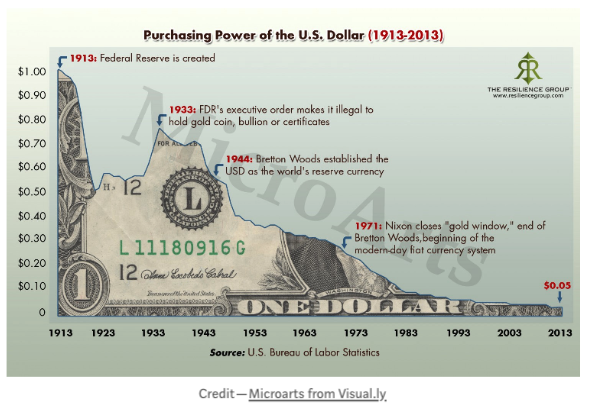
Although it speaks by itself, take a moment to realize that the dollar lost 95% of its purchasing power in just 100 years.
As money printing progresses, this situation can only deteriorate and it is a problem for the individuals because it makes virtually impossible to save money.
You can’t just save you are bound to invest at least to keep the purchasing power. Giving the overall decrease in asset returns, it also forces you to go on riskier investments to have some acceptable returns.

Distortion in the Economy

This might actually be the real problem because money (or currency today) is one of the most important variables in the economic system and if it gets manipulated this doesn’t come without consequences.
When you take a look at the degree of distortion in today’s economy there is a real chance that this situation won’t end up well.
To get an idea of the massive manipulation of the entire economy that is going on, start by assessing the expansion of the monetary base:
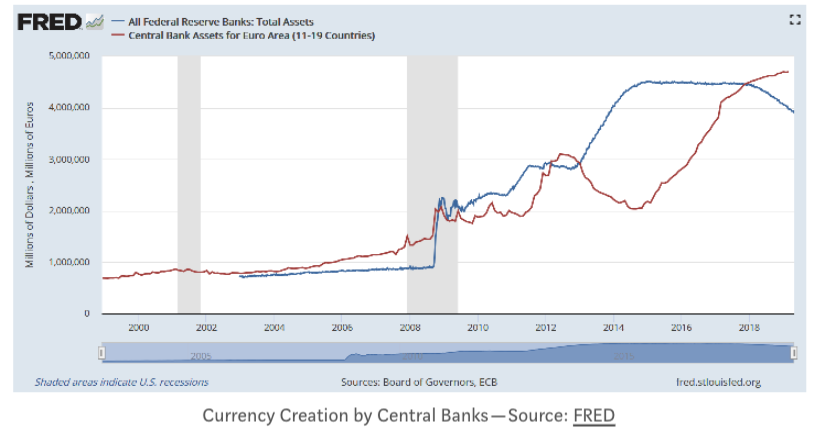
As you can see, the quantity of currency almost quintupled in a matter of a single decade and this was all currency created in order to keep the economy going.
This is crazy and while it helped to postpone a slowdown in the economy, it fostered a huge debt assumption that sooner or later will result in a burden for the economy.
The problem with this monetary system is that can’t balance the forces of the free market. The gold standard had a huge advantage over it because it was self-balancing since the overall amount of money was fixed.
Without a conscious effort to limit excesses, greater and greater imbalances start to appear, cracks start to show up and the system is under threat.
This also caused other distortions, like the push to stock market valuations that are now in bubble territory.
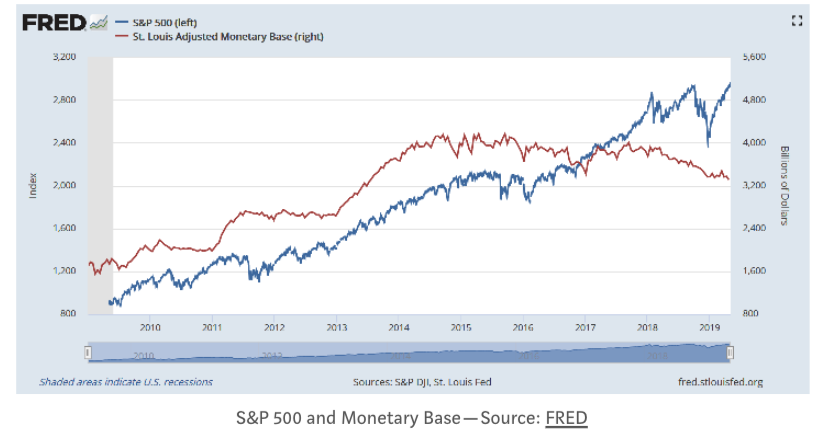
Take a look at this chart and realize by yourself that there is no chance that is is a coincidence. There is almost a perfect correlation between expanding the monetary base and increasing stock prices.
You can also see that as monetary policy tried to start to raise interest rates, uncertainties on the market promptly showed up and now the FED already changed its strategy.
We might see soon a new monetary expansion, the problem is that this time it would happen before a crisis and it leaves us with a huge question:
What to do then when we enter the real crisis?

Conclusion

Without any connection with a fixed quantity of gold (more in general, a “fixed quantity”), the monetary system currently has no limits for currency creation.
The fact that financial crisis is getting bigger and bigger and levels of debtare getting higher and higher is a direct consequence of money printing.
Today we find ourself with an economy that is slowing down, levels of debt never seen before, frighteningly high financial markets valuations and LESS TOOLS TO FIGHT THE NEXT CRISIS
I am not saying that money printing and fighting a recession is a bad thing by itself, but without any control, it is a real problem because it leads to the destruction of purchasing power and the generation of distortions in the economy and markets.
The point is that the economic crisis has a fundamental rebalancing role in the economy and prevent them to work doesn’t come without consequences.
It’s understandable that governments and policymakers don’t want to have a crisis while they are in charge, but forcing the economy through monetary policy to never slow down brings on the risk of a full-blown financial disaster. Something never is seen before that counts for everything that didn’t take place until today

Tuesday, June 04, 2019

Economies and stockmarkets do not always match up well

That makes it hard for investors to diversify into emerging markets.


Everybody knows Monty Python’s “cheese shop” sketch—everybody who is over 50 and a comedy nerd, that is. The shopkeeper, played by Michael Palin, asks a customer, played by John Cleese, what cheese he would like. Do you have Red Leicester? Sold out. Caerphilly? On order. Cheddar? Not much call for it. Each increasingly testy request for a different cheese (43 of them) is cheerfully met with a “no”, “sorry” or feeble excuse. Pressed to back up his claim to the best cheese shop around, the shopkeeper replies: “Well, it’s so clean, sir!”
This leads us, as smoothly as a Python segue, to a frequent complaint about the main stock index for investors in emerging markets. The opportunity is as clear as a sign saying “Cheese Shop”. Most of the growth in the world’s gdpover the next five years will be in developing countries, says the imf. You might like to buy a basket of stocks from a broad range of countries that taps into this growth. But the benchmark msciemerging-market index does not really offer that.
It is light on exposure to the fastest-growing bits of the world economy, notably in Africa. Instead it has a heavy tilt towards economies in the Asian supply chain to rich-world consumers. In short, it looks to some investors like a cheese shop that is so clean because it is uncontaminated by cheese. Yet the trouble lies not with the index compilers, but with the nature of public markets.
The matter turns on the different ways in which economies and markets are classified. With countries, it mostly comes down to income level: if gdpper person is above a certain threshold, an economy counts as developed. The criteria for financial-market development are different. Here, what matters is how easy it is for foreign investors to move large sums into and out of local stocks. That in turn depends on two things. The first is the stockmarket’s liquidity: the bigger the market, the better equipped it is to handle big purchases or sales of stock on any given day. The second is openness. A market with lots of biggish listed stocks, which trade frequently, might still fail to qualify for developed-market status because it has limits on foreign ownership or other barriers to cross-border trading.
Take South Korea, for instance. Decades of sustained growth turned it into a rich country, with gdp per person of $31,000 at current exchange rates. Yet its currency can be bought and sold only in Korea, and only during local market hours. It cannot be traded offshore. That may seem like a minor matter. But index funds that move vast sums to and fro quickly like to do their currency trades in one go. Developed stockmarkets are defined by the absence of such frictions, says Sebastien Lieblich, of msci. Though Taiwan is richer than Portugal, and Korea’s gdpis bigger, they are both classified by mscias emerging markets. Together they account for a quarter of the index. Add in the 33% weight for Chinese stocks and its constituents lean heavily towards “Factory Asia”.
A stock index measures what is investable. If you are seeking exposure to broad-based economic development, you need to be creative. That means looking at smaller, less liquid stocks outside the index, or perhaps the shares of rich-world firms that earn the bulk of their revenue in developing countries. The alternative is to drop down a level in terms of liquidity and openness to “frontier markets”, which include fast-growing economies in Asia, such as Bangladesh and Vietnam, but also in Africa. This is a much smaller universe of stocks. The market capitalisation of msci’s frontier-market index is around $120bn, compared with around $5trn for its emerging-market index. And it is also dominated by a few countries. Stocks listed in Kuwait, Vietnam and Argentina account for more than half of it.
Economies and stockmarkets do not match up well, even in rich countries. America accounts for 55% of msci’s world index but a much smaller share of the world economy. The size of its equity market relative to gdp is at one extreme (along with Britain and Switzerland), notes Victor Haghani of Elm Partners, with Germany and Italy at the other. The best reason for investing across borders is not to plug into faster gdpgrowth (for which you may overpay), but for diversification. By owning a broad range of stocks, investors leave themselves less exposed to specific company, industry or country risks. The best thing about indices of big, liquid stocks is that buying and selling them is cheaper. For the only thing that grates more than Parmesan is high-cost investing.

Monday, June 03, 2019

Iran, Iraq, & The Axis Of Sanity

No other country in the Middle East is as important in countering America’s rush to provide Israel with another war than Iraq. Fortunately for Iran, the winds of change in Iraq and the many other local countries under similar threat, thus, make up an unbroken chain of border to border support. This support is only in part due to sympathy for Iran and its plight against the latest bluster by the Zio-American bully.
In the politics of the Middle East, however, money is at the heart of all matters. As such, this ring of defensive nations is collectively and quickly shifting towards the new Russo/ Sino sphere of economic influence. These countries now form a geo-political defensive perimeter that, with Iraq entering the fold, make a US ground war virtually impossible and an air war very restricted in opportunity.
If Iraq holds, there will be no war in Iran.

In the last two months, Iraq parliamentarians have been exceptionally vocal in their calls for all foreign military forces- particularly US forces- to leave immediately. Politicians from both blocs of Iraq’s divided parliament called for a vote to expel US troops and promised to schedule an extraordinary session to debate the matter. “Parliament must clearly and urgently express its view about the ongoing American violations of Iraqi sovereignty,” said Salam al-Shimiri, a lawmaker loyal to the populist cleric Moqtada al-Sadr.
Iraq’s ambassador to Moscow, Haidar Mansour Hadi, went further saying that Iraq “does not want a new devastating war in the region.” He told a press conference in Moscow this past week, “Iraq is a sovereign nation. We will not let [the US] use our territory,” he said. Other comments by Iraqi Prime Minister Adil Abdul-Mahdi agreed. Other MPs called for a timetable for complete US troop withdrawal.
Then a motion was introduced demanding war reparations from the US and Israel for using internationally banned weapons while destroying Iraq for seventeen years and somehow failing to find those “weapons of mass destruction.”
As Iraq/ Iran economic ties continue to strengthen, with Iraq recently signing on for billions of cubic meters of Iranian natural gas, the shift towards Russian influence- an influence that prefers peace- was certified as Iraq sent a delegation to Moscow to negotiate the purchase of the Russian S-400 anti-aircraft system.
To this massive show of pending democracy and rapidly rising Iraqi nationalism, US Army spokesman, Colonel Ryan Dillon, provided the kind of delusion only the Zio-American military is known for, saying,
Our continued presence in Iraq will be conditions-based, proportional to need, in coordination with and by the approval of the Iraqi government.”
Good luck with that.
US influence in Iraq came to a possible conclusion this past Saturday, May 18, 2019, when it was reported that the Iraqi parliament would vote on a bill compelling the invaders to leave. Speaking about the vote on the draft bill, Karim Alivi, a member of the Iraqi parliament’s national security and defense committee, said on Thursday that the country’s two biggest parliamentary factions — the Sairoon bloc, led by Shia cleric Muqtada al-Sadr, and the Fatah alliance, headed by secretary general of the Badr Organization, Hadi al-Ameri — supported the bill.
Strangely, Saturday’s result has not made it to the media as yet, and American meddling would be a safe guess as to the delay, but the fact that this bill would certainly have passed strongly shows that Iraq well understands the weakness of the American bully: Iraq’s own US militarily imposed democracy.
Iraq shares a common border with Iran that the US must have for any ground war. Both countries also share a similar religious demographic where Shia is predominant and the plurality of cultures substantially similar and previously living in harmony. Both also share a very deep seeded and deserved hatred of Zio- America. Muqtada al-Sadr, who, after coming out first in the 2018 Iraqi elections, is similar to Hizbullah’s Hassan Nasrallah in his religious and military influence within the well trained and various Shia militias. He is firmly aligned with Iran as is Fattah Alliance. Both detest Zio- America.
A ground invasion needs a common and safe border. Without Iraq, this strategic problem for US forces becomes complete. The other countries also with borders with Iran are Armenia, Azerbaijan, Turkmenistan, Turkey, Afghanistan and Pakistan. All have several good reasons that they will not, or cannot, be used for ground forces.
With former Armenian President Robert Kocharian under arrest in the aftermath of the massive anti-government 2018 protests, Bolton can check that one off the list first. Azerbaijan is mere months behind the example next door in Armenia, with protests increasing and indicating a change towards eastern winds. Regardless, Azerbaijan, like Turkmenistan, is an oil producing nation and as such is firmly aligned economically with Russia. Political allegiance seems obvious since US influence is limited in all three countries to blindly ignoring the massive additional corruption and human rights violations by Presidents Ilham Aliyev and Gurbanguly Berdimuhamedow.
However, Russian economic influence pays in cash. Oil under Russian control is the lifeblood of both of these countries. Recent developments and new international contracts with Russia clearly show whom these leaders are actually listening to.
Turkey would appear to be firmly shifting into Russian influence. A NATO member in name only. Ever since he shot down his first- and last- Russian fighter jet, Turkish president Recep Tayyip Erdogan has thumbed his nose at the Americans. Recently he refused to succumb to pressure and will receive Iranian oil and, in July, the Russian S-400 anti-aircraft/missile system. This is important since there is zero chance Putin will relinquish command and control or see them missiles used against Russian armaments. Now, Erdogan is considering replacing his purchase of thirty US F-35s with the far superior Russian SU- 57 and a few S-500s for good measure.
Economically, America did all it could to stop the Turk Stream gas pipeline installed by Russia’s Gazprom, that runs through Turkey to eastern Europe and will provide $billions to Erdogan and Turkey. It will commence operation this year. Erdogan continues to purchase Iranian oil and to call for Arab nations to come together against US invasion in Iran. This week, Turkish Defense Minister Hulusi Akar renewed Turkey’s resolve, saying his country is preparing for potential American sanctions as a deadline reportedly set by the US for Ankara to cancel the S-400 arms deal with Russia or face penalties draws near.
So, Turkey is out for both a ground war and an air war since the effectiveness of all those S-400’s might be put to good use if America was to launch from naval positions in the Mediterranean. Attacking from the Black Sea is out since it is ringed by countries under Russo/ Sino influence and any attack on Iran will have to illegally cross national airspace aligned with countries preferring the Russo/ Sino alliance that favours peace. An unprovoked attack would leave the US fleet surrounded with the only safe harbours in Romania and Ukraine. Ships move much slower than missiles.
Afghanistan is out, as the Taliban are winning. Considering recent peace talks from which they walked out and next slaughtered a police station near the western border with Iran, they have already won. Add the difficult terrain near the Iranian border and a ground invasion is very unlikely
Although new Pakistani President Imran Khan has all the power and authority of a primary school crossing guard, the real power within the Pakistani military, the ISI, is more than tired of American influence. ISI has propagated the Taliban for years and often gave refuge to Afghan anti-US forces allowing them to use their common border for cover. Although in the past ISI has been utterly mercenary in its very duplicitous- at least- foreign allegiances, after a decade of US drone strikes on innocent Pakistanis, the chance of ground-based forces being allowed is very doubtful. Like Afghanistan terrain also increases this unlikelihood.
Considerations as to terrain and location for a ground war and the resulting failure of not doing so was shown to Israel previously when, in 2006 Hizbullah virtually obliterated its ground attack, heavy armour and battle tanks in the hills of southern Lebanon. In further cautionary detail, this failure cost PM Ehud Olmert his job.
For the Russo/Sino pact nations, or those leaning in their direction, the definition of national foreign interest is no longer military, it is economic. Those with resources and therefore bright futures within the expanding philosophy and economic offerings of the Russo/ Sino pact have little use any longer for the “Sorrows of Empire.” These nation’s leaders, if nothing more than to line their own pockets, have had a very natural epiphany: War…is not, for them, profitable.
For Iran, the geographic, economic and therefore geo-political ring of defensive nations is made complete by Syria, Lebanon and Iraq. Syria, like Iraq, has every reason to despise the Americans and similar reasons to embrace Iran, Russia, China and border neighbour Lebanon. Syria now has its own Russian S-300 system which is already bringing down Israeli missiles. It is surprising that Lebanon has not requested a few S-300s of their own.
No one knows what Hizbullah has up its sleeve, but it has been enough to keep the Israelis at bay. Combined with a currently more prepared Lebanese army, Lebanon under the direction of Nasrallah is a formidable nation for its size. Ask Israel.
Lebanon and Syria also take away the chance of a ground-based attack, leaving the US Marines and Army to stare longingly across the Persian Gulf open waters from Saudi Arabia or one of its too few and militarily insignificant allies in the southern Gulf region.
Friendly airspace will also be vastly limited, so also gone will be the tactical element of surprise of any incoming attack. The reality of this defensive ring of nations means that US military options will be severely limited. The lack of a ground invasion threat and the element of surprise will allow Iranian defences to prioritize and therefore be dramatically more effective. As shown in a previous article, The Return of the Madness of M.A.D, Iran like Russia and China, after forty years of US/ Israeli threats, has developed new weapons and military capabilities, that combined with tactics will make any direct aggression towards it by American forces a fair fight.
If the US launches a war it will go it alone except for the few remaining US lapdogs like the UK, France, Germany and Australia, but with anti-US emotions running as wild across the EU as in the southern Caspian nations, the support of these Zionist influenced EU leaders is not necessarily guaranteed.
Regardless, a lengthy public ramp-up to stage military assets for an attack by the US will be seen by the vast majority of the world- and Iran- as an unprovoked act of war. Certainly at absolute minimum Iran will close the Straits of Hormuz, throwing the price of oil skyrocketing and world economies into very shaky waters. World capitalist leaders will not be happy. Without a friendly landing point for ground troops, the US will either have to abandon this strategy in favour of an air war or see piles of body bags of US servicemen sacrificed to Israeli inspired hegemony come home by the thousands just months before the ’20 primary season. If this is not military and economic suicide, it is certainly political.
Air war will likely see a similar disaster. With avenues of attack severely restricted, obvious targets such as Iran’s non-military nuclear program and major infrastructure will be thus more easily defended and the likelihood of the deaths of US airmen similarly increased.
In terms of Naval power, Bolton would have only the Mediterranean as a launch pad, since using the Black Sea to initiate war will see the US fleet virtually surrounded by nations aligned with the Russo/ Sino pact. Naval forces, it should be recalled, are, due to modern anti-ship technologies and weapons, now the sitting ducks of blusterous diplomacy. A hot naval war in the Persian Gulf, like a ground war, will leave a US death toll far worse than the American public has witnessed in their lifetimes and the US navy in tatters.
Trump is already reportedly seething that his machismo has been tarnished by Bolton and Pompeo’s false assurances of an easy overthrow of Maduro in Venezuela. With too many top generals getting jumpy about him initiating a hot war with Iraq, Bolton’s stock in trade-war is waning. Trump basks in being the American bully personified, but he and his ego will not stand for being exposed as weak. Remaining as president is necessary to stoke his shallow character. When Trump’s limited political intelligence wakes up to the facts that his Zio masters want a war with Iran more than they want him as president, and that these forces can easily replace him with a Biden, Harris, Bernie or Warren political prostitute instead, even America’s marmalade Messiah, will lose the flavor of his master’s blood lust for war.
In two excellent articles in Asia times by Pepe Escobar, he details the plethora of projects, agreements, and cooperation that are taking place from Asia to the Mid-East to the Baltics. Lead by Russia and China this very quickly developing Russo/ Sino pact of economic opportunity and its intentions of “soft power” collectively spell doom for Zio-America’s only remaining tactics of influence: military intervention. States, Escobar:
We should know by now that the heart of the 21stCentury Great Game is the myriad layers of the battle between the United States and the partnership of Russia and China. The long game indicates Russia and China will break down language and cultural barriers to lead Eurasian integration against American economic hegemony backed by military might.”
The remaining civilized world, that which understands the expanding world threat of Zio-America, can rest easy. Under the direction of this new Russo/ Sino influence, without Iraq, the US will not launch a war on Iran.
This growing Axis of Sanity surrounds Iran geographically and empathetically, but more importantly, economically. This economy, as clearly stated by both Putin and Xi, does not benefit from any further wars of American aggression. In this new allegiance to future riches, it is Russian and China that will call the shots and a shooting war involving their new client nations will not be sanctioned from the top.
However, to Putin, Xi and this Axis of Sanity: If American wishes to continue to bankrupt itself by ineffective military adventures of Israel’s making, rather than fix its own nation that is in societal decline and desiccated after decades of increasing Zionist control, well…
That’s just good for business!