About Me

My photo
An Investor and counsellor in Financial Market

Wednesday, October 17, 2018

Brazil is shaping up for a unique kind of financial crisis

Chronic governance failings mean it is in a battle with itself
RUDI DORNBUSCH, a renowned economist who died in 2002, said there were two sorts of currency crisis. The pre-1990s kind is slow. It starts with an overvalued exchange rate, which gives rise to a trade deficit. Foreign-exchange reserves are gradually run down to pay for it. When they are gone, the game is up. The currency drops. The finance minister loses his job. But life goes on much as before. The world does not collapse.
The second sort of crisis is the first sort on steroids. A country that might once have blown some World Bank loans on bad policies is able to tap global capital markets for billions of dollars to misuse. Domestic banks join the party. The economy booms. When the flow of capital suddenly reverses, the currency collapses. Bankruptcy is widespread. The damage is big enough to affect others. 
Brazil would seem to demand a third category. Elections this month will decide its next president and the character of its congress. They will thus shape the response to a slow-motion financial crisis. The drama is likely to be played out in the currency market. The impact might be far-reaching. But Brazil displays no symptoms of an old-fashioned balance-of-payments crisis. Nor is it at the mercy of global capital. Brazil’s crisis is, in essence, a battle with itself. 
Compare Brazil with Argentina and Turkey, both in the eye of market storms this year. They fit the template for a currency crisis. Both had run large deficits on the current account, a broad measure of the trade balance. These were financed by foreign borrowing, much of it in dollars. Both suffer high inflation. Both had skimpy foreign-exchange reserves. Brazil is different. Its current account is broadly in balance. Inflation is close to a record low. Its plentiful currency reserves dwarf its dollar debts.
Brazil’s problem is that its government finances are on a dangerous path. Public debt has risen from 60% to 84% of GDP in just four years. That owes a lot to a collapse in revenues after 2013. A brutal recession did not help. But the budget had been flattered by windfall receipts from a mining boom and credit-fuelled consumer spending. Those will not be repeated. 
The third way
That means spending cuts are needed to fix the public finances. The government wage bill has grown rapidly. But over-generous pensions are a far bigger problem. They already account for 55% of non-interest public spending. The cost will go on rising as Brazil ages. Things might be worse were it not for a constitutional amendment in 2016, which caps the rise in public spending. An attempt to reform pensions was aborted when the president, Michel Temer, was implicated in the corruption scandals that have seen one of his predecessors impeached and another jailed. 

In a different Brazil, politics would seek to reconcile the claims of bondholders (who are almost all Brazilian savers), pensioners, well-paid government workers and the rest of the country. The last group has suffered a squeeze on public services and living standards to make the sums add up. Instead, the corruption crisis has engulfed the governing class. The two front-runners for president are polarising figures who might struggle to navigate pension reform through congress. The crunch point might be next August, if not before, says Arthur Carvalho of Morgan Stanley. A budget for 2020 must be submitted then. If pension reform is not in place, a big squeeze will be needed elsewhere to stay below the spending cap, he says. Or the cap itself will have to be lifted.
Bondholders would take fright. Though foreigners hold little of Brazil’s debt, there would still be capital flight, a falling currency and rising bond yields. As Brazilian savers anticipate the inflation and economic chaos that will result from soaring public debt, they will seek to escape it. Savers elsewhere in Latin America have long held dollar accounts offshore as a shield from inflation at home. This would be novel for Brazilians, says Mr Carvalho. But because short-term interest rates have been slashed to reflect low inflation, the opportunity cost of pulling money from Brazil has rarely been lower. 
Nothing is ever entirely new. The symptoms of Brazil’s past crises were high inflation and external deficits. But below the surface, the underlying problem was lax fiscal policy, says Armínio Fraga of Gávea Investimentos, a hedge fund, and a former governor of Brazil’s central bank. In the slow-burning sort of crisis, said Dornbusch, a mid-course correction can prevent the worst. Brazil might yet manage that. If it cannot, events are likely to speed up dramatically.

Tuesday, October 16, 2018

The Strait Of Hormuz - A Presentation To The Traders4ACause Conference

Summary

The U.S. walked away from the Iran agreement.
Brent and WTI crude oil make new highs.
Iran and Saudi Arabia remain at each other’s throats.
Sanctions take effect on Nov. 4; the Strait of Hormuz is a flashpoint.
BNO is a bet on Iranian retaliation.
The U.S. walked away from the Iran agreement
Earlier this year, U.S. President Donald Trump walked away from the Iran nuclear nonproliferation agreement. The move came as no surprise as on the campaign trail, and during the first year of his administration, he called the agreement the worst deal he had ever seen.
The relationship between the United States and Iran has been tense, to say the least, since the theocracy took power in the late 1970s and the revolution started with the seizing of U.S. hostages from the embassy in Teheran. The 2015 agreement was an attempt to stop Iran from attaining a nuclear weapon, but the Trump Administration believe that it fell short of the goal while providing Iran with funding and investment to pursue their nuclear program and support terrorists in the Middle East and around the world. When the U.S. leader walked away from the deal, he told the world that he would put harsh sanctions on the theocracy in Teheran.

Brent and WTI crude oil make new highs

The two benchmarks for crude oil prices around the world are Brent and WTI. Approximately two-thirds of the world, including the Middle East, prices their crude oil on the Brent price.
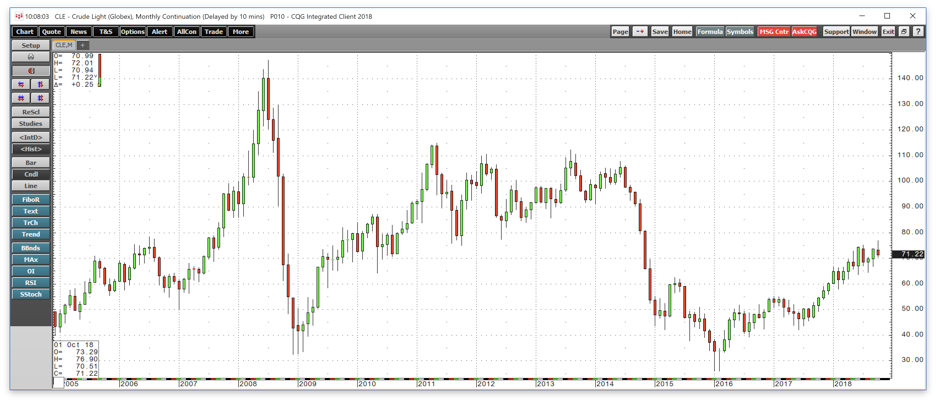
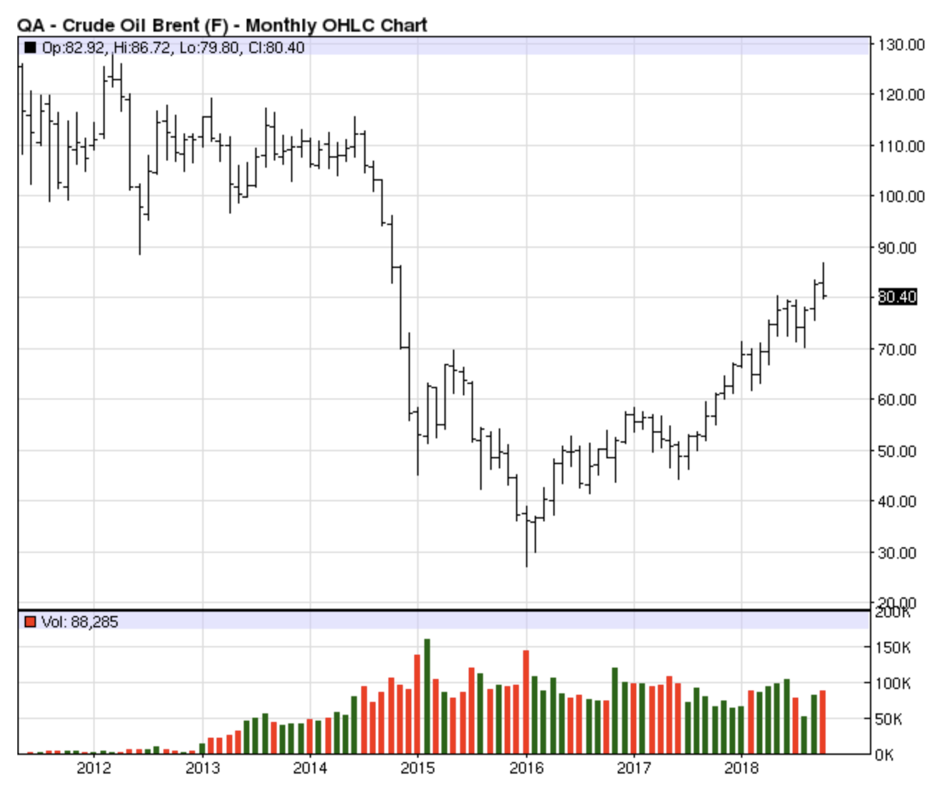
Over recent weeks, the prices of both crude oil futures market have risen to their highest levels since 2014.

Source: CQG
The monthly chart of NYMEX WTI crude oil futures highlights that the price rose to its highest level since June 2014 at $76.90 per barrel during the first week of October. The next level of technical resistance stands at $107.73 per barrel, $30.83 or 40% above the most recent peak.

Source: ICE/RMB
Meanwhile, Brent nearby futures traded to a high of $86.72 during the first week of October and resistance on the upside is at the June 2014 high at $115.69 per barrel, $28.97 or 33.4% above the most recent high.

Iran and Saudi Arabia remain at each other's throats

The Middle East has always been one of the most politically turbulent regions in the world. Over recent years, the rising tensions between the theocracy in Teheran and the Saudi Royal Family has resulted in hostilities across the region. The ongoing proxy war in Yemen has caused rockets to fly into Saudi sovereign territory. Meanwhile, the Saudi blockade of Qatar has been a direct strike at Iran's rising influence in the region.
The Saudis have U.S. support while Iran counts on Vladimir Putin and Russia as their allies. Therefore, the issues facing the region have taken on a geopolitical risk that threatens peace not only in the Middle East but around the world. The Saudis have been cheerleaders when it comes to President Trump's hard line towards Iran.

Sanctions take effect on November 4- The Strait of Hormuz is a flashpoint

The new and severe sanctions on Iran will take effect on November 4, and the U.S. has warned companies and countries around the world against doing any business with the theocracy. Iran exports 2.7 million barrels of crude oil to the world each day, and if President Trump has his way, they will not be able to sell that oil to consumers around the globe.
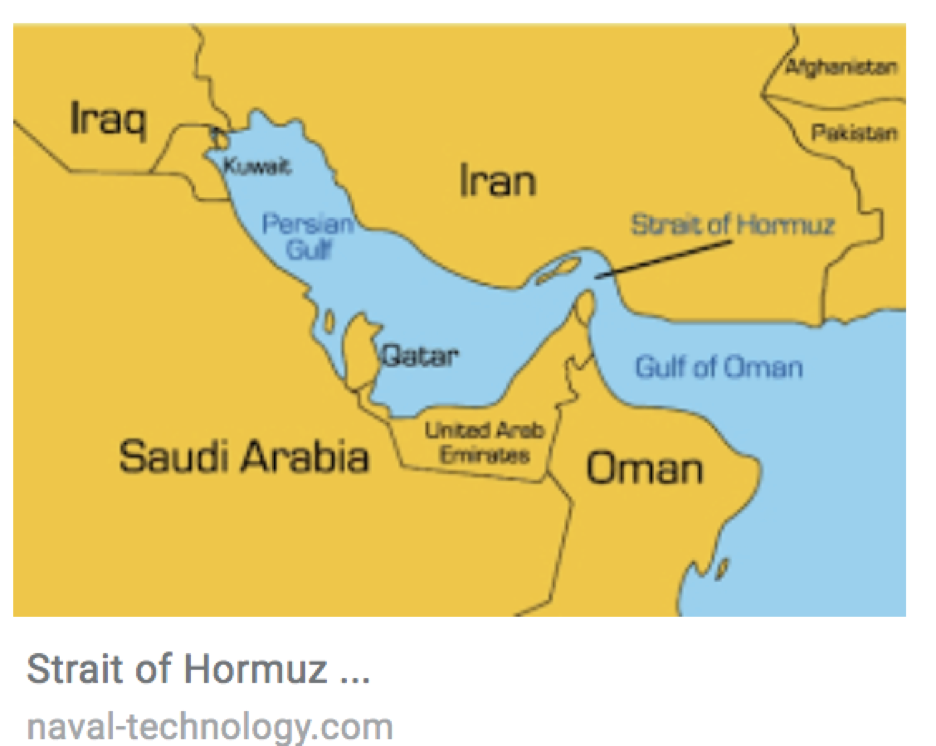
Iranian President Rouhani warned that if Iran cannot export its oil to destinations around the world, they will make sure that no other exporter in the region can supply the energy commodity to their customers. The 2.7 million barrels of Iranian crude oil flows through a narrow seaway that separates the Persian Gulf from the Gulf of Oman each day. The Strait of Hormuz is a passage that is twenty-one nautical miles long at its most narrow point.

As the chart shows, the Strait borders on Iran. Moreover, 19 million barrels of crude oil or 20% of the world's daily supplies flow through the seaway each day. Fellow OPEC members and producing countries in the Middle East including Iran, Iraq, Kuwait, Saudi Arabia, Qatar, the UAE, and Oman all are within striking distance of the Strait and most transport their exports through the passage. Therefore, any retaliation to U.S. sanctions could cause the Strait to become a tense and dangerous area in the coming days and weeks. Any hostilities that impact the production, refining or logistics of supplying crude oil to the world could cause the price to spike to the upside and challenge the 2014 highs above the $100 per barrel level. The last time we witnessed a price spike on military actions in the Middle East was in 1990 when Saddam Hussein marched into Kuwait. The price of crude oil doubled from $20 to $40 at that time. Almost all of the gains were in the nearby future contract as the supply concerns caused the backwardation to widen to a level that is nearly equal to the entire price of deferred futures contracts.

BNO is a bet on Iranian retaliation

If Iran decides to retaliate against sanctions, the most significant impact will likely hit the Brent futures contract because it is the pricing mechanism for oil from the Middle East. Additionally, the most significant price volatility could come in the front end of the forward curve and the active month futures contract on the Intercontinental Exchange. For those who do not trade or invest in the futures arena, the United States Brent Oil ETF product (BNO) offers an alternative. The fund summary for the ETF states:
The investment seeks the daily changes in percentage terms of its shares' per share net asset value ('NAV') to reflect the daily changes in percentage terms of the spot price of Brent crude oil. The Benchmark Futures Contract is the futures contract on Brent crude oil as traded on the Ice Futures Europe Exchange that is the near month contract to expire, except when the near month contract is within two weeks of expiration, in which case it will be measured by the futures contract that is the next month contract to expire.
BNO holds contracts on the nearby the Brent futures contract. Therefore, the ETF is highly correlated with the price action in the ICE Brent crude oil futures market in the front position futures contract.

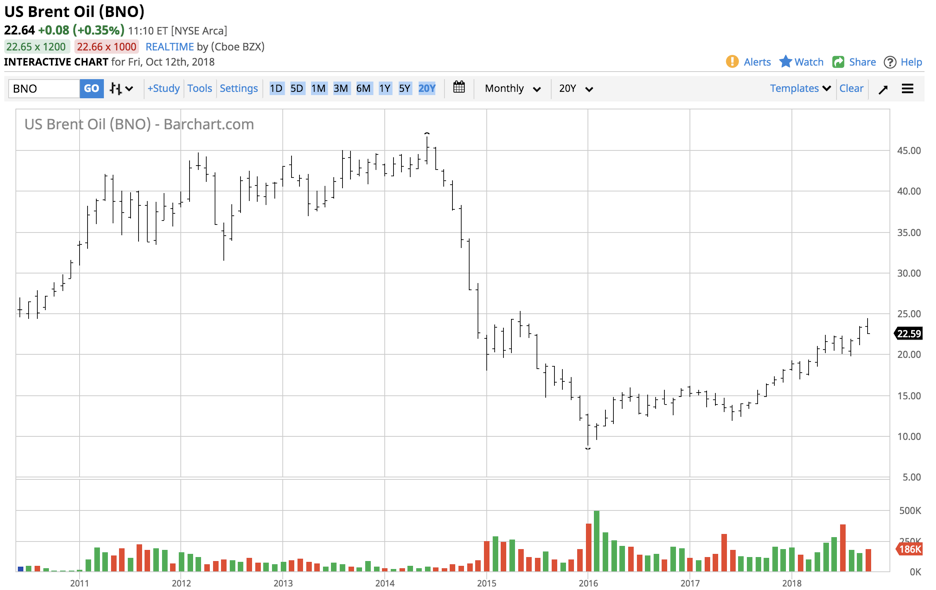
Source: Barchart
As the chart illustrates, BNO was trading at $22.64 per share on Friday, Oct. 12. In 2014, when Brent traded at over $115 per barrel, the ETF rose to a high of $46.68, over 100% higher than its current price level. A long position on the BNO ETF is a bet on Iranian retaliation to the sanctions that will begin to bite the theocracy in less than one month.
The Strait of Hormuz has the potential to become a flashpoint for Iranian retaliation if the OPEC member cannot sell their crude oil production to customers around the globe. While U.S. military power would undoubtedly prevent Iran from stopping traffic through the seaway, even a whiff of a threat of hostilities could prove explosive for the price of the energy commodity that powers the world.
This article is an expression of an opinion by Andrew Hecht

Monday, October 15, 2018

The Uranium Alternative Flying Under Investors' Radar

Nuclear

Most junior resource investors know uranium, and many got in on the action when NexGen Energy and Fission Uranium made their discoveries in the Athabasca Basin of Saskatchewan, the region with the highest grades of uranium in the world. Smart, or lucky, shareholders of NXE enjoyed a cumulative share price rise of around 430 percent between 2014 and 2016, while Fission Energy - famous for its Patterson Lake South property that yielded the open-pittable Triple R deposit - jumped from 91 cents in November 2013 to $1.62 a share in April 2014, for a gain of 78 percent.
Uranium is the fuel needed to create the nuclear reaction that can either create nuclear power or nuclear weapons. To make nuclear fuel from uranium ore, the uranium is first extracted from the rock, then enriched with the uranium-235 isotope, before being made into pellets that are loaded into assemblies of nuclear fuel rods. In a nuclear reactor, several hundred fuel assemblies containing thousands of small pellets of uranium oxide are in the reactor core. The nuclear chain reaction that creates energy starts when U-235 splits or “fissions”, which produces a lot of heat in a controlled environment.
In a conventional nuclear reactor, the pressurized water reactor, fuel rods containing uranium pellets are placed in water. Visualized as a giant kettle, the heat generated from the pellets boils water to create steam, which turns turbines to generate electricity. But the downside of conventional nuclear power stations is the nuclear reaction also produces plutonium, which is highly radioactive, and other wastes, causing a problem for disposal. Stronium-90 and cesium-137, contained in nuclear waste, have half-lives of about 30 years, but plutonium-239 takes 24,000 years to fully decay.
When it works well, the nuclear reaction is an efficient form of energy creation. One uranium pellet weighing just 6 grams is said to produce the same amount of energy as a tonne of coal. But it also leaves a lot of radioactive waste that needs to be incinerated, encased in concrete, or buried deep underground for centuries.
When nuclear power goes wrong, the fallout is catastrophic. Nuclear meltdowns like Chernobyl in Russia, Three Mile Island in the U.S., and Fukushima in Japan are burned into the collective consciousness and serve as constant reminders of the dangers of nuclear power that drive the anti-nuke movement.
While nuclear energy generation will never be without risks, proponents argue these are manageable and small compared to the risk of increased greenhouse gas emissions caused by the continued burning of fossil fuels for power, that are warming the planet. For this reason, nuclear is always in the mix of energies required to make the transformation from an oil-based economy to one where renewable and nuclear energies make up a larger proportion of our global electricity. The question is, must we keep using uranium in our nuclear power plants, or is there another option? There is. It’s uranium’s ugly stepsister, a little-known element known as thorium.
Some scientists believe thorium is key to developing a new version of cleaner, safer nuclear power. So why hasn’t thorium entered the popular and investor lexicon like uranium has? The silvery-white metal has a fascinating history, and despite taking a backseat to uranium as the primary nuclear fuel, it is making a comeback. This is the story of thorium, the wünder-fuel that wasn’t, but could be.
History
Thorium is named after Thor, the Norse god of thunder. It was first discovered in 1815 by Jöns Jakob Berzelius, a Swedish chemist, but a few years later it was determined that the mineral was actually yttrium phosphate. In 1828 Berzelius was given a sample of a black mineral found on an island off the coast of Norway by Hans Esmark, a Norwegian mineralogist. The mineral contained several known elements including lead, tin, iron, manganese and uranium, but 60 percent was an unknown substance that was subsequently named thorite. Thorium was first isolated by mixing thorium oxide with carbon, creating thorium chloride. When reacted with potassium, the result was thorium and potassium chloride, according to Chemicool. It took another 70 years for scientists to realize that thorium was radioactive. The discovery was made by Gerhard Schmidt, a German chemist, and Marie Cure, a Polish physicist, who are often credited with its discovery.
Thorium oxide (ThO2) has the highest melting point of all oxides (3300°C) so it’s not surprising that its early applications were in lantern mantles, arc-light lamps, welding electrodes and heat-resistant ceramics. Thorium oxide is also used in camera lenses and scientific instruments.
Abundance
Thorium is actually fairly common on Earth. According to Livescience it occurs in the Earth’s crust at 6 parts per million - about as much as lead and three times more abundant than uranium; it is the 41st most abundant element on Earth.
However it is thought to be rare because thorium is normally found as minor constituents of metals. Interestingly though, natural thorium occurs as almost pure 232Th, the most stable thorium isotope, which has a half-life comparable to the age of the universe (14 billion years), and whose radioactive decay is the largest contributor to the Earth’s internal heat. Right now it’s estimated the planet still has about 85 percent of the thorium present when the Earth was formed. Scientists at Los Alamos National Laboratory - where the first nuclear weapons were designed as part of the Manhattan Project - think that thorium was created in the cores of supernovae (the last stages of a star’s life), then scattered across the universe when the stars exploded.
Trace elements are found in rocks, soil, water, plants and animals, with higher concentrations contained within thorite, thorianite, monazite, allanite, and zircon. The element is mined mostly in Australia, Brazil and India. The rare earth mineral monazite contains between 6 and 12 percent thorium phosphate.
According to the World Nuclear Association (WNO) world monazite resources are estimated at around 16 million tonnes, 12MT of which are found in mineral sands deposits in India. A large vein deposit of thorium and rare earth elements is in Idaho. Recovering thorium from monazite involves leaching it with sodium hydroxide at 140°C followed by a process to precipitate pure ThO2. The WNO states that under 10,000 tonnes a year of monazite are extracted per year from India, Brazil, Vietnam and Malaysia, and “without commercial rare earth recovery, thorium production is not economic at present.”
Use in nuclear energy
The story gets really interesting when thorium was found to be radioactive - just two years after the discovery of uranium radioactivity by French physicist Henry Bequerel. Initially thorium’s radioactivity was thought to have health benefits, and was promoted as a cure for rheumatism, diabetes and even impotence. However in 1932 these uses were banned due to a federal investigation that found that people injected with thorium suffered from leukemia and abnormal chromosomes.
Attention then turned to the use of thorium in nuclear energy. During the Cold War the U.S. looked at using 232Th to create 233U - which was being investigated as both a reactor fuel and to build nuclear bombs. But the U.S. Military rejected a bomb built with 233U because it did not have “technical advantages” over uranium-plutonium bombs and especially since it it is difficult to produce pure 233U states a 1966 technical report.
Uranium’s chief advantage over thorium, as a nuclear fuel, was that it could be used to produce both atomic weapons and nuclear power, while thorium, unlike uranium, is not “fissile” – meaning it cannot be split to make a nuclear chain reaction – and could only be applied to nuclear power.
With the United States in the early stages of an arms race against the former Soviet Union to develop a nuclear arsenal, it was easy to see which element would win out. While thorium was used in a later version of America’s first civilian nuclear power plant - headed up by Hyman Rickover, the U.S. admiral responsible for creating the world’s first nuclear-powered submarine - it would take a back seat to uranium as the primary fuel for nuclear reactors.
Thorium nuclear reactors were developed at the Oak Ridge National Laboratory to support nuclear-powered long-range bombers, but the program was scrapped in 1961 in favor of other technologies according to a 2009 NASA paper. This is because the liquid fluoride thorium reactors did not produce as much plutonium, needed for developing nuclear weapons, as uranium-powered reactors.
Nonetheless, the first thorium-based nuclear reactor was built at the Indian Point Energy Center, New York, in 1962.
As mentioned thorium is not able to split an atom to produce the nuclear reaction; instead, when thorium is exposed to neutrons, it eventually emerges into the isotope U-233, which splits and releases energy. In this way thorium is said to be “fertile” rather than fissile. Recycled plutonium can also be used with thorium.
Uranium vs thorium
Other than the fact that uranium is better than thorium in building nuclear weapons, how do the two nuclear fuels stack up against one another? According to the Royal Society of Chemistry, thorium’s benefits include:
• Thorium is three to four times more abundant than uranium. There is estimated to be enough thorium on the planet to last 10,000 years.
• Thorium is more easily extracted than uranium.
• Liquid fluoride thorium reactors (LFTR) - a type of molten salt reactor - have very little waste compared with reactors powered by uranium.
• It is more efficient. One tonne of thorium delivers the same amount of energy as 250 tonnes of uranium.
• LFTRs run at atmospheric pressure instead of 150 to 160 times atmospheric pressure currently needed for water cooled reactors.
• Thorium is less radioactive than uranium.
The 2011 Fukushima disaster in Japan soured the world on nuclear, and started scientists looking more closely at thorium as a “greener” alternative. While conventional nuclear plants are only able to extract 3-5 percent of the energy in uranium fuel rods, in molten salt reactors favored by thorium proponents, nearly all the fuel is consumed. Where radioactive waste from uranium-based reactors lasts up to 10,000 years, residues from the thorium reaction will become inert within 500. Lastly, because plutonium is not created as a waste product in a thorium reactor, it cannot be separated from the waste and used to make nuclear weapons. Although, the World Nuclear Association points out that the United States made about two tonnes of U-233 during the Cold War and detonated a nuclear weapon containing U-233. The explosive yield though was less than expected, just 22 kilotons. In 1998 India detonated a small nuclear device from U-233.
As far as disadvantages, thorium takes extremely high temperatures to produce nuclear fuel (550 degrees higher than uranium dioxide), meaning thorium dioxide is expensive to make. Second, irradiated thorium is dangerously radioactive in the short-term. Detractors also say the thorium fuel cycle is less advanced than uranium-plutonium and could take decades to perfect; by that time, renewable energies could make the cost of thorium reactors cost-prohibitive. The International Nuclear Agency predicts that the thorium cycle won’t be commercially viable while uranium is still readily available.
Molten salt nuclear reactors
Molten salt reactors (MSRs) are well suited to thorium fuel, and while they were first conceived of in the 1940s, as noted above, to fuel aircraft, there has been a renewed interest in them. In the Liquid Fluoride Thorium Reactor (LFTR), the fuel is not cast into pellets like uranium, but is rather dissolved in a vat of liquid salt.
According to ZME Science, since molten salt reactor technology was revived in the 2000s, interest has grown quickly, with four companies in the US announcing plans for MSRs, as well as in Japan, Russia, France and China. In Norway, Thor Energy started producing power from thorium at its Halden test reactor in 2013, with help from Westinghouse. The third phase of a five-year thorium trial operation got underway in January.
India’s thorium program is well advanced. The country envisions meeting 30 percent of its electricity demands through thorium-based reactors by 2050. With large quantities of thorium and little uranium, India wants to use thorium for large-scale energy production. It plans to construct and commission a fleet of 500 sodium-cooled fast reactors - which burn spent uranium and plutonium - in order to breed plutonium to be used in its advanced heavy water reactors that employ thorium as the nuclear fuel. A prototype of the 500-megawatt fast breeder reactor (FBR) in Kalpakkam, India was supposed to be finished in late 2017 but has been put off to later this year.
One of the main advantages of MSRs is the reactor cannot melt down, as we saw in Fukushima when electric pumps were inundated by the tsunami, failing to cool the fuel rods, which overheated and caused radiation emissions. MSRs can also be made cheaper and smaller than conventional reactors, since they do not have large pressurized containment tanks, meaning they could be used in factory settings. MSRs use molten salt instead of water as a coolant, allowing them to reach temperatures over 80°C, three times hotter than a conventional nuclear plant cooled with water.
Another advantage is that nuclear waste (ie. plutonium) can be recycled to recover the fissile materials needed to create the nuclear reaction. In this way, thorium reactors not only generate less waste than conventional reactors, but also help to rectify the nuclear waste disposal problem.  
Work continues
Examples of companies and countries that are testing thorium’s viability as a nuclear fuel keep growing. Last summer a Dutch nuclear institute started experimenting with MSRs. NRG, the name of the facility, on the North Sea coast of the Netherlands, launched the Salt Irradiation Experiment in collaboration with the EU. New Scientist reports the researchers will use thorium as the nuclear fuel for the reactor where both the reactor fuel and the coolant are a mixture of molten salt. The experiment will also examine how to deal with the nuclear waste.
Indonesia, which has a large amount of thorium contained within monazite, signed an agreement three years ago with US company ThorCon Power, to develop molten salt reactors. A 1,000-megawatt thorium-based reactor would be used for base-load power and produce 5 gigawatts a year. The country wants around 20 percent of its energy mix to come from thorium molten salt reactors by 2050.
In the United States, the Department of Energy is partnering with TerraPower, Vanderbilt and the Oak Ridge National Lab, among others, to build a molten chloride fast reactor - a type of MSR - Oilprice.com reported. Southern Company in 2016 was the second firm to receive a grant from the DOE.
China, seemingly always on the leading edge of new energy, has put aside US$3.3 billion to build two molten salt reactors in the Gobi Desert, to be up and running by 2020, the South China Morning Post said in December. The reactors could spawn new uses for the radioactive element, including applications in warships and drones.
Conclusion
 If there hadn’t been an urgent need to develop nuclear weapons for the Cold War, there’s a reasonably good chance that thorium rather than uranium would have become the nuclear fuel of choice. The ability of uranium to kickstart the nuclear reaction makes it one of the most strategically important minerals on Earth. If the world was running out of uranium, thorium demand, and the technology to make molten salt reactors, would probably be much farther advanced than it currently is. But we are not running out of uranium. According to the World Nuclear Association (WNA), in 2017, world uranium production totalled 59,531 tonnes, which satisfied 92 percent of world demand. The top producers are Kazakhstan, Canada and Australia. Total known, recoverable uranium resources as of 2015 were 5.718 million tonnes.
Contrast this with thorium. The WNA states there are 6.555 million tonnes of thorium resources in the world - with most thorium held in India, Brazil and Australia/ the US (tied for third). That’s a bit more than total uranium resources. But how much thorium is mined? According to the USGS, in 2017, only 2.2 tons of thorium (mostly monazite) were imported into the United States; thorium compound exports were 83 tons. Obviously the tiny numbers are because there is currently no market for thorium. But if there was, there are around 6 million tonnes of resources waiting to be converted into reserves. Quite an opportunity for thorium explorers should molten salt reactors ever catch on enough to augment, let alone replace, conventional uranium-based reactors. The demand for thorium fuel, and its price, would skyrocket.
For now, thorium is a theoretical solution to our energy dilemma, but it could be much more than that. A concerted effort to develop thorium reactor technology could provide stable, clean, base-load power for millions, something that is not possible with renewables due to the intermittency factor (ie. power can only be generated when the sun shines and the wind blows) and the current early stages of renewable battery storage technology. It is safer and better for the environment than uranium, and can even use radioactive waste as feedstock for the nuclear reaction, thus killing two birds with one stone. The market isn’t yet ready for thorium, but when it is, a whole new mining sector and supply chain will be born.


Friday, October 12, 2018

Offering Inspiration and Advice, Real Vision Is HGTV for Hedge Fund Hopefuls

Kieran O’Dea rises at 5 a.m. to begin his daily routine, shuffling to his desk to eye his portfolio: a cluster of biotechnology stocks and a bet that Tesla will go bust.
Then he pulls up the latest video on Real Vision, the start-up financial video service that promotes the trading ideas and insights of hedge fund managers large and small. On this morning, the play is buying beaten-down Chinese stocks. He studies the clip carefully, as he has done with all 1,200 videos shown on Real Vision since it went live in June 2014.
Mr. O’Dea, 29, is the chief investment officer of Hedge Knight Capital, which manages mostly family money in the low seven figures. He is wearing swim shorts and a wrinkled T-shirt; his feet are bare and tan.
His office consists of an unmade bed, two computer screens and a stunning view of Long Island Sound. Mr. O’Dea may be master of his own hedge fund, but he could not be more disconnected from the Wall Street machine. No sell-side research clogs his inbox. He does not own a Bloomberg terminal. And there is no TV tuned to CNBC, the financial news hub ubiquitous on trading floors.
“I hardly watch it — and I don’t have access to any of that other stuff, either,” Mr. O’Dea said. “I get all my market access from Twitter and Real Vision.”
Real Vision offers a way to skip the traditional hedge fund path: slog away at an investment bank or a mutual fund, then settle down in Midtown Manhattan or Greenwich, Conn. For a modest fee, Real Vision will connect investors to a network of elite Wall Street analysts, traders and hedge fund managers, making it easier for novices like Mr. O’Dea to jump the line.
Raoul Pal, a former hedge fund executive who also worked at Goldman Sachs and runs an investment strategy service called Global Macro Investor, co-founded Real Vision. Since then, 20,000 people have signed up, paying $180 a year to hear directly from financial insiders.
It is a vibrant community with an average age of 38, which distinguishes it from CNBC and its more mature audience. Mixing the Netflix payment model with a cozy interview style, Real Vision offers to help upstart investors decode the mysteries of today’s markets. It features those insiders presenting their views in lengthy, explanatory videos: How to short China, the long-term opportunities in emerging markets and the best way to play Bitcoin, among others.
A nearly hourlong interview with the billionaire Mark Cuban is among the free videos on the site. And last week, Stanley F. Druckenmiller, an industry star, gave a long interview warning of a debt bubble in the market.
Real Vision also celebrates the hedge fund life — the outsize trades, houses and swagger — and tempts aspirants like Mr. O’Dea into thinking that they, too, might join the club.
It is a world that Mr. Pal, who earlier in his career pitched ideas to luminaries like Paul Tudor Jones and George Soros, knows well. He said he was motivated to start Real Vision after watching CNBC’s coverage of the financial crisis and thinking there was an opening for deep dives into finance’s most arcane areas.
“The media was too busy treating finance as entertainment and sound bites,” he said. “If you are going to cheerlead while this thing is going up, you have to warn them of the risks. It is a moral obligation.”
But there’s still an element of theater to Real Vision. Recently, Mr. Pal interviewed Michael Novogratz, a billionaire investor specializing in cryptocurrencies, in his office. During the discussion on the ups and downs of Bitcoin, Mr. Novogratz wore pink jeans that matched his sneakers and took a seat in front of an original leather jumpsuit worn by the motorcycle daredevil Evel Knievel, standing in a glass case under neon lights.
Mr. Pal had flown in from his home in the Cayman Islands, and he displayed an untucked shirt, sneakers without socks and a stubble beard. It could well have been a scene from “Billions,” the television show about the machinations and appetites of hedge fund titans.
“I used to think that these guys were gods,” Mr. O’Dea said. “But if you spend enough time watching them, you can figure out what they are up to.”
And if his formative experience was being a world-ranked video game player — in both World of Warcraft and Smite, he said — not a striving investment banker, so what? Mr. O’Dea watched the best gamers as he honed his craft once before. How hard could it be?
“It has been my total school — I mean, I had no idea what a bear market or a bull market was when I started,” Mr. O’Dea said. “It was like watching people play video games.”
Currently, 9,790 hedge funds are plying their trade, according to HFR, an industry tracker. With so many options, the pressure to perform has never been greater.
The last time hedge funds collectively beat the Standard & Poor’s 500-stock index was 2008. So far this year, Hedge Knight is up 37 percent Mr. O’Dea said, soundly beating the index’s 9 percent increase and thrashing the near-flat return the fund’s peer group has delivered.
Mr. O’Dea’s grandfather Leonard E. Baum was Hedge Knight’s main financial backer until his death. Propped up against Mr. O’Dea’s window is a faded photograph of Mr. Baum, a mathematician who put in place the trading framework that James H. Simons, the founder of Renaissance Technologies, employed to make his $84 billion Medallion Fund one of the world’s most successful hedge funds. Sitting in a lawn chair, Mr. Baum has his toddler grandson in a tight hug.
If his grandfather was Mr. O’Dea’s main source of capital, Real Vision is his source of inspiration.

Part of the service’s allure is the glimpse it gives of life in the bubble. One interviewee holds forth by his swimming pool in St. Barts; another contemplates his career while strolling through his cavernous horse barn.
Mr. O’Dea’s favorite video — one that he has watched countless times — marked Real Vision’s beginning in 2014: an hourlong interview with Mark Hart, a hedge fund manager in Dallas.
In the video, Mr. Hart wears his hair slicked back and spins tales of accumulating art, becoming an expert in Brazilian jujitsu and living in the moment — what he refers to as “chasing flow.”
“I wanted to be that guy,” Mr. O’Dea recalled.
He made a pilgrimage to Texas to meet Mr. Hart, and they bonded over biotechnology companies. Mr. O’Dea was curious about the science of disease: His grandfather suffered from cone-rod dystrophy, a condition that erodes vision, and his younger brother Brennan — the only other employee at Hedge Knight — is afflicted with over a half-dozen autoimmune illnesses. Brennan O’Dea spends nine months a year in a small cabin in Idaho, studying biology and scanning the market for cutting-edge companies. He has selected all 12 biotech stocks in Hedge Knight’s portfolio.
Real Vision has plenty of believers.
“I have been a subscriber since they were two months old,” said Chase Taylor, 35, an Air Force officer whose dream is to sell investment research to hedge funds.
He has not worked in the industry, nor did he go to business school. “I figured if these guys are doing it, I can too,” he said.
When Mr. Pal told subscribers in early 2017 that he was raising $7 million from outside investors, 1,700 offered to invest. He ultimately increased the sum to $10 million, and 50 subscribers became shareholders, although neither Mr. O’Dea nor Mr. Taylor is among them.
But Real Vision’s contributors can also promote some of Wall Street’s edgiest trades, like betting on volatility or loading up on emerging market bonds.
Take Mr. O’Dea’s fund: a dozen biotechnology stocks, some with values below $50 million, and a bet that Tesla goes bankrupt. It is a very risky portfolio, especially for a manager with such limited experience.
Real Vision is careful to present its strategies as trading ideas — not recommendations. At the end of each video, an employee warns investors to weigh their risk appetite before jumping in.
Ultimately, Mr. O’Dea’s contention that in finance — as with video games — you can ascend to an elite level by scrutinizing what the best players do remains unproven.
Which does not mean he won’t give it a shot.
“Now, I know what I am doing,” Mr. O’Dea said. “And guess what: I am a 29-year-old hedge fund manager.”

Thursday, October 11, 2018

Extreme poverty is growing rarer


HANS ROSLING, a Swedish academic who died in 2017, became famous for telling people that the world was faring better than they believed. One of his favourite examples was the rapid decline in extreme poverty. Sadly, just as Rosling’s elegant charts and YouTube talks drilled that story into people’s minds, the facts began to change.
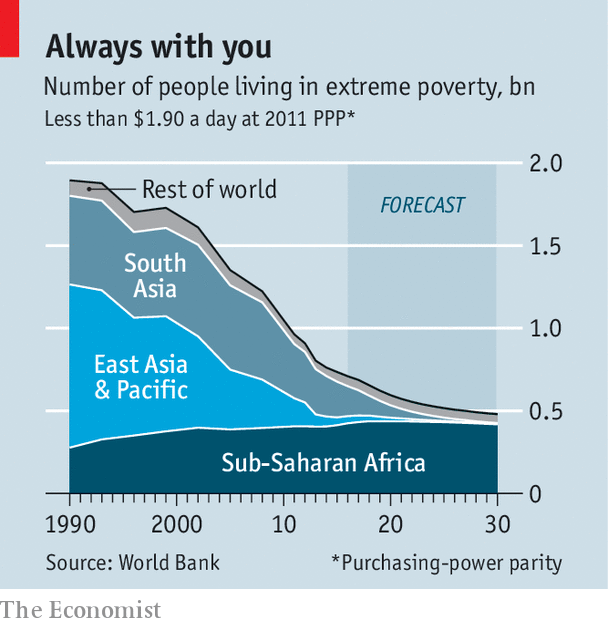
On September 19th the World Bank released estimates for extreme poverty in 2015, defined as living on less than $1.90 a day at 2011 purchasing-power parity. The good, Roslingish news is that poverty continued to diminish (see chart). In 2015 the extreme poor numbered 736m people, or 10% of the world. The Bank’s best guess for 2018 is 8.6%.
The bad news is that poverty is becoming harder to tackle. Over the past few decades, rapid economic growth and the expansion of welfare in Asia have borne down on extreme want there. That leaves sub-Saharan Africans as a growing majority of paupers. African poverty is especially intractable because of weak economies, high birth rates and the fact that many poor Africans are not even close to the $1.90 line. Between 2013 and 2015, the World Bank thinks, the poor population of sub-Saharan Africa grew from 405m to 413m. As a result, the global poverty rate is going down about half as quickly as before.


There is a broader lesson in that, says Laurence Chandy, director of data and research at UNICEF, the UN Children’s Fund. The world has been preoccupied with the task of pulling people out of extreme poverty. But there was always another challenge, which is becoming more pressing. How can entire populations be prevented from falling into it?The latest estimates contain another nasty surprise. In the Middle East and north Africa the number of deeply impoverished people appears to have almost doubled in two years, from 10m to 19m. Two war-torn countries, Syria and Yemen, explain this growth. It is hard to be certain, given the difficulty of collecting data. But the Middle Eastern jump hints at a broad change. Increasingly, extreme poverty is found in chaotic, ill-governed places. Figures on hunger released earlier this month suggest that it is growing in Venezuela.

Wednesday, October 10, 2018

A radical idea for reducing inequality deserves more attention

A social wealth fund could narrow the gap between the rich and the poor


RECENT decades have not been particularly good ones for those who toil on, rather than own, the means of production. Labour markets have made a slow and incomplete recovery from the trauma of the Great Recession. The crisis only briefly dislodged corporate profits as a share of GDP from historically high levels. Across much of the world, the share of national income flowing to labour has fallen over the past 40A social wealth fund could narrow the gap between the rich and the poor years.
Taxing the rich in order to fund spending on the poor is a straightforward solution to inequality. But the well-heeled are adept at squeezing through tax loopholes, and at marshalling the political clout needed to chip away at high tax rates. Those frustrated by enduring levels of inequality are contemplating ever bolder ways to redress the lopsided balance between owners and workers.
In an ideal world, untrammelled markets would ensure that every firm and every worker earned precisely what they deserved. But as economists since Adam Smith have recognised, markets are inevitably distorted by the unequal distribution of power. As Smith wrote: “People of the same trade seldom meet together, even for merriment and diversion, but the conversation ends in a conspiracy against the public.”
The socialists of the 19th century reckoned that the best way to check the power of capital was collective ownership. Experiments with state management of the economy in the 20th century made the shortcomings of such systems horribly clear. In practice they tend to be violently coercive, and their inability to take advantage of the distributed knowledge of markets often produces a grinding stagnation. (China may have so far avoided this outcome, but it has also signally failed to produce an equitable distribution of wealth.)
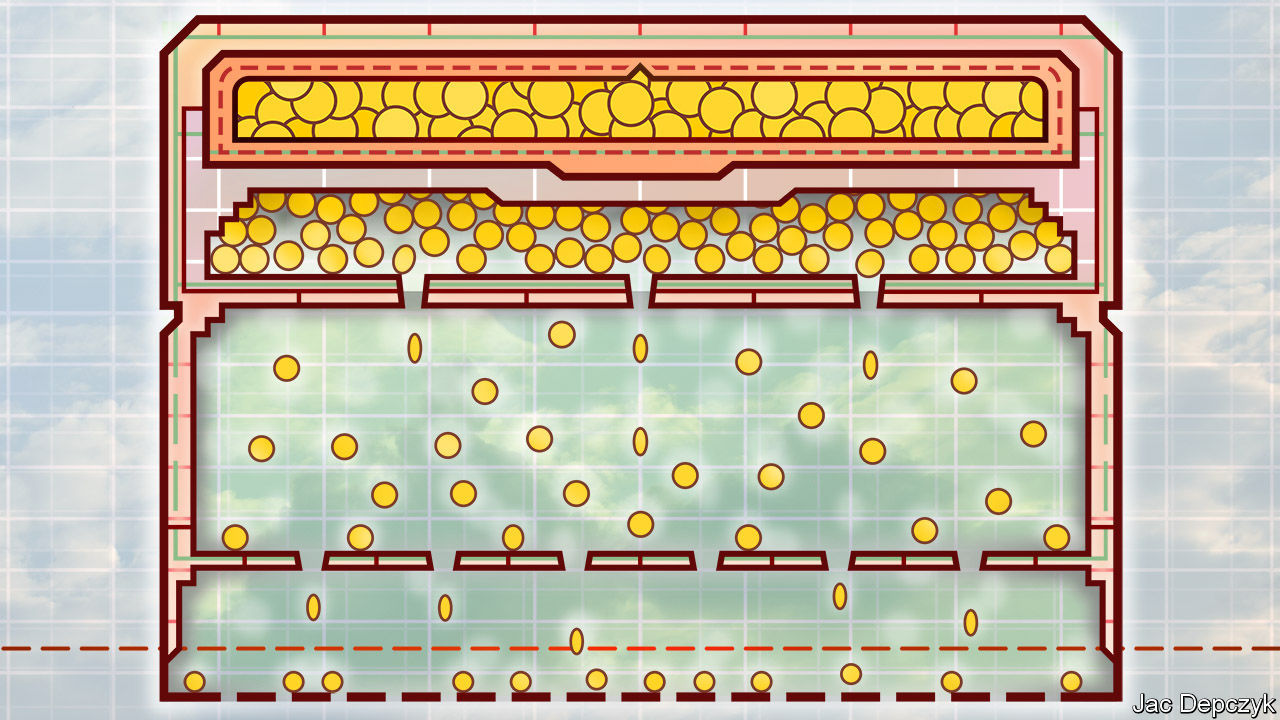
The market for ideas is, however, stocked with gentler, more practical leftism. Perhaps, for instance, the state could own a share of the economy’s assets on behalf of the population. In a recent paper Matt Bruenig, a left-leaning writer, argues for the creation of an American “social wealth fund”. The fund, he says, should accumulate stakes in equity, bond and property markets, and then disburse a share of its investment income each year as a “universal basic dividend”. Even in the most egalitarian decades of the past century, the richest 10% of the population owned the majority of the wealth. Money passes down the generations through gifts and bequests, but also through the extra educational and entrepreneurial opportunities it affords. A social dividend would counteract this entrenchment of advantage.
The proposal has a certain appeal. If funded through taxes on existing wealth—like property and bequests—such an entity could be a simple way to reduce the unfair opportunities afforded to the rich at birth. And there are workable examples already in operation. Alaska’s fund, financed with royalties from its oil industry, is worth 113% of its GDP. It is invested in a diversified portfolio that has yielded annual returns of nearly 10% over its lifetime. The fund’s dividend payments appear to reduce wealth inequality and poverty, without discouraging recipients from finding work. Norway’s government, through oil-funded sovereign wealth funds created to protect its generous social safety-net against future declines in oil revenues, controls nearly 60% of the country’s wealth. Yet the country has not turned into a grey socialist dystopia.
Complications could arise if such a fund operated at a scale proportionate to America’s economy and capital markets, however. The disciplining effect of the market might well be muted if the state accumulated stakes in most firms. Recent work by Martin Schmalz and others suggests that large-scale stock ownership by passive asset managers (like BlackRock and Vanguard), who often control sizeable stakes in many firms within an industry, is associated with less competitive behaviour by firm managers. Active ownership by the state might address that problem. But it could introduce others, such as greater scope for corruption.
More significantly, a social wealth fund raises difficult questions about the structure of the economy. It would create a conflict between workers’ interests as wage earners and their interests as recipients of dividends: more revenue flowing towards pay-cheques would mean less for profits. Left-leaning critics worry that a social wealth fund might undermine efforts to strengthen labour unions. A fund might, ironically, soften public attitudes towards capitalism’s more ruthless aspects. Working people could feel differently about lay-offs, offshoring and automation if their dividends stood to swell as a result. More worryingly, the public could become more accommodating of corporate behaviour designed to increase market power. Abuses by monopolistic tech firms might prove harder to rein in when they contribute to soaring profits—and to dividends for all.
Own goals
Other ideas for empowering workers attract similar criticisms. Stronger unions would have every incentive to bargain down capital’s share of companies’ profits, but very little incentive to support competition-boosting reforms that might undermine the stability of those profits. Offering labour representatives seats on company boards, a policy supported by Elizabeth Warren, a senator from Massachusetts, seems likely to improve workers’ fortunes. But it might also make them complicit in preserving revenues at all costs, the better to plump up worker wages.
None of the more radical proposals to tackle inequality are riskless, in other words. But a social wealth fund that turns workers into owners of, rather than antagonists to, capital might appeal to workers without alienating powerful business interests. And if such a fund were to cultivate a sense of economic solidarity, it might well encourage other steps towards a more equitable society. Don’t dismiss the idea.