About Me

My photo
An Investor and counsellor in Financial Market

Monday, April 22, 2019

Gold & Basel 3: A Revolution That Once Again No One Noticed

Real revolutions are taking place not on squares, but in the quiet of offices, and that’s why nobody noticed the world revolution that took place on March 29th 2019. Only a small wave passed across the periphery of the information field, and the momentum faded away because the situation was described in terms unclear to the masses.
No “Freedom, equality, brotherhood”, “Motherland or death”, or “Power to Councils, peace to the people, bread to the hungry, factories to the worker, and land to the farmers” – none of these masterpieces of world populism were used. And that’s why what happened was understood in Russia by only a few people. And they made such comments that the masses either did not fully listen to them or did not read up to the end. Or they did listen to the end, but didn’t understand anything.
But they should’ve, because the world changed so cardinally that it is indeed time for Nathan Rothschild, having crumpled a hat in his hand, to climb onto an armoured Rolls-Royce [a joke referencing what Lenin did – ed], and to shout from on top of it to all the Universe: “Comrades! The world revolution, the need for which revolutionaries spoke about for a long time, came true!” [paraphrasing what Lenin said – ed] And he would be completely right. It’s just that the results of the revolution will be implemented slowly, and that’s why they are imperceptible for the population. But the effects, nevertheless, will be soon seen by absolutely everyone, up to the last cook who even doesn’t seek to learn to govern the state soon.
This revolution is called “Basel III”, and it was made by the Bank for International Settlements (BIS). Its essence is in the following: BIS runs the IMF, and this, in turn, runs the central banks of all countries. The body of such control is called BCBS – the Basel Committee on Banking Supervision. It isn’t just some worthless US State Department or Congress of American senators. It’s not a stupid Pentagon, a little Department of the Treasury, which runs around like the CIA’s servant on standby, or a house of collective farmers with the name “White House”.
This isn’t even the banks of the US Federal Reserve, which govern all of this “wealth”. This is a Government of all of them combined. That real world Government that people in the world try not to speak about aloud.
BCBS is the Politburo of the world, whose Secretary General, according to rumours, is comrade Baruch, and the underground structure of the Central Committee is even more secret. It has many euphemisms, the most adequate of which is “Zurich gnomes”. This is what Swiss bankers are called. Not even owners of commercial banks, but namely those ordinary-looking men sitting in the Swiss city of Basel who Hitler – who tried to attach the whole world to the Third Reich, and who preserved neutrality with Switzerland during all the war – didn’t dare to attack. And, as is known, in Switzerland, besides Swiss rifleman, in reality there isn’t even an army. So who was the frenzied Fuhrer afraid of?
Nevertheless, the “recommendations” that were made by BCBS on March 29th 2019 were immediately, at the snap of the fingers, accepted for execution by all the central banks of the world. And our Russian Central Bank is not an exception. There is even the statement of the press service of the Central Bank of the Russian Federation posted on the official website of the Central Bank. It is called “Concerning the terms of implementation of Basel III”. The planned world revolution was in 2017 (magic of dates and digits or just a coincidence [a reference to 1917 – ed]?), but it has started only now.
Its essence is simple.
In the world the system of exclusive dollar domination established in 1944 in Bretton Woods and reformed in 1976 in Jamaica, where gold's equivalency to money was cancelled. The dollar became world money and gold became an ordinary exchange good, like metal or sugar traded in London on commodity exchanges.However, this was determined there by only three firms of the “Pool of London” that belong to an even smaller number of owners, but, nevertheless, it’s not gold, but oil that became the dollar filler.
We have lived in such a world ever since. Gold was considered as a reserve of the third category for all banks, from central to commercial ones, where the reserves were, first of all, in dollars and bonds of the US. The norms of Basel III demand an increase, first of all, in monetary reserves. This impeded the volumes of monetary resources of banks that could be used to carry out expansion, but it was a compulsory measure for saving the stability of a world banking system that showed to be insufficient in a crisis.
In Russia pseudo-patriots were very much indignant at this, demanding to reject Basel III, which they called a sign of “a lack of sovereignty”. In reality, this is a quite normal demand to observe international standards of bank security, which were becoming more rigid, but since we [Russians – ed] were not printing dollars, so of course it had an impact on us. And since the alternative is an exit from world financial communications into full isolation, so our authorities, of course, did not want to accept such nonsense that was even designated by pseudo-patriots as a “lack of sovereignty”. To call sovereignty – freedom, to put your head in the noose is, let’s agree, a strange interpretation of the term.
The Basel III decision meant that gold as a reserve of the third category was earlier estimated at 50% of its value on the balance sheets of world banks. At the same time, all owners of world money traded in gold not physically, but on paper, without the movement of real metal, the volume of which in the world wasn’t enough for real transactions. This was done in order to push down the price of gold, to keep it as low as possible. First of all, for the benefit of the dollar. After all, the dollar is tied to oil, which had to cost no less than the price of one gram of gold per barrel.
And now it was decided to place gold not in the third, but “just” in the first category. And it means that now it is possible to evaluate it not at 50, but at 100% of its value. This leads to the revaluation of the balance sheet total. And concerning Russia, it means that now we can quietly, on all legal grounds, pour nearly 3 trillion rubles into the economy. If to be precise, it is 2.95 trillion rubles or $45 billion at the exchange rate in addition to the current balance sheet total. The Central Bank of the Russian Federation can pour this money into our economy on all legal grounds. How it will happen in reality isn’t yet known. Haste here without calculating all the consequences is very dangerous. Although this emission is considered as noninflationary, actually everything is much more complicated.
During the next few months nothing will change in the world. The U-turn will be very slow. In the US the gold reserves officially total 8133.5 tons, but there is such a thing as a financial multiplier: for every gold dollar, the banks print 20-30 digital paper ones. I.e., the US can only officially receive $170 billion in addition, but taking into account the multiplier – $4.5 trillion. This explains why the Federal Reserve System holds back on increasing interests rates and so far maintains the course towards lowering the balance sheet total – they are cautious of a surge in hyperinflation.
But all the largest states and holders of gold will now revalue their gold and foreign exchange reserves: Germany, Italy, France, Russia, China, and Switzerland – countries where the gold reserves exceed 1,000 tons. Notice that there is no mumpish Britain in this list. Its reserves are less than 1000 tons. Experts suspect that it is perhaps not a coincidence that the dates of Brexit and the date of Basel III coincide. The increased financial power of the leaders of Europe – Germany and France – is capable of completely concluding the dismantlement of Britain on the European continent. It was necessary to get out as soon as possible.
Thus, it seems that it is possible to congratulate us – the dollar era lasting from 1944 to 2019 has ended. Now gold is restored in its rights and is not an exchange metal, but world money on an equal basis with the dollar, euro, and British pound. Now gold will start to rise in price, and its price will rise from $1200-1400 per troy ounce up to $1800-2000 by this autumn. Now it is clear why Russia and China during all these years so persistently decanted its export income into the growth of gold reserves. There is now such a situation where nobody in the world will sell gold.
Injections of extra money will suffice for the world economy for 5-6 months. In the US this money can be used to pay off the astronomical debt. Perhaps this wasn’t Zurich’s last motive for making such a decision. But after all, the most important thing is an attempt to slip out from under the Tower of Pisa that is the falling dollar.
Since the dollar and oil are connected, the growth of the price of gold will directly affect the growth of the price of oil. Now a barrel costs as much as 1.627 grams of gold. A price growth will cause the world economy – where 85% of the money dollar supply turns into stock surrogates like shares, bonds, and treasuries – to cave in. The stock exchange will not be able to bundle together such an additional mass of money any more.
It will be good for oil industry workers – even, perhaps, best of all, but not for long. The economical crash because of expensive oil will become a crash for all oil industry workers too. It is precisely this that is the main reason why our rights for additional emissions can remain unused in full volume, although a gift in such a form will not be completely ignored. The May 'Decrees of Putin' in the current context are being understood completely differently. Russia runs away from the oil-based economic model in all ways. Including by political reforms and changing the elites.
However, why is the decision of Basel a revolution?
Because from the autumn the financial flood in the world economy will begin. It will entail the acceleration of Russia and China’s isolation from the dollar system and the crash of the economies that completely depend on the dollar – the vassal countries of the US. It will be worst of all for them. And this means that the reasons for increased distancing between the EU and the US will increase in number manyfold.
A redrawing of the map of global unions awaits the world.
And the redrawing of these unions will be carried out not least by military methods. Or with their partial use, but in one way or another, reasoning involving force in the world will increase almost to the level of guaranteed war. “Almost” is our hope for rescue, because the US loses all main instruments of influence on this world. Except force.
But it’s not for this purpose that the “Zurich gnomes” created this world, so that the US is so simply turned into radioactive ashes. The US will be drenched with cold water like a broken down nuclear reactor, while the world has entered the zone of the most global transformations over the past few centuries. The revolution that so many waited for, were afraid of, and spoke so much about has started. Buckle up and don’t smoke, the captain and crew wish you a pleasant flight.

Friday, April 19, 2019

Strange saga of Amartya Sen and the Rothschilds

Rothschilds & Co funds units of ‘civil society’ in India that control narrative on ‘human rights violations’.

Amartya Sen has become hyperactive in attacking policies that benefit the people of India, but one fact he has been shy of disclosing during his attacks is his apparent conflict of interest by virtue of marrying Emma Rothschild, one of the heiresses of the world’s wealthiest family. The family have made money off India and the Indian government. The assets of the Rothschilds are estimated to be worth at least US$400 billion and the family has a reputation of enriching itself by finding opportunity even on growing misery around the world. The Rothschild family has a history of manipulating stock markets, funding world wars, engineering large scale decisions in their favour, exercising significant control over the banking system, and owning large media outlets to influence public opinion in their favour. Amartya Sen, of course, is the apostle of poverty.
The family business of Amartya Sen’s family on wife’s side, NM Rothschild & Sons, is seen as having made tremendous amounts of money during the United Progressive Alliance regime between 2004 and 2014, even as Sen’s blue-eyed-boy, Jean Dreze was a key member of Sonia Gandhi’s National Advisory Council. The connection between Amartya Sen and his family’s business is not merely a tenuous one. On the contrary, Sen’s father-in-law himself, Nathaniel Mayer Victor Rothschild, 3rd Baron Rothschild, was part of the management of NM Rothschild & Sons. Victor’s cousin, Lynn Forester de Rothschild, owns a significant stake in the Economist magazine, which explains the magazine’s constant barbs against the Hindu community even as they support Sonia Gandhi and prop up Amartya Sen’s economic ideas.
One deal that is regarded as benefiting NM Rothschild & Sons during the UPA rule involves the e-auction of 3G spectrum. The firm had been chosen to conduct the e-auction even though they had never been known as a computer software firm. The firm pocketed Rs 30.5 crore for conducting the auction and this must be considered as a gift by the UPA government. It is not clear why there was a need for an e-auction when there were only a handful of participants in the bidding process. The most questionable aspect of this whole episode was that the Rothschilds were not a neutral third party, but had been retained by Aircel, which was looking for a buyer for their towers that were eventually sold for $1.8 billion. Of course, none of this has been probed even after 2014.
Today, several firms that involved NM Rothschild & Sons to swing deals during the UPA era are embroiled in financial scams. Apart from Aircel, which is caught up in the Aircel-Maxis scam, NM Rothschild was also involved in Vedanta’s purchase of Cairn India, Kingfisher Airlines taking over Air Deccan, and the promoters of Venkateswara Hatcheries acquiring the English Premier League football club, Blackburn Rovers. Each of these firms has come under the scanner of the authorities. Venkateswara Hatcheries was raided by the income tax sleuths after suspicions about transactions related to movements of huge amounts of cash in the wake of demonetisation. For this reason, Amartya Sen’s criticism of demonetisation may contain more than meets the eye.
A few months ago, it was determined that Rothschild Bank AG and one of its subsidiaries may have violated money laundering rules in the multi-billion-dollar 1MDB corruption case in Malaysia. This background of Rothschild Bank is combined with the fact that mergers and acquisitions, especially those spanning multiple international jurisdictions, readily lend themselves to allegations of being vehicles for money laundering through arbitrary valuation of the firm being acquired. As a definitive conclusion cannot be reached without a comprehensive inquiry, there is a need to investigate NM Rothschild activities in India and determine whether the unusually high rate of scams among their clientele is a coincidence.
The Rothschilds have been active in a number of sectors in India including infrastructure, financial advisory, healthcare, and food processing, and when one Rothschild firm sold its share in a joint venture to Del Monte Pacific, Lynn Forester de Rothschild, CEO of EL Rothschild said, “We are delighted to have brought this company to a point where it has attracted large international players like Del Monte Pacific. This is a positive way for us to participate in the explosive economic growth of India.” Amartya Sen has not extended the same consideration towards the poorer people of India who would also want to participate in the “explosive economic growth of India”. Instead, he has ranted and raved against policies that would allow Indians to participate in their own economy, and along with his protégés in the National Advisory Council of the UPA government, he has ensured that Indians would only qualify as recipients of small amounts of money thrown at them as part of welfare schemes wrapped in the name of “Mahatma Gandhi”, while being prevented from actively participating as productive members of the economy and competing against his family on wife’s side, the Rothschilds.
Amartya Sen’s recent salvos on India include demands of non-interference in what he calls the “civil society”, which really translates to foreign and foreign-funded non-governmental organisations that actively interfere in Indian politics. He asks for complete freedom for the Reserve Bank of India with no oversight by the Indian people or their democratically elected representatives even as those who control the RBI take instructions from the International Monetary Fund and the World Bank. These demands may reflect his family’s priorities, as the proposal for setting up the RBI first arose during the hearings before the Indian Currency Committee in 1898 and 1899 from two members of the Rothschild clan—Alfred de Rothschild and his brother Nathan Mayer Rothschild, 1st Baron Rothschild. Both Rothschilds wanted RBI to be controlled from the West, with no oversight from the Delhi government, exactly as Amartya Sen now demands. Indian freedom fighters saw through this game of the British and defeated their efforts to create the Reserve Bank in the 1920s. The Rothschilds’ business in India goes back to a much earlier period. As far back as 1814, Nathan Mayer Rothschild, the grandfather of the two Rothschilds who provided inputs to the Currency Committee, was not only a voting member of the United Company of Merchants of England, Trading to the East Indies (also known as the East India Company), but was also among the few people eligible to be chosen as its director.
Today, Rothschild & Co funds units of the so-called “civil society” in India that control the narrative on what constitutes “human rights violations”. (Hint: Anything Hindus do is a violation of human rights unless it benefits those who wield power in America and Europe.) One organisation it funds is Prerana, which lists Asha for Education as a partner on its website. In 2002, the founder of Asha for Education, Sandeep Pandey, attended the party congress of the Naxalite group Communist Party of India (Marxist-Leninist)-Liberation and called for the unity of “revolutionary” organisations. CPI(ML)-L openly advocates an “armed revolution” and its stated objectives include the use of “illegal” methods and raising an army to wage a war against India. At their 2002 meeting, the party also honoured “comrade martyrs” or terrorists killed in action.
Like Amartya Sen, some in the UPA were aligned with the group friendly to the Naxalites and had Naxalite supporters on Sonia Gandhi’s National Advisory Council. It is fitting that the government which was based on Amartya Sen’s economic policies ended up with the same track record as his family business—a trail of deals that enriched the wealthiest people in the world at the cost of the poorer people in the country

Thursday, April 18, 2019

The Fed's Body Count Rises

“The problem with the war (Vietnam), as it often is, are the metrics. It is a situation where if you can’t count what’s important, you make what you can count important. So, in this particular case what you could count was dead enemy bodies.” – James Willbanks, Army Advisor, General of the Army George C. Marshall Chair of Military History for the Command and General Staff College
“If body count is the measure of success, then there’s a tendency to count every enemy body as a soldier. There’s a tendency to want to pile up dead bodies and perhaps to use less discriminate firepower than you otherwise might in order to achieve the result that you’re charged with trying to obtain.” – Lieutenant Colonel Robert Gard, Army and military assistant to Secretary of Defense Robert McNamara

Verbal Jenga

In recent press conferences, speeches, and testimony to Congress, Federal Reserve (Fed) Chairman Jerome Powell emphasized the Fed’s plan to be “patient” regarding further adjustments to interest rates. He also implied it is likely the Fed’s balance sheet reductions (QT) will be halted by the end of the year.
The support for this sudden shift in policy is obtuse considering his continuing glowing reports about the U.S. economy. For example, the labor market is “strong with the unemployment rate near historic lows and with strong wage gains. Inflation remains near our 2% goal. We continue to expect the American economy will grow at a solid pace in 2019…” The caveats, according to Powell, are that “growth has slowed in some major foreign economies” and “there is elevated uncertainty around several unresolved government policy issues including Brexit, ongoing trade negotiations and the effect from the partial government shutdown.”
Powell’s juggling of monetary policy and economic projections is a form of verbal Jenga with the blocks delicately stacked. Powell hopes to avoid saying anything to disrupt the structure without regard for veracity. To read more on our perception of his authenticity, read our latest article: Jerome Powell on 60 Minutes: Fact Check.
Jerome Powell’s policy rationale and politics is not entirely logical. Does it make sense to manage U.S. monetary policy to the self-inflicted BREXIT risks associated with the U.K., a country with a productive output about one-tenth that of the United States? Or with concerns about growth in China, which has never produced reliable public economic data? Or the residual effects of the U.S. government shutdown, which had an impact of less than 0.1% of GDP?
The Fed’s mandate, as legislated by Congress, is to manage the economy to full employment and stable inflation. Nothing about Powell’s recent comments justify policy change based on those guidelines. The change in policy is primarily speculative conjecture. It was also speculative conjecture that was behind Bernanke’s speech in January of 2008, where he confidently stated that a recession was not in the cards and his earlier comments that a national housing recession was implausible.

Mandates that Matter

What if the Fed had goals that really mattered like productivity and prosperity metrics that offer a genuine gauge of the health of the nation? What if they focused on the long-term cause and effect of their actions as opposed to becoming the day-traders they are, with a focus predominately on the markets and the wealthy?
The tiny world the Fed currently occupies is hyper-focused on “inflation” (which they cannot measure), unemployment (which is backward looking) and “financial stability” which is a catch-all for rationalizing whatever they choose to do at any given moment, namely propping up the stock market. These are undefinable goals which allow the Fed to move the goalposts as frequently as necessary to accommodate whichever constituent is least satisfied at the moment (President Trump, the stock market, the banks, etc.).
Markets and economies, like nature itself, are beholden to a cycle, and part of the cycle involves a cleansing that allows for healthy growth in the future. Does it really make sense to prop up dead “trees” in the economy rather than allow them to fall and be used as a resource making way for new growth?

The Fed’s War

The Fed’s version of economic assessment is like the metrics used to justify military action in Vietnam. Footage of Huey helicopters lifting nets full of dead “enemy soldiers” supported the optics of an American military campaign making progress in the war against Soviet-style communism. The “kill ratio”, calculated as the ratio of dead “gooks” divided by the number of dead American boys, was an important measure of success (The highly offensive term “gooks” was an all-encompassing, common slang term used by U.S. military forces to make soldiers think of all Vietnamese as sub-human and therefore easier to kill men, women, and children). 
The problem was that the government and military manufactured numbers that made it look as though they were making progress in the war. They did not actually “manufacture” numbers so much as improperly include dead Vietnamese civilians in with the count of actual North Vietnamese soldiers and Viet Cong militia. These metrics were a guise for a true measure of success or failure. Need more enemy dead to boost the kill ratio? Use less discriminating firepower to get a broader sweep of destruction to boost the number.
The Fed, however, cannot even pretend to count what is important – productivity and inflation – so they make it up as they go along. They use pieces of economic data that tell whatever tale they need to retain the confidence of leadership, banks, and citizens. They give speeches, hold press conferences and even go on 60 Minutes to advance the spin. It is the current-day equivalent of “counting corpses” to get the numbers needed.
As with the Vietnam War, the game-theory of monetary policy being applied today is intended to obfuscate and demoralize those who argue against it. Unlike Vietnam, however, where body count became the important metric, the Fed concocts metrics and analysis such as r-star, fabricated inflation statistics, and questionable labor composites.
They have, as firepower, the support of the established government, which depends on the Fed to serve its complicit role in support of government spending and rampant national debt accumulation. As the graph below reflects, the trajectory of U.S debt outstanding is the pure mathematical definition of a parabolic curve. Having greatly reduced any possibility of true organic growth, debt has become the backbone of economic growth.
Data: Flow of Funds – Domestic Non-financial
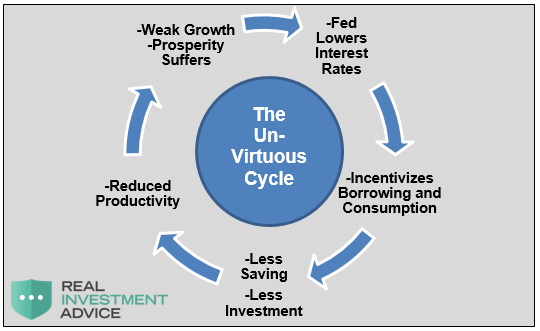
In coordination with the U.S. Treasury Department, the Fed acts in a manner that incentivizes the very behavior they should discourage. The Fed punishes savers by manufacturing lower interest rates to spur consumer and corporate borrowing and spending at a time when both are heavily burdened by existing debt. As a result, savings are diminished and investment suffers. When investment is reduced, productivity, the main source of economic dynamism and advancing standards of living, suffers.
Fed policy advances debt-driven consumption and spending before savings and investment, which puts the economic cart before the horse. Eventually, as we are now seeing, this destructive cycle causes prosperity to deteriorate. Citizens become fed up with the establishment rule and begin to elect radical politicians with radical ideas about how to fix the system.

Reactionaries

The Fed has shown themselves to be more worried about the stock market than the long-term well-being of the populace. Unlike Paul Volcker, who took on enormous career risk in his handling of monetary policy in the late 1970s and early 1980s, it appears there is no one with a similar level of character or integrity at the Fed today. There is no one willing to sacrifice in the short run for the long run health of the nation. Volcker was, at the time, vilified for making difficult and painful decisions in his time at the helm of the Fed, but ultimately, he set the stage for one of the greatest periods of growth and innovation in American history. Today, the Fed is held hostage by the fluctuations of the stock market and the protestations of the President.
“We would do better if we would show ourselves a little more relaxed and less terrified of what happens in… certainly the smaller countries of Asia and Africa, and not jump around like an elephant frightened by a mouse every time these things occur. This is not only not our business, but I don’t think we can do it successfully… I have a fear that our whole thinking about this problem is still affected by some sort of illusions about invincibility on our part.” – George Kennan
George Kennan was an academic who advanced the U.S. policy of pacification during the first 20 years of the cold war. His doctrines were frequently misused in the justification of U.S. foreign policy in Southeast Asia in the 1950s and 1960s. As troop buildup in Vietnam continued in the mid-1960s, Kennan was called to testify before Congress. Despite his warnings of an unwinnable war, politicians seeking re-election could not bring such a message to the American public. Better to sacrifice the lives of less-privileged 19-year-old boys than admit a flaw in the U.S. foreign and the military policy machine. Besides that, building bombs to be blown up in a foreign country boosted economic output even though there was nothing productive or beneficial about it.
Today, Kennan’s comments can easily be mapped to the proclivity of central bankers’ actions and the stock market “mouse.”

Complex System

The United States economy is an extremely complex and dynamic system. Trying to measure the level and pace of economic growth, employment, inflation, and productivity are very difficult, if not impossible tasks. The various government and private agencies bearing the responsibility for such measurement do their best in what must be acknowledged as a highly imperfect effort. Initial readings are always revised, sometimes heavily, especially at key turning points in the economy.
Of greater concern, we are led to assume the methodology used to assess the quality of economic growth is not only proper but precise. However, one glance at the components of GDP shows the inclusion of activities that are questionable and excludes other things that clearly should be included. As a result, economic policy-making focuses on those things which are measured according to their preferences without regard for accuracy or importance. Emphasis is placed on “body count” without proper discernment. For more on this read our article The Fallacy of Macroeconomics.

Summary

In the Vietnam War, General William Westmoreland maintained a strategic emphasis on attacking North Vietnamese troops which supported the Viet Cong guerillas in South Vietnam. Westmoreland referred to something he called “the crossover point.” This was defined as the point at which U.S. military forces were killing more of the North Vietnamese enemy troops than could be replaced. It was truly a strategy of attrition. As a result of this concept, as discussed above, what became important as a grisly gauge of success was “body count.” Since body count was all that mattered, everyone became an enemy soldier whether innocent civilian or North Vietnamese military officer.
You don’t get details with a body count. You get numbers. And the numbers are lies, most of them. If body count is your success mark, then you are pushing otherwise honorable men to become liars. – Joe Galloway, News Correspondent, and Journalist
In the same way that Westmoreland’s approach to executing the Vietnam War failed to produce results, served as a false justification for actions taken, and cost countless young American and Vietnamese lives, the U.S. government and the Fed are engaged in misreading the optics of a series of measures in the economy to justify their actions as evidenced by the following:
  1. Fed policy is influenced by the constituents of the Central Bank which includes the federal government, major global banking institutions, and the wealthiest 1%
  2. U.S. interest rates, the global benchmark for the price of money, are manipulated by Fed policy
  3. Stock market valuations are heavily influenced by manipulated interest rates and currencies
  4. Stock market prices are manipulated higher by share buybacks facilitated by low-interest rates
  5. The federal government, through advocacy of the Securities Exchange Commission’s (SEC) share buyback Rule 10b-18, endorses stock price manipulation policies
“We tend to fight the next war in the same way we fought the last one. We are prisoners of our own experience. It was a kind of oversimplification of the problem combined with our overconfidence that caused us, I think, to be arrogant. And it’s very, very difficult to dispel ignorance if you retain arrogance.” – Lieutenant General Sam Wilson, Army
Federal Reserve actions and the Vietnam War are worlds apart, but the thinking in the mind of the bureaucrat is very similar. Misleading tactics are often used as a tool for those that need to justify something that makes little to no sense and violates moral code.

Wednesday, April 17, 2019

The World’s Cheapest Hospital Has to Get Even Cheaper

Cancer surgery for $700, a heart bypass for $2,000. Pretty good, but under India’s new health-care system, it’s not good enough.

It was only after a junior surgeon opened the patient’s chest, splitting his sternum with a quick buzz from a handsaw and cranking a savage-looking retractor to pin open his rib cage, that the rare and lethal disease became visible.
A normal heart has the rough dimensions of an apple, but the beige and purple mass beating between the man’s ribs had inflated to the size of a cantaloupe—the result of clots in his pulmonary artery that were blocking the flow of blood to his lungs. With his own circulatory system effectively strangling him from the inside, his heart had swollen from the effort of keeping him alive. In the West, the condition would almost never be allowed to progress this far. But the patient, an outwardly healthy 31-year-old, lives in a remote city in western India, where doctors had no idea how sick he was. At such a late stage, the only way to save his life was this difficult and dangerous operation at Narayana Health City in Bangalore.


A pulmonary thromboendarterectomy, the surgery Shetty performed, can tie up an operating room for most of a day. In the U.S., the procedure can cost more than $200,000. Shetty did it for about $10,000 and turned a profit. A cardiac surgeon by training, Shetty is the founder and chairman of 
Narayana Health, a chain of 23 hospitals across India that may be the cheapest full-service health-care provider in the world. To American eyes, Narayana’s prices look as if they must be missing at least one zero, even as outcomes for patients meet or exceed international benchmarks. Surgery for head and neck cancers starts at $700. Endoscopy is $14; a lung transplant, $7,000. Even a heart transplant will set a patient back only about $11,000. Narayana is dirt cheap even by Indian standards, with the investment bank Jefferies estimating that it can profitably offer some major surgeries for as little as half what domestic rivals charge.After the body was cooled to protect against brain damage while the patient’s heart was stopped, a nurse dimmed the overhead lights and the junior surgeon stood back, clearing space for Dr. Devi Shetty, wearing an LED headlamp and loose dark-blue scrubs, to get to work. Shetty, 65, is tall and lean, with large brown eyes and a high, prominent nose. After collecting himself for a moment, he began digging deep into the pulmonary artery with scissors and forceps to remove the clots one by one, keeping his arms pinned tightly to his sides to reduce unwanted motion. Soft and sticky, the masses kept breaking apart as Shetty tried to secure his hold on them. But slowly the clots emerged, some congealed into floppy circles the size of a quarter, others with tiny arms where they’d branched off into capillaries, like miniature squids. Shetty had almost no margin for error. Miss one, and the whole ordeal would be for nothing; move too aggressively, and a slip could puncture a lung. It took 90 minutes to get them all.
Narayana has made Shetty one of India’s best-known doctors and the proprietor of a lucrative business, with about $8 million in profit in 2017. But he now faces a problem that might be even more complex than heart surgery: how to make his hospitals cheaper still. The reason is Modicare, the national health insurance program that’s one of Prime Minister Narendra Modi’s signature initiatives. Under way since September, it’s perhaps the most ambitious public-health effort in history, intended to give basic coverage for the first time to 500 million of India’s poorest. At first it seemed no one was in a better position to gain from this flood of new patients than Shetty. But his enthusiasm gave way to anxiety last year after the government published its list of reimbursement rates, which are lower even than Narayana’s prices. Those rock-bottom payments mean that to thrive under Modicare, Narayana needs to find ways to cut costs further—and then keep cutting.
Shetty thinks he can do it and, in the process, create a model for ultralow-cost health care that can be applied anywhere. “We are trying to produce a pilot for the rest of the world to follow,” he said over a lunch of curries and fried fish after scrubbing out from the heart operation. He was still wearing his surgical cap. “In 10 years, India will become the first country in the world to dissociate health from affluence. India will prove that the wealth of the nation has nothing to do with the quality of health care its citizens can enjoy.”
It’s a noble vision, and Narayana is as well-positioned as any provider to help make it a reality. But it’s hard to overstate the scale of the challenge Shetty faces. For a surgery like the one he’d just performed, Modicare would provide only $1,300.
Shetty comes from a clan of prosperous restaurateurs, operators of a chain of eateries that served the coconut-heavy cuisine of Karnataka, on India’s west coast. When he was a child, his parents tried not to leave him alone with anything mechanical, because he would try to take it apart and put it back together again. Apart from art class, where Shetty was allowed to work with his hands, he was an indifferent student; he had to repeat the second grade. But his attitude to school changed drastically in 1967, when a teacher informed the class that a South African doctor had just performed the world’s first heart transplant. Shetty says he knew immediately that he wanted to one day do the same. “It is the pinnacle of what somebody can do with their fingers,” he recalls thinking.
In his mid-20s, Shetty entered a local medical school, where he saw the toll that poverty can take on health in India. Many of the patients who came to his teaching hospital, he noticed, weren’t recovering from surgery properly—sometimes resulting in a fistula, a painful abscess of the abdominal or anal region. When Shetty investigated, he learned that the cause of their complications was simple: The patients couldn’t afford the protein their bodies needed to mend. So he began handing out hard-boiled eggs; soon he was known as the Egg Doctor.
Shetty went on to train at Guy’s Hospital in London. At the time, he says, the cardiac team at Guy’s could perform as many as six surgeries in a day—an unheard-of pace in India. Shetty wondered if it could be replicated at home. He got his chance when an industrial tycoon, G.P. Birla, recruited him to help found a heart hospital in Kolkata. There, Shetty achieved national recognition for performing India’s first neonatal heart surgery, in 1992. He also met his most famous cardiac patient, Mother Teresa. When she was well enough, she sometimes accompanied Shetty on his rounds. He says he was inspired by the depth of the nun’s commitment to India’s least fortunate—but he was unwilling to emulate her approach, and not simply because of its material sacrifices. Although Shetty often performed free surgeries for the poorest of the poor, he reasoned that the only way to sustainably serve large numbers of people in need was to make it a business. “What Mother Teresa did was not scalable,” he says—perhaps the first time venture capital jargon has been applied to the work of the Angel of Calcutta.
In the mid-1990s, Shetty began experimenting with a business school concept alternately called upskilling or task-shifting. The idea is for everyone involved in a complex process to work only at the top of his qualification, leaving simpler tasks to lower-paid workers. In a hospital, this might mean that the costliest staff—experienced surgeons—enter the operating theater only to complete the most difficult part of a procedure, leaving everything else to junior doctors or well-trained nurses. Then they move to the next theater to perform the same task again.
In 2000, Shetty secured a $20 million investment from his father-in-law, the owner of a successful construction business, to create the first Narayana hospital, which would put assembly line surgery into action. (Narayana was the benefactor’s middle name.) Initially focused solely on cardiac procedures, Shetty gradually expanded Narayana’s remit to include most major operations and set up regional hospitals that could feed patients with complex conditions into its two largest facilities: the Bangalore flagship and another in Kolkata. Within a decade the company had a national network and, in 2014, even opened in the Cayman Islands, in part to attract medical tourists from the U.S. Two years later, Narayana Health went public in Mumbai; it’s been continuously profitable since.
“Everyone does as much as they can,” Ashwinikumar Kudari, a senior gastrointestinal surgeon, says toward the end of a busy day at the Bangalore hospital. He’s just removed two malignant tumors the size of golf balls from a middle-aged woman’s intestines—the seventh surgery he’s performed or supervised since morning. A compact man with a trim mustache and a wry smile, Kudari is soon on the move again, checking in briefly on a gallstone removal next door before dashing up a spiral staircase to another operating theater. There, he takes over from a colleague who’s struggling to locate a particularly tricky fistula. “Our margins are low on one surgery, but because we do so many in a day, we can make enough,” he remarks after the elusive fistula—the longest he’s ever seen—is found, running from the man’s anus to above his groin. By working at this pace, the average Narayana surgeon performs as many as six times more procedures annually than an American counterpart.
Shetty’s philosophy of thrift is everywhere. The surgical gowns are procured from a local company for about a third of the cost of international suppliers. The tubes that carry blood to heart-and-lung machines are sterilized and reused after each surgery; in the West, they’re thrown away. The machines themselves, along with devices such as CT and MRI scanners, are used well past their warranties, kept running by a team of in-house mechanics. The operating rooms, pieces of real estate so expensive that many hospitals bill for their use by the minute, are also part of the assembly line. Whereas preparing a U.S. surgical theater for the next patient can take 30 minutes or more, Narayana has gotten the process down to less than 15, in part by keeping turnaround teams with fresh instruments, drapes, and other supplies on immediate standby, ready to roll the moment a room is available. Even patients’ families are part of the upskilling model. Narayana trains them to bathe patients and change bandages in the hospital, as they’ll do when they get home. This allows paid staff to focus on more challenging work. Through all these methods and more, Narayana has been able to get the retail cost of a heart bypass, its most common operation, down to $2,000, about 98 percent less than the U.S. average.
It’s all a far cry from the high-touch treatment Westerners expect, but Shetty is adamant that none of the practices compromise safety. Sterilizing and reusing clamps and tubing is permitted under the standards of the Joint Commission, a U.S.-based body that vets and accredits hospitals worldwide, including Narayana’s cardiac hub. Involving properly instructed family members in the simplest care tasks isn’t unheard of in Europe and North America, and some studies suggest it may improve patients’ prospects. (Unlike busy nurses, relatives have just one person to focus on.)
The data appear to back Shetty up. In part because its huge volumes help surgeons quickly develop proficiency, the chain’s mortality rates are comparable to or lower than those in the developed world, at least for some procedures. About 1.4 percent of Narayana patients die within 30 days following a heart bypass, according to the Commonwealth Fund, which studies public health, compared with 1.9 percent in the U.S. Narayana also outperforms Western systems in results for valve replacements and heart-attack treatment, the group found.
Yet even for bypasses—Narayana’s bread-and-butter procedure, with greater economies of scale than any other—Shetty needs to cut costs further, because Modicare will reimburse only about $1,300 for each surgery. For other treatments, the difference between current price tags and Modicare payment schedules is much wider. “They are paying less than what it costs,” Shetty says. “Unless you have someone paying more than what it costs, you may be able to survive for five years, but what about when the machines get old and need to be replaced?” Even at Narayana, thrift goes only so far.
Per capita, central-government spending on health care in India is lower than in any other major economy. Until recently only a quarter of the population had any insurance, forcing hundreds of millions to pay out of pocket or go without treatment. The Prime Minister’s People’s Healthcare Plan, as Modicare’s official name translates from Hindi, provides about 500,000 rupees ($7,000) in annual hospital coverage to 107 million families, their eligibility determined by the primary breadwinner’s occupation. That works out to roughly a half-billion individuals—among them ragpickers, rickshaw pullers, street vendors, and the vast rural army of landless casual laborers—now getting insurance for the first time.
Critics have urged Modi to put the money into India’s shaky system of free public hospitals, but he argues that the country is better off relying on what’s already in many respects a world-class private health-care industry and that the government can’t afford to build enough facilities itself. Modi is trying to contain one of Asia’s widest budget deficits, and he’s allocated the equivalent of only $900 million for Modicare in the coming fiscal year. (Costs are generally split 60-40 between Delhi and the states.) Private hospitals aren’t obliged to accept Modicare, and several hospital groups and physicians’ associations are boycotting the program, criticizing its low rates. Thousands of providers have nonetheless opted to participate, both to gain access to new patients and to avoid antagonizing the prime minister. And even if Modi loses in the national elections taking place in May, most observers expect the program will continue.
To run the initiative, Modi hired Indu Bhushan, 58, a former bureaucrat who’d taken the unheard-of step, in India’s cosseted civil service, of leaving his guaranteed lifelong job for an external gig—in his case, as a portfolio manager for the Asian Development Bank. In a country that often struggles to deliver on ambitious policy, Bhushan’s message is simple: Modicare is here, and private operators need to get on board. “We have to have expanded capacity, and much of this capacity has to come through the private sector,” he says, sounding at once wishful and mildly threatening. “The private sector also wants to be part of something that is so high-profile politically. ... They would like to be seen to be contributing to this, which is something close to the heart of the chief executive of the country.”
During his meetings with hospital administrators, Bhushan urges them to look on the bright side. Modicare’s rates may be low, but it promises reimbursement within 15 days, faster even than some private plans. In his telling, Modicare patients will be a ready-made customer base for entrepreneurs with ideas for delivering low-margin, high-volume health care, while providing existing hospitals with a sort of financial backstop—minimally profitable but reliable generators of revenue who pay their bills on time. And because those patients will be concentrated in poorer cities and rural areas, Bhushan’s hope is that they’ll drive the construction of new facilities in underserved regions.
He also tacitly acknowledges that the current price list is something of an opening bid, subject to adjustment if hospitals are cooperative. “That’s how businesspeople work, right? If you offer them some price, they’ll say, ‘Can we make a deal?’ ” he says coyly. To create incentives for quality, bonuses may be available, too. With state approval, hospitals accredited by India’s version of the Joint Commission can charge the government an extra 15 percent; teaching facilities are eligible for an additional 10 percent.
In contrast to the ultra-itemized billing familiar to Americans, Modicare pays flat fees for every procedure, including the entire hospital stay required to get it done. (Narayana operates the same way.) The longer a patient occupies a bed, the greater the hit to the hospital. So it’s in the interest of Narayana, and anyone who wants to make money off Modicare, to get ancillary costs as low as possible without jeopardizing outcomes.
The team Shetty has charged with doing so works a half-hour’s drive from the Bangalore hospital, in a neighborhood that illustrates some of the tensions created by the city’s emergence as India’s answer to Silicon Valley. Across the road there’s a gleaming juice bar; about 300 feet away, a garbage fire burns at a deserted construction site. The street is home to two startups, and inside a tiny white office building that Narayana leases is a third, of sorts.
There, about 70 programmers and product specialists set up their laptops every day wherever they can find a spot, WeWork-style. They’re building Atma, a platform intended to handle the back end of everything that happens at Narayana hospitals: admissions, payments, scheduling, pharmacy dispensations. Every time a piece of equipment is used—something as trivial as a syringe or as complex as an MRI machine—the system will record it, along with data on outcomes and complications. Narayana will then begin endlessly combing through the numbers, looking for unnecessary costs and devising ways to stamp them out. 
The executive leading Atma, which means “soul” in Sanskrit, is Shetty’s son Viren, a 34-year-old Stanford MBA who’s clearly in charge. As he passes subordinates’ offices at Narayana headquarters, they sometimes pop to their doors to say, “Hello, sir.” He argues that more sophisticated use of data can dramatically alter Narayana’s cost base. Viren gives the example of a Narayana heart surgeon who tended to install more pacemakers than his colleagues—so many, in fact, that he accounted for 80 percent of pacemakers used in his entire unit. When the doctor’s superiors inquired about the habit, he said his patients’ conditions were more complex than those that others handled. But a look back at the numbers showed this wasn’t true, so Narayana fired him. “The whole push for us,” Viren says, is “to highlight the flaws in our coverage, [and to] find out where these little spikes of cost are.” The Shettys see further savings coming not from any single reform, but from thousands of little tweaks at every stage of treatment.
The other main component of Narayana’s plan to overhaul itself for Modicare is more conventional: getting some people to pay more. At the top of a private elevator in the Bangalore hospital is the Platinum Wing, which opened in 2015. Although its customers receive the same treatment from the same doctors as regular patients, they recuperate in style. Rooms have hardwood floors and rainfall showers, and soft flute melodies are piped into the hallways. In addition to South Asian staples, the canteen serves locally exotic dishes such as tuna salad and chicken stroganoff.
Platinum Wing patients pay an extra 8,500 rupees a day in addition to the cost of a basic single room. It’s money Shetty is counting on to subsidize the rest of Narayana, and he’s planning to expand the concept to more of the company’s hospitals. Even in India’s poorest cities, he estimates that 10 percent to 20 percent of the population might be willing to pay for such comforts.
Modicare is still in its infancy—as of March just 1.5 million people had used it—and Narayana is only partway through preparing for full implementation. Making the changes required to prosper under its constraints will be the work of years, a constant battle to shave off a few rupees here and there. But if Narayana succeeds, it may become a model not only for competitors in India but also for Western health-care operators, which are trying desperately to contain costs. Nowhere is this more true than the world’s most expensive health-care market, the U.S. “There’s going to be a lot of interest in how India is pulling this off,” says Ashish Jha, the director of Harvard’s Global Health Institute. “You’re going to see health-care organizations in America and elsewhere really rethinking their business model and how they do things.”
That’s a notion the elder Shetty enthusiastically endorses. “I would like in my lifetime for every citizen of this planet to get health care at a price they can afford to pay without having to beg or sell something,” he says.
First, though, Modicare will have to reach people such as Jayama, who like many South Indians uses only one name. A 50-year-old woman who earns 6,000 rupees a month hauling bricks, she’s one of a few dozen patients hoping to see a doctor at a free clinic Narayana offers in her village in a scrubby region of Karnataka. Her neck is badly swollen, an obvious sign of hyperthyroidism. She rummages through a plastic bag for her medical records, which a nurse scans for review by a doctor in Bangalore. His face soon flashes up on a large computer monitor; after asking Jayama a few questions, he recommends she go to a hospital to see a specialist.

Jayama is befuddled by the advice. The last time she sought treatment she needed a 10,000-rupee loan. Two years later, she still hasn’t managed to pay it back. When asked about using Modicare, Jayama says she’s never heard of it or, for that matter, of Narendra Modi himself; she’s illiterate. After the basics of how a visit to a thyroid specialist could be covered are explained to her, she pauses for a few moments, then responds with an expression in the local language, Kannada: “Aadare olleyadu.” Roughly, it translates as “If it happens, it’s good.”