About Me

My photo
An Investor and counsellor in Financial Market

Monday, May 27, 2019

The global battle over high drug prices

Western countries, as well as poor ones, are demanding transparency in the cost of drugs

THESE DAYS it is hard to find a government that is not struggling with the high price of medicines. In England, the government is fighting Vertex, a drug company, over the cost of a drug for cystic fibrosis, Orkambi. In America, diabetics have died because of the high cost of insulin. In the Netherlands, the government for a time stopped buying the immuno-oncology drug, Keytruda, because it was too expensive—even though it had helped to develop it. The list price of Orkambi is about $23,000 a month in America, and Keytruda is about $13,600 month (for as long as treatment continues). It has taken such rich-world dramas to force the unaffordability of medicines to the top of the global health agenda, even though poorer countries have complained about it for decades
On May 20th governments started tackling the issue at the World Health Assembly (WHA), an eight-day policy forum where health ministers define the goals for the World Health Organisation for the coming year. There is a lot for them to discuss, including the expansion of universal health care, antimicrobial resistance, the impact of climate change on health and the deepening crisis of Ebola in the Democratic Republic of Congo. Yet the hottest topic is the high price of new medicines, particularly cancer drugs.
In February the Italian health minister, Giulia Grillo, published a draft resolution on drug pricing. It calls for international action to improve the transparency of prices and R&D costs, as well as the costs of production of medicines. Firms will also be asked to divulge all the different forms of government support they receive. These may range from venture-capital funds and start-up financing to tax incentives and even research conducted by academics. The hope is that greater clarity should lower drug prices. The Italian proposal is backed by many countries, rich and poor.
Pharmaceutical companies currently publish only list prices. These are large, somewhat fictional numbers that are subject to being bargained down. Just how big a discount governments, insurers and other middlemen can secure is confidential. Many have concluded that all the secrecy is putting those who pay for the drugs at a disadvantage. Els Torreele of Médecins Sans Frontières, an NGO, says that different buyers—even those in the same country—can be charged widely differing prices. “Prices are kept secret and buyers are asked to sign confidential agreements,” she says. And despite the fact that, in theory, poor countries might be charged less than rich ones, there are concerns that the reverse may in fact be true.
Drug firms are not pleased. The International Federation of Pharmaceutical Manufacturers and Associations told Stat, a medical-news website, that the draft resolution would “divert attention and resources from finding sustainable solutions to access”. Britain, Germany and Denmark are trying to water down the proposal, probably under pressure from their large pharma industries—even though they are all facing growing drug-pricing problems at home. Pharma companies have long argued that the costs and risks of developing a drug warrant high prices. They argue that greater price transparency will mean that poor countries will no longer get good deals, because firms will not want to undermine their ability to extract high prices from wealthier states.
But the degree to which poor countries get favourable treatment is usually unknown, except for some high-profile cases: vaccines, perhaps, and antiretroviral drugs to treat HIV infections. The WHO estimates that 100m people fall into poverty annually owing to the prices they pay for medicines. Moreover, there is evidence that the prices charged for some drugs are, indeed, unreasonably high. A WHO report at the end of 2018, on cancer medicines, concluded that companies priced their drugs largely according to their expectations of income, rather than what the drug cost to make or how to maximise access to patients. That a firm is making as much profit as possible is, perhaps, unremarkable. However, drug firms are not ordinary companies. Their products are needed to save lives, and they obtain monopolies on their drugs through patent systems granted by governments and, by extension, society.
The WHO also found that, even acknowledging the high cost of developing drugs, cancer medicines are generating returns far in excess of the R&D costs, and far more than is necessary to finance and create incentives for future efforts. It also appears that cancer drugs are more expensive than other medicines—seemingly because buyers are willing to pay more to treat terminal conditions. Australian data show that the cost per prescription for cancer drugs is at least 2.5 times higher than for other medicines.
The pharma industry generates large profits. In America, 12 of the country’s most profitable drug companies reported more than $29bn in profits in the first quarter of this year, according to Axios, a news website.
Advocates argue that transparency will allow people to judge whether governments have made good decisions about the medicines that they buy. In countries with weak governance, more transparent pricing should help to combat corruption.
America has made drug-pricing transparency a priority recently, and drug-makers must now disclose their list prices even on television advertisements. (List prices are important to patients because they may have to pay a proportion of this sum themselves.) Whatever the outcome this week at the WHA, pharma companies will face growing demands to come clean about the cost of life-saving drugs.

Friday, May 24, 2019

The abandoned farms behind the global coffee craze


“A lot of farms are being abandoned,” says Sonia Vásquez, an organic coffee grower on the slopes of San José, south-west Honduras. “A lot of people are migrating — many can no longer make ends meet.”
Over the past six years Ms Vásquez, 46, has seen her crop devastated by disease — a coffee tree fungus that has ravaged parts of Latin America. Now her business has been wrecked by tumbling global prices — the value of her crop has shrunk by almost a third over the past year, falling well below break even.
Yet this should be a boom time for growers like Ms Vásquez based in the “coffee belt”, the region over the equator between the Tropics of Cancer and Capricorn. Consumers are drinking more — from drip coffees to vanilla lattes to cold brews — than ever before, but Ms Vásquez and other farmers from Peru to Papua New Guinea and Ethiopia to Ecuador are struggling. Prices of arabica beans — 60 per cent of the market — have fallen to a near 14-year low of around 90 cents a pound on the Intercontinental Exchange.
The value of the global coffee industry has almost doubled in the past decade to $90bn, according to Euromonitor. Despite fears that climate change could reduce supply in the medium to long term
a combination of better than expected harvests with more efficient producers and currency markets has conspired to keep wholesale prices low.
Both Brazil and Honduras last year reported record coffee output, while Colombia has been producing its highest levels since the 1990s. But demand has not kept pace and there is a massive oversupply in the market.

The true cost of your £2.50 coffee


Breakdown: 35% Shop costs/rent; 25% Staff costs; 15% Tax plus additional costs; 10% Profit; 7% Cups, napkins, stirrers; 4% Milk; 4% Coffee

Price of just the coffee: 10p
“This has surpassed an economic crisis. People are moving away [from the farms]. They are absolutely heartbroken,” says Roberto Vélez, chief executive of the National Federation of Coffee Growers of Colombia. “Consumers don’t know what is really going on.”
Affected farmers in Guatemala and Honduras have been joining the migrant caravans to the US, while some in Peru and Colombia are turning to coca, the source of cocaine, say traders. And while in the short term there may be plenty of beans, the exodus from coffee growing, especially that of the higher grade product, has fuelled worries among buyers about the sustainability of future supplies.
“If the situation continues, I’m not sure where we are going to be in five years’ time,” says Matt McDonald, procurement manager at Cafédirect, a UK coffee importer whose main suppliers include Peruvian co-operatives. “It’s a detrimental cycle because [the growers] cannot afford enough fertiliser, the quality reduces, the yield reduces. And it gets worse each year.”
Some multinationals are already acting to secure supplies by providing farmers and co-operatives with technical support and tree saplings. In September Starbucks committed $20m to smallholder farmers in Nicaragua, Guatemala, Mexico and El Salvador.


In Honduras, coffee farms are being abandoned as farmers can no longer make ends meet © Bloomberg Nestlé, the world’s largest coffee buyer which invests about SFr68m ($67m) a year on technical support programmes for farmers, acknowledges that the price situation is unsustainable. But it adds that addressing the issue of farmers’ income is beyond the scope of any one company, and that it is “engaging with the International Coffee Organization” to try and find some solutions.
Coffee is largely divided into robusta, the hardy lower quality bean which is turned into instant coffee or blended into espressos to add a bitter kick, and arabica, the smooth mild tasting higher quality bean. Arabica is graded from high — the beans grown at altitude which are wet processed — to lesser quality, farmed at lower altitudes and dried in the sun.
At the root of the price problem is the increased production of low-grade arabica coffee, say traders, which is dragging the whole market lower. “There is too much commodity grade coffee,” says Stephen Hurst at Mercanta, a UK-based trader focused on the speciality end of the market.
This flood of beans has driven the arabica futures price — traded on the ICE and known as the New York “C” — lower. Coffee prices are bought and sold using the New York price as a reference, with higher grades traded with an added premium and lower grades priced at a discount. The current benchmark has meant that even with an added premium, many producers are not able to break even. The New York C has averaged about $1.20 a pound over the past three years. But over the same period the cost of producing, processing and transporting the beans has, for some growers, been more than $1.50 a pound.
This has lead producers to seek a new way to price their coffee and bypass the New York C as a benchmark for the industry. Some are dealing directly with growers or co-operatives to negotiate a price based on their costs and profits.


Last year Brazil reported record coffee output, yet demand has not kept pace and there is a massive oversupply in the market © Bloomberg Mr Vélez says Colombian growers are desperate to untangle themselves from the New York market, because it does not reflect the true value of the high grade coffees produced across Latin America. He adds: “Why do I have to be tied to a market which doesn’t work?”
Opponents argue the situation has been made worse by the rise of digital trading, where algorithms — some of them programmed to act on forecasts of Brazilian output — execute trades in anticipation of the market rising or falling, exacerbating price volatility.
Like many agriculture commodities, the coffee market is prone to “boom and bust” cycles where high prices trigger the planting of more trees and better management, resulting in improved production. In the case of coffee, the cycles are accentuated as it is not an annual crop and once a tree is planted it will continue producing although yields and quality tend to drop. But when the trees first mature — up to four years after planting — the new output can weigh on prices. And those lower prices can then lead to poorer quality beans and less output.
In this environment Brazil has come to dominate the market. Not only is it the largest producer and exporter of coffee, accounting for 28 per cent of the world’s coffee trade last year, its farmers can grow their beans at low cost, with a break-even point of below 90 cents per pound. For many of its growers, harvesting is mechanised, with mass production allowing beans to be processed in much simpler ways compared with those in Central America and Colombia.
The country produced a record 62m 60kg bags last year, while a weak currency offered local producers and exporters higher returns on beans sold overseas. And although output is predicted to take a breather this year, it could produce another large surplus in 2020. “Other producers may see falls in production,” says Carlos Mera, senior analyst at Rabobank. “But it’s unlikely to be enough to compensate for the likely increase in Brazil.”
Yet even for low-cost farmers in Brazil, current prices are starting to hit profits. José Marcos Magalhães, president of Minasul, a large coffee co-operative in Varginha in the south of Minas Gerais which exports to 17 countries, says many of its 8,000 members are smallholders, whose margins are being squeezed. “If this price range continues, there will be unemployment,” he says.
Lúcio de Araújo Días, commercial head at Cooxupé, Brazil’s regional co-operative and its largest coffee exporter, is adamant about what is to blame for the relentless drop in prices: financial speculation. Over the past five to six years, these financial players have taken their cue from the largest producer and exporter, Brazil, and since 2017 have held record “short” positions, betting on a fall in prices, at a time when non-Brazilian producers are already struggling to cover their costs.
“The global financial market is selling coffee thinking it can go on forever,” says Mr Araújo Días. “The funds are selling endlessly, every day they sell.”
Ever since the New York coffee exchange opened in the 1880s, speculators have been blamed for manipulating prices. Apart from buyers and sellers of physical coffee locking in their prices using futures, participants such as hedge funds also place bets on rising or falling coffee prices.
However, the level of speculation over the past year has led to questions from buyers and sellers, who use it to hedge their future purchases and sales, about the efficacy of the market.


“The speculators’ short positions are massive,” says Steve Pollard, coffee analyst at London-based brokers Marex Spectron. “But while they exaggerate the moves, they don’t determine the overall direction of the market.”
Although the growers’ stories are often used in the marketing of individual coffee brands, consumers are largely oblivious to the current plight of the farmers, assuming that the increased price they are paying for their morning brew is — at least partly — passed on to the producer.
But in an everyday £2.50 brew, the coffee itself accounts for about 4 per cent, or around 10p — rent, labour and tax taking a much larger portion of the cost.
“The cost of coffee is really marginal [for the retailer],” says Jeffrey Young, chief executive of consultants Allegra Strategies. “Even if your coffee beans go down 30 per cent, the cost of cups and workers has gone up, the rent has probably gone up and everything else has gone up.”
Paying farmers a fair return for their beans has been the focus for some progressive roasters and traders in an attempt to “decommoditise” coffee.
Ken Lander experienced the pain of the grower first hand when he quit his legal career in the US to live in San Rafael de Abangares, in north-west Costa Rica. He bought a coffee farm almost as a hobby, intending to live off his US real estate sales, but lost all his assets in the 2008 financial crisis and was forced to start selling his beans.


He quickly realised that the batch of coffee he had just sold — which was roasted in the US — was generating about $30,000 in retail sales of which he received just $600.
The 52-year old teamed up with other growers and entrepreneur Michael Jones to start a coffee importing business in 2011 in Atlanta. Thrive Farmers, which buys from about 1,000 farmers across five countries, has a revenue sharing model designed to give 50 to 75 per cent of the revenue from the beans’ retail value to growers.
“How do you create a gross margin for a farmer that actually incentivises them to want to stay in the business?” asks Mr Lander, who is now Thrive’s chief sustainability officer while still growing his own coffee. “Our farmers have made three times more profits than their next best offer in the marketplace.”
Back in Honduras, Jairo Murillo, who grows coffee between the country’s capital Tegucigalpa and La Paz, needs to earn a living for his family. “We can’t survive,” says the 27-year old who has a 1.7 acre farm. “Lots of people have left because of this. I’m thinking about leaving, or I’ll sell if I can find a buyer. There’s no other option.”
Mr Lander says that like Thrive, many coffee companies from large to small have their own programmes to help the grower, but acknowledges that something more structural across the industry needs to be put in place.
“If we don’t, as a coffee industry, come to realise that a farmer cannot continue to grow coffee and make almost no margin or a negative margin, then we’re going to have issues,” he says. “You don’t have to be an economist to figure that out. It’s not that hard.”
High-end beans: ‘Specialist’ market faces future supply line fears
The number of farmers who can no longer afford to stay in the industry is a particular concern for buyers of high-grade beans who rely on smallholders to produce unique flavours.
The so-called “specialty coffee” sector often relies on the farmers’ personal stories to market their brands. The concern is that the current market gyrations will drive out all but the most efficient producers — those in Brazil for arabica beans and Vietnam for robusta. “Do we want a world where all the arabica is only available from Brazil?” asks one leading coffee company executive.
Speciality coffee — from the artisanal drip in a café to the single-serve pod in a home machine — is going from strength to strength. Loosely defined as coffee above 80 on the Specialty Coffee Association’s tasting scale of up to 100, it now accounts for more than half of the coffee consumed in the US. And many executives now accept that the industry New York “C” pricing benchmark no longer properly reflects the value of speciality beans. “Specialty and commodity coffee need different kinds of price discovery,” says Professor Peter Roberts at Emory University’s Goizueta business school in Atlanta, Georgia.
One of the issues has been the lack of information as the details of price agreements are often closely guarded. Some high-end roasters and traders negotiate directly with growers and cooperatives for high-grade coffee, paying the farmer based on costs as well as the retail price,
In 2014 Prof Roberts started Transparent Trade Coffee, a website that offers price information. And together with coffee consultant Chad Trewick, he has launched a speciality price guide based on data supplied by 21 importers, exporters and roasters in 10 different countries. The latest data show that in 2017-18, prices ranged from about $1.55 a pound to $9.05 with the median at $3, compared with a market average of about $1.

Thursday, May 23, 2019

When a 'Tata'​ contested the General Elections...

In the general elections of 1971, the fifth since Indian independence, Naval Tata (father of Ratan Tata), then chairman of Tata Electric Companies (now Tata Power) decided to stand for elections as an independent candidate from South Bombay. The Shiv Sena was backing his candidature and Bal Thackeray was supposed to have been the principal campaigner. It was to be a three-cornered election. The Congress candidate was Kailas Narain. The third candidate was George Fernandes representing the Samyukta Socialist Party. Fernandes was a sitting MP and had gained immense visibility as a labour leader. Despite his leanings, he respected J.R.D. Tata. A couple of years earlier, in 1969, J.R.D. had personally invited Fernandes at the Safdarjung Road Tata Guest House in New Delhi to request him to lead the Tata Steel workers union, an offer that he had declined. The outcome of the elections was surprising. Fernandes lost his deposit with mere 10.34% votes. Unexpectedly, Naval Tata stood second with 40.38% votes. The Congress candidate won the election with 47.1% votes.
No alt text provided for this image
Image: Naval Tata (1904-1989), former Vice Chairman, Tata Sons
It was a reassuring moment for the Tatas and Indian democracy that a values-driven private citizen held a good chance to win elections. Yet, the direct and indirect implications of this experiment would soon emerge before J.R.D. and Naval Tata. 
No alt text provided for this image
Image: Prime Minister Indira Gandhi (1966-1977; 1980-84)
It is believed that Prime Minister Indira Gandhi was displeased with the Tatas’ attempt in contesting elections against the Congress candidate. Furious and unforgiving, she is supposed to have told J.R.D. Tata, ‘So the Tata group wants to set up a front against me?’ 
This was history repeating itself. Nearly 15 years earlier, Prime Minister Nehru had reacted in a similar fashion. The context was different. J.R.D. was increasingly disillusioned by the Nehruvian approach to socialism, centralized planning and nationalization of key industries. To add to that, during the 1957 general elections, the Communist Party of India, emerged as the second largest party in the Lok Sabha. J.R.D. believed that the country needed a credible opposition, and the leftist parties would further damage the prospect of free enterprise flourishing in India.

When Jawaharlal Nehru was upset with J.R.D. Tata

No alt text provided for this image
Image: Chakravarti Rajagopalachari (1878-1972)
Around 1959, Chakravarti Rajagopalachari, former Governor General of India, and a Congressman, started a new party in reaction to the Nehru-led Congress’ anti-industry and socialistic approach to governance. In a letter dated 15 May 1961, he requested J.R.D.’s support to the fledgling Swatantra Party. ‘I request you that even if you help the ruling party with funds for its political and electioneering activities, it would also be just and proper for you to help a party that seeks to build an efficient check on its errors.’ 
No alt text provided for this image
Image: Prime Minister Nehru (left) with JRD Tata (right) at Jamshedpur
Naval Tata asked J.R.D. to exercise caution. He was concerned that a public support to Rajaji would earn Nehru’s displeasure. J.R.D. took two full months before sending a positive reply. However, the transparent leader that he was, he communicated this decision to his ‘life-long friend’ Jawaharlal Nehru when he met him the next time. On hearing about the Tatas’ support to Swatantra Party, Nehru blew up, ‘You have no business to do that.’ In order to pacify him and clarify his stance, J.R.D. wrote a detailed letter to the prime minister dated 16 August 1961. JRD stated,
‘…We have been perturbed by the total absence of any responsible and organised democratic opposition which we feel is an equally indispensable element of any permanent democratic organisation of society… It is indispensable in the national interest that an effort should be made to displace the Communist Party as the second largest in the Parliament… We have therefore come to the conclusion that in addition to continued support to the election funds of the Congress, we should also contribute, although on a lower scale, to the funds of the Swatantra Party…’ [i] 
No alt text provided for this image
Image: An artist's recreation of Prime Minister Nehru and JRD Tata at Jamsedpur's Jubilee Park
In a letter dated 18 August Nehru responded,
‘…You are of course, completely free to help in any way you like the Swatantra Party. But I don’t think that your hope that they will emerge as a strong hope is justified…’ [ii]

The aftermath of Naval Tata contesting elections

In 1975, when Naval Tata was following up for permissions for Tata Power's thermal power plant expansion, the response was hostile to say the least. Madhav Godbole, Maharashtra’s power secretary threatened to take over Tata Power's assets. He even explored with the Western and Central Railways if they could make their own arrangements for power. The response was in the negative.
Finally, Naval Tata personally went to meet Godbole and presented his case with facts and figures. But Godbole (literally meaning the one who speaks sweetly, in Marathi) wouldn’t yield. This agitated Naval Tata so much that he reacted with an emotional outburst, ‘Even if I have been adopted into the Tata family from a Parsi orphanage, Mr Godbole, I cannot liquidate the assets created by my ancestors.’ This mollified Godbole a bit and he agreed to consider the application. The quid-pro-quo this time was that Tata Power's distribution network in Kalyan, Thane and Ulhasnagar was to be taken over by the government.  

Janta Party forms the Central Government

The threat of nationalization was looming large on most private firms. When energy sector companies like Burmah Shell, Esso and Caltex were nationalized in 1976 as Bharat Petroleum and Hindustan Petroleum respectively, the Tatas were concerned that the government would forcibly take over Tata Power. As a precautionary measure, the Tata Power offices were moved out of Bombay House and relocated to Nirmal Building at Nariman Point, a kilometre away. When the threat ebbed, the Tata Power office moved back to Bombay House and the Nirmal office space was given to TCS, led by F.C. Kohli, who was formerly with Tata Power. 
Despite these efforts, the Central government’s approval wasn’t coming. The indirect implication of Indira’s ire resulted in the permission for the fifth thermal plant of Tata Power getting delayed by full six years, till the Emergency was lifted and the Janata Party had come to power.
In an interview with The Hindustan Times on 1 January 1977, a couple of months before the Emergency was lifted, J.R.D. had appreciated the Emergency era for ‘bold steps’ it had taken for the economy, the success in reversing inflation and the discipline it inculcated in industry and society at large. He was impressed that throughout the Emergency, the trains ran on time. This earned him the indignation of the new Prime Minister of India – Morarji Desai, who rode to power in March 1997 with the Janata Party-led coalition on the anti-Emergency plank.
No alt text provided for this image
Image: George Fernandes, Industries Minister in the Janta Party Government (1977-1979)
In an exciting turn of events, the approval of Tata Power's fifth thermal plant was now before the new industries minister – George Fernandes, who was defeated by Naval Tata in the previous elections! Fernandes’ first reaction was to turn down the proposal. It was Viren Shah, chairman and managing director of Mukand Iron & Steel Works, who pleaded on behalf of the Tatas. He emphasized that the new power plant would not make J.R.D. or Naval Tata richer by a rupee. Instead it would supply additional power to thousands of small and medium enterprises of Bombay.
Fernandes was quite convinced. Yet, he explored whether a government undertaking was willing to take up this project. P. Ramachandran, Union energy minister, declined the proposal that the National Thermal Power Corporation (NTPC) could take up this project. Fernandes is believed to have called Maharashtra Chief Minister Vasantdada Patil to check if Maharashtra State Electricity Board would be interested. The rapid response was that no state electricity board had the ability to take up the project.  
No alt text provided for this image
Image: George Fernandes (second from left) with Prime Minister Morarji Desai (extreme right)
Finally, Fernandes himself called Naval Tata to check if Tata Power was still interested to proceed with their six-year-old application. Overwhelmed at the prospect of the project finally seeing the light of day after a 75-month wait, Naval Tata’s response was a resounding ‘Yes’. When Fernandes suggested that a senior executive could come to his office to complete the formalities, Naval Tata, the company chairman, himself landed in Delhi the next day.
Business historian Gita Piramal mentions the conversation that followed in Fernandes’ Udyog Bhavan office. When Fernandes asked Tata the reason that had caused the delay in gaining a clearance for the project, Naval remained silent. With a smile playing on his lips, he raised his hand with the thumb rubbing the index finger. When Fernandes further asked the level at which money was demanded, Naval Tata continued to smile but didn’t utter a word. Having understood the situation, Fernandes cleared the proposal. It also sent a strong signal to the government machinery that the Tatas were willing to wait, or even let go off business opportunities, but were not willing to grease palms of decision makers in Delhi.
No alt text provided for this image
Image: Tata Power Plant, Trombay, Maharashtra 
With the decks cleared, India’s first 500 MW thermal plant with multiple-fuel burning capability was commissioned at Tata Power’s Trombay complex in 1984. With its 152-metre chimney, it was twice the height of Qutub Minar. Only Japan had a similar sized unit in all Asia at that time. India joined the league, 13 years late.
Note:
[i] In 1996, Tatas Sons established the Tata Electoral Trust to insulate themselves against political pressures. The corpus for this trust was contributed by individual companies. It made grants on an impartial basis to all political parties for admin costs and overheads.
[ii] Nehru’s prediction did come true and the Swatantra Party merged in 1974 with the Bharatiya Kranti Dal (BKD). Post the 1977 elections, the BKD merged into the Janata Party. Yet, JRD’s concerns (stated in the letter) about the lack of a credible opposition in the Parliament and consequences of the excessive dominance of a single party rule for long decades were justified. They were reflected in the Emergency imposed by Indira Gandhi in 1975.

Wednesday, May 22, 2019

"The Markets Implications Are Enormous": Trade War With China Is Not About Trade But About Geopolitics

Forget soybeans, auto imports, iPhones, crude oil, and cheap Chinese gadgets. Also forget tariffs, duties, and subsidies. Even forget weapons.
The real reason behind the US-China "trade" war has little to do with actual trade, and everything to do with what China's president, Xi Jinping, said when he visited a memory chip plant in the city of Wuhan in early 2018. In a white lab coat, he made an unexpectedly sentimental remark, comparing a computer chip to a human heart: “No matter how big a person is, he or she can never be strong without a sound and strong heart”.
Because - as we explained last December  - what is really at the basis of the ongoing civilizational conflict between the US and China, a feud which many say has gradually devolved into a new cold war if few top politicians are willing to call it for what it is, are China’s ambitions to be a leader in next-generation technology, such as artificial intelligence, which rest on whether or not it can design and manufacture cutting-edge chips, and is why Xi has pledged at least $150 billion to build up the sector. China’s plan has alarmed the US, and chips, or semiconductors, have become the central battlefield in the trade war between the two countries. And it is a battle in which China has a very visible Achilles heel.
But what if the "trade"conflict with China is about more than even technological development? If, as Bank of America assumes, the US-China trade war is about geopolitics and not just economics, the as the bank notes, the "implications for markets are enormous."
Below are several excerpts from BofA commodity and derivative strategist  Francisco Blanch on the true implications of what is shaping up as the biggest civilizational conflict in modern history, which is coming at a time when "America is not as great as it used to be"...
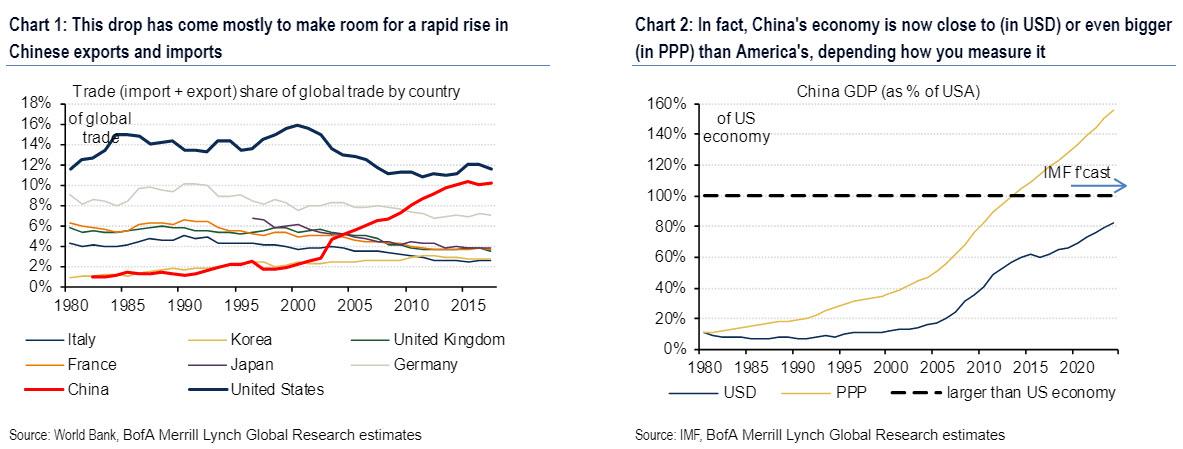
Greatness is a relative concept, measured often against oneself but also against others. In that regard, America has facilitated the rise of China by turning free trade into a global public good. Yet trade theory suggests that hegemons can maximize their income by applying optimal tariffs under certain conditions. The astonishing irruption of China in global commerce following her entry in the WTO has deeply transformed the global economy. For starters, America's share of global trade has rolled down for two decades to make room for a rapid rise in Chinese exports and imports (Chart 1). Importantly, China's economy is now close to (in USD) or even bigger (in PPP) than America's, depending how you measure it (Chart 2).
As Blanch puts it, in economic terms, China is the rising power and the global hegemon is finally starting to feel the heat. As a result, the strategist has taken an in depth look into the issues and found that several historical conflicts between an established and a rising power were preceeded by major trade disputes.
The first key point is that China's geopolitical ascent and resulting trade conflict, comes as incomes have stagnated in the past decades:
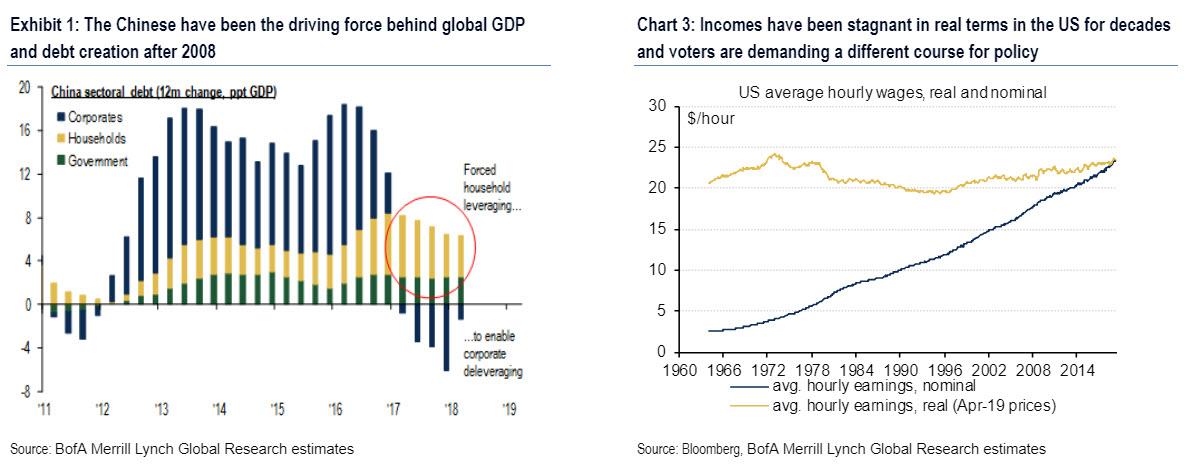
As Blanch notes, it has taken some time, and a major shift in domestic politics, for US foreign and trade policy to catch up with the geopolitical challenges of a rising China. Following the Global Financial Crisis, Washington had too many problems to focus on China's growth. Plus the Chinese were the driving force behind global GDP and debt creation after 2008 (Exhibit 1) in a world hungry for growth. The European sovereign debt crises of 2011 and 2012 made Chinese economic activity an even more important pillar of the world economy. Neither the US nor other world leaders had the appetite or the domestic support to confront China's trade practices back then. But now the paradigm has changed. Incomes have been stagnant in real terms in the US for decades and voters are demanding a different course for policy (Chart 3).
In contrast to stagnating US wages, Chinese real incomes and wages have been rising at one of the fastest rates in the world for five decades now. In that sense, Chinese policymakers and business leaders seem to have delivered for their people what democratically elected politicians in the West have not.
But while the US may have lost the worker prosperity and wage growth title to China, the US still leads the world in trade and profits.
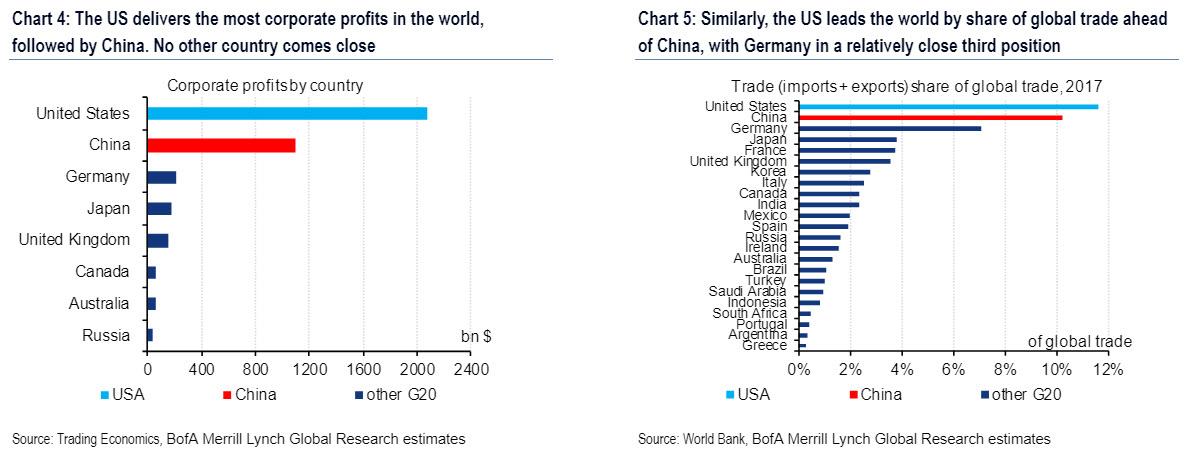
Indeed, America is also experiencing a renaissance of its own at the moment (largely thanks to a fake bull market now well into its 10th year). Buoyant equity markets, the longest economic expansion in history, and the lowest unemployment rate in 48 years have emboldened US policy makers to tackle China. One key issue that has captivated voters is the narrative that American workers' income is going overseas. This world view largely ignores the effects of technology. But in politics perception is reality. So the ongoing breakdown of global supply chains is just the start of a long trend, in BofA's view. In any case, America's economic power is still unmatched. Even if followed by China, the US still produces the vast amount of corporate profits in the world. No other country comes close (Chart 4.). Similarly, as BofA notes, the US leads the world by share of global trade ahead of China, with Germany in a relatively close third position (Chart 5).
Additionally, last year the US has become energy independent
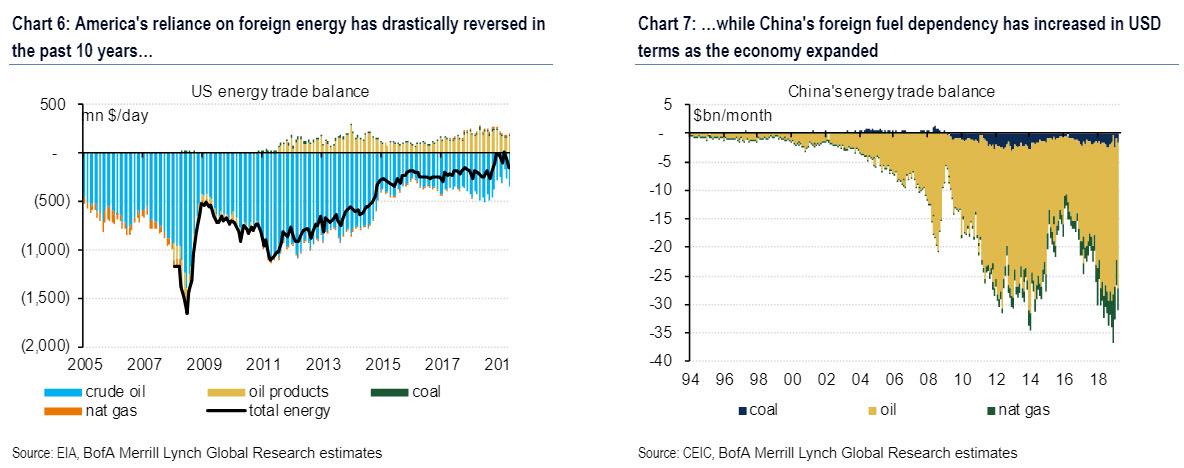
Discussing the timing of a trade war many have said was long overdue, the BofA strategist writes that "in some ways, President Trump has picked a good time to start his trade battle": America is in a position of strength and there is bipartisan consensus that China is getting too close for comfort. Another important point to understand is the structure in the foreign trade balances of both China and the US. Energy has been a crucial driver of foreign policy decisions in Washington for a long time. The new angle here is that America's reliance on foreign energy has drastically reversed in the past ten years (Chart 6), opening the door to a renewed battery of sanctions and tariffs against US foes. Energy independence has also given Washington the confidence that the US economy will be roughly insulated from global oil price swings. Meanwhile, China's foreign fuel dependency has increased in USD terms as the economy expanded (Chart 7), creating a major Achilles heel for the rising power.
So how did China achieve such fast growth in only a few decades?  Simple: as Blanch answers, the biggest driver behind China's growth was American imports. BofA explains:
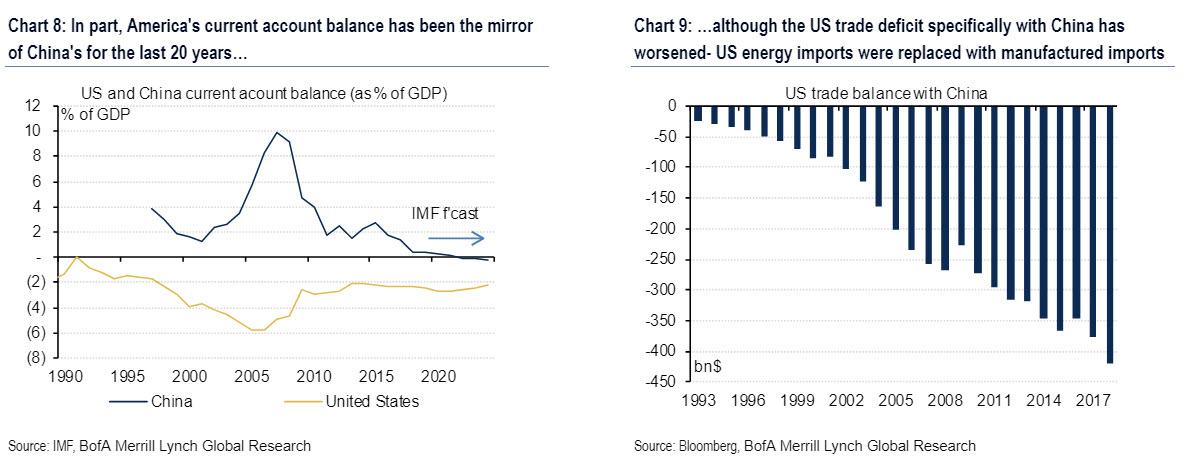
China's spectacular economic ascendence can be traced to a number of factors. Massive domestic savings and huge capital accumulation, coupled with rapid urbanization and fast rising exports, have all been key drivers of China´s growth. Policy makers in China have also been exceptionally adept at implementing multi decade plans and building infrastructure at a staggering speed. Why is the White House so focused on China? In part, America's current account balance has been the mirror of China's for the last 20 years (Chart 8). But even as America has improved its trade balances with the rest of the world helped by an energy renaissance, the annual US trade deficit with China has worsened from 84bn in 2000 to 420bn at present. As such, the drop in US energy imports was replaced with manufactured imports from China in the past decade (Chart 9.).
No one in Washington seemed to notice until voters sent a loud and clear message.
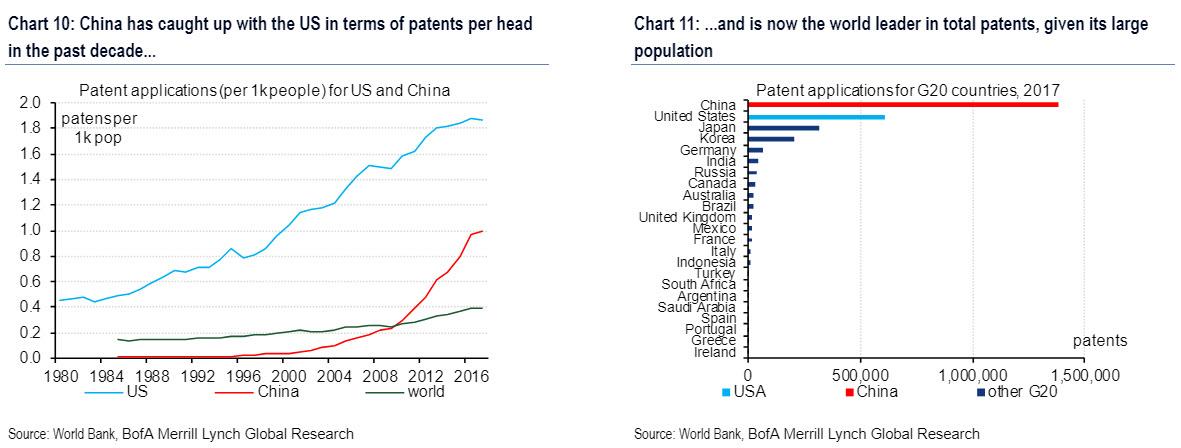
Another reason behind China's blistering ascendancy was its technology and "intellectual property." The reason is that for most of its history, China forced foreign companies to transfer technology by setting up Chinese-controlled joint ventures in its domestic market. These rules, coupled with the promise of access to one of the world's largest domestic markets, encouraged US corporations to transfer technology and turn a blind eye on intellectual property rights violations. Partly as a result of that, BofA notes that China has caught up with the US in terms of patents applications per head in the past decade (Chart 10). And while China is only filing about half the patent applications per head that America delivers, given its population size, China is now the world leader in total patent applications (Chart 11). This extraordinary surge in patent applications, Blanch notes, has surely risen eyebrows in DC.
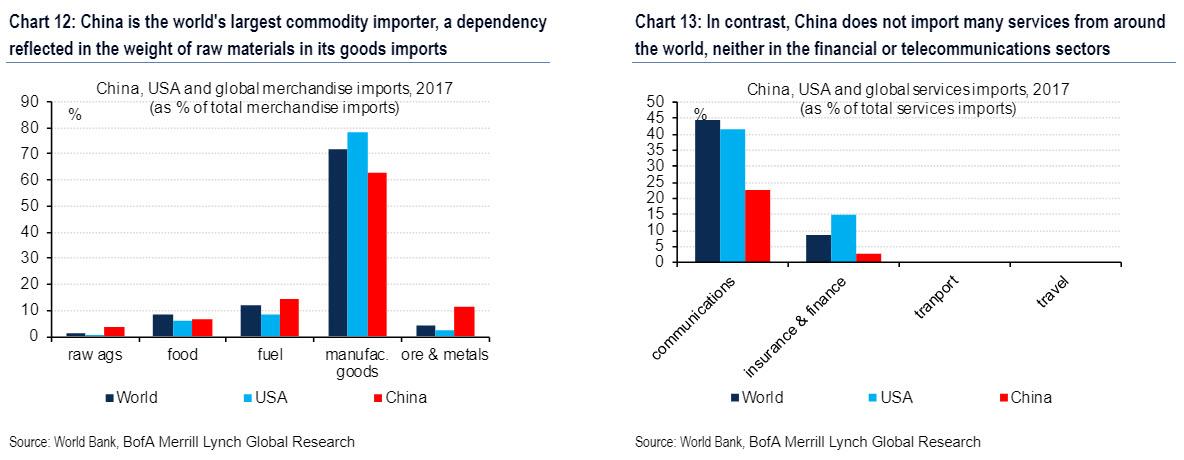
The third key reason for China's ascent has been its enormous foreign commodity purchases, which is due to its dependency on foreign raw materials. China is the world's largest commodity importer and this dependency is reflected in the relative weight of raw materials in its goods imports (Chart 12). As BofA notes, China is the world's largest importer of oil, coal, iron ore, copper and soybeans, and this massive dependency on foreign raw materials "has become a growing weakness. This is particularly true now that China's strategic competitor has become the largest producer of energy in the world." In contrast, China does not import many services from around the world, neither in the financial or telecommunications sectors.
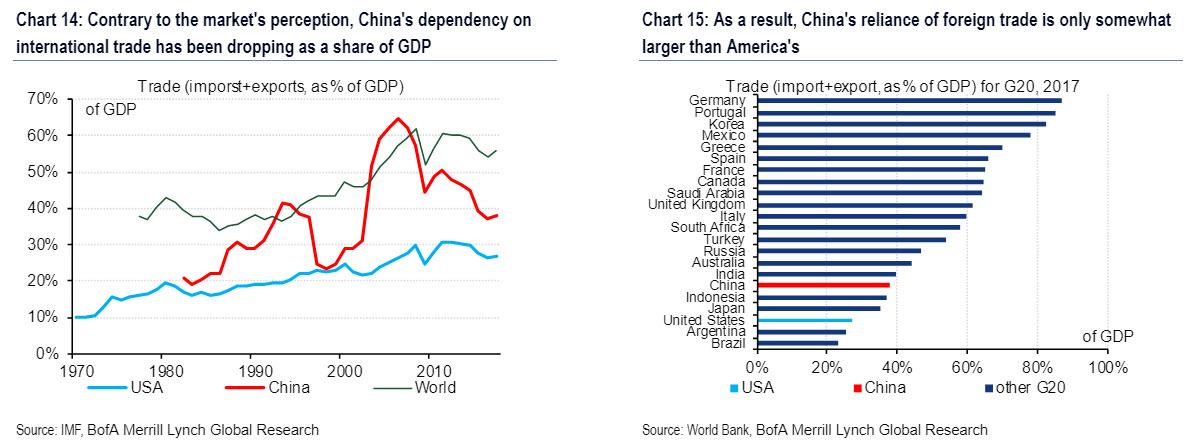
China's growth has also been boosted on the export side, specifically thanks to a huge surge in manufacturing exports and a very large increase in raw material imports, which has created both a trade partner, but also a major "strategic competitor" to the US. But contrary to the market's, or at least Trump's, perception China's dependency on international trade has been dropping as a share of GDP (Chart 14). And since know that Chinese export growth in the past two decades was very strong, it follows that the falling export dependency is largely the result of China's GDP growing so quickly. As such, China's reliance of foreign trade today is only somewhat larger than America's. Note that the US enjoys one of the lowest foreign trade dependencies as a share of GDP in the G20, only slightly above after Argentina and Brazil (Chart 15).
This means that both the US and China could be labelled large, closed economies in international trade jargon. Germany would be on the opposite end of this spectrum. In practical terms, this relatively low trade dependency suggests that a protracted trade war would not likely have devastating consequences for neither China nor the US. Unlike Germany, both have large, deep domestic markets they can rely upon.
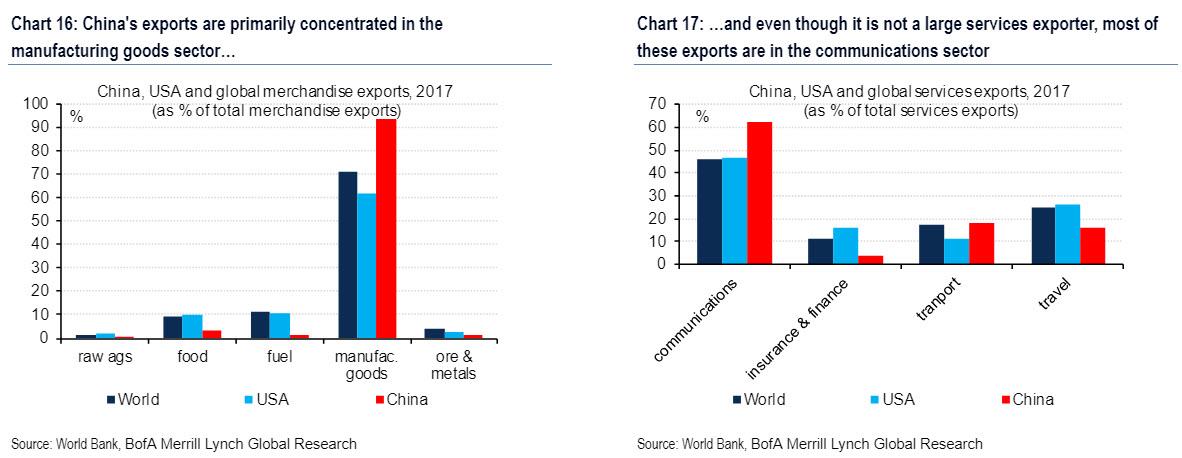
Meanwhile, as China's global trade standing grew, China's policies encouraged the rapid development of manufacturing at home (much to Germany's chagrin). As a result, Chinese exports are primarily concentrated in the manufacturing goods sector (Chart 16). China has been so effective at squeezing out manufacturers that it has ended up in a position of weakness, with limited ability to retaliate against the United States in a trade conflict. This strategic vulnerability is also visible on another angle of the trade war: the telecommunications sector. Even though China is not a large services exporter, most of Chinese services exports originate from the communications sector (Chart 17).
It is therefore not surprising, BofA notes, that the two largest Chinese companies operating in this sector, Huawei and ZTE, have become targets of US government action in recent months. By lifting tariffs on Chinese manufactures and imposing restrictions on the telecommunications sector, the White House has effectively encircled China's main sources of foreign exchange. The implication is that China's limited dependency on US goods and services has become a liability, rather than an asset. Now China has limited leverage to retaliate against the US on trade.
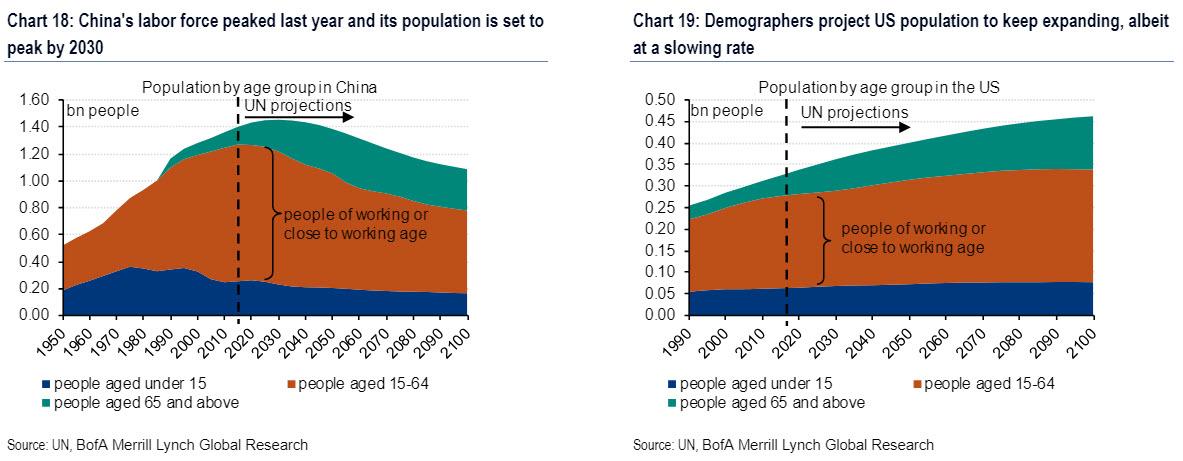
Finally, as BofA recaps the backdrop of the biggest civilizational clash, perhaps in history, demographics are becoming a headwind for China: "Another factor that may have propelled Washington to take a more aggressive trade stance with China now rather than later is demographics. For the most part, working age population is contracting in developed markets and expanding at a healthy pace in emerging markets. In this respect, both the US and China are the exceptions to their respective OECD and non-OECD peers. China's labor force peaked last year and its population is set to peak by 2030 (Chart 18). In contrast, the aging population problem in Developed Markets is mostly confined to Japan and Europe, while the US actually has still a growing population of working age (Chart 19)."
Why is this important? Simply said, because with diverging demographic trends and a larger economy, "a modest slowdown in the rate of Chinese economic growth could enable the US to retain its title as the world's largest economy and military spender for decades to come." Put differently, the faster China turns into Japan, the less of a geopolitical challenge it would pose to the US.