About Me

My photo
An Investor and counsellor in Financial Market

Monday, January 14, 2019

How China could dominate science

Should the world worry?

A Hundred year ago a wave of student protests broke over China’s great cities. Desperate to reverse a century of decline, the leaders of the May Fourth Movement wanted to jettison Confucianism and import the dynamism of the West. The creation of a modern China would come about, they argued, by recruiting “Mr Science” and “Mr Democracy”.
Today the country that the May Fourth students helped shape is more than ever consumed by the pursuit of national greatness. China’s landing of a spacecraft on the far side of the Moon on January 3rd, a first for any country, was a mark of its soaring ambition. But today’s leaders reject the idea that Mr Science belongs in the company of Mr Democracy. On the contrary, President Xi Jinping is counting on being able to harness leading-edge research even as the Communist Party tightens its stranglehold on politics. Amid the growing rivalry between China and America, many in the West fear that he will succeed.
There is no doubting Mr Xi’s determination. Modern science depends on money, institutions and oodles of brainpower. Partly because its government can marshal all three, China is hurtling up the rankings of scientific achievement, as our investigations show (see article). It has spent many billions of dollars on machines to detect dark matter and neutrinos, and on institutes galore that delve into everything from genomics and quantum communications to renewable energy and advanced materials. An analysis of 17.2m papers in 2013-18, by Nikkei, a Japanese publisher, and Elsevier, a scientific publisher, found that more came from China than from any other country in 23 of the 30 busiest fields, such as sodium-ion batteries and neuron-activation analysis. The quality of American research has remained higher, but China has been catching up, accounting for 11% of the most influential papers in 2014-16.
Such is the pressure on Chinese scientists to make breakthroughs that some put ends before means. Last year He Jiankui, an academic from Shenzhen, edited the genomes of embryos without proper regard for their post-partum welfare—or that of any children they might go on to have. Chinese artificial-intelligence (ai) researchers are thought to train their algorithms on data harvested from Chinese citizens with little oversight. In 2007 China tested a space-weapon on one of its weather satellites, littering orbits with lethal space debris. Intellectual-property theft is rampant.
The looming prospect of a dominant, rule-breaking, high-tech China alarms Western politicians, and not just because of the new weaponry it will develop. Authoritarian governments have a history of using science to oppress their own people. China already deploys ai techniques like facial recognition to monitor its population in real time. The outside world might find a China dabbling in genetic enhancement, autonomous ais or
geoengineering extremely frightening.
These fears are justified. A scientific superpower wrapped up in a one-party dictatorship is indeed intimidating. But the effects of China’s growing scientific clout do not all point one way.
For a start, Chinese science is about much more than weapons and oppression. From better batteries and new treatments for disease to fundamental discoveries about, say, dark matter, the world has much to gain from China’s efforts.
Moreover, it is unclear whether Mr Xi is right. If Chinese research really is to lead the field, then science may end up changing China in ways he is not expecting.
Mr Xi talks of science and technology as a national project. However, in most scientific research, chauvinism is a handicap. Expertise, good ideas and creativity do not respect national frontiers. Research takes place in teams, which may involve dozens of scientists. Published papers get you only so far: conferences and face-to-face encounters are essential to grasp the subtleties of what everyone else is up to. There is competition, to be sure; military and commercial research must remain secret. But pure science thrives on collaboration and exchange.
This gives Chinese scientists an incentive to observe international rules—because that is what will win its researchers access to the best conferences, laboratories and journals, and because unethical science diminishes China’s soft power. Mr He’s gene-editing may well be remembered not just for his ethical breach, but also for the furious condemnation he received from his Chinese colleagues and the threat of punishment from the authorities. The satellite destruction in 2007 caused outrage in China. It has not been repeated.
The tantalising question is how this bears on Mr Democracy. Nothing says the best scientists have to believe in political freedom. And yet critical thinking, scepticism, empiricism and frequent contact with foreign colleagues threaten authoritarians, who survive by controlling what people say and think. Soviet Russia sought to resolve that contradiction by giving its scientists privileges, but isolating many of them in closed cities.
China will not be able to corral its rapidly growing scientific elite in that way. Although many researchers will be satisfied with just their academic freedom, only a small number need seek broader self-expression to cause problems for the Communist Party. Think of Andrei Sakharov, who developed the Russian hydrogen bomb, and later became a chief Soviet dissident; or Fang Lizhi, an astrophysicist who inspired the students leading the Tiananmen Square protests in 1989. When the official version of reality was tired and stilted, both stood out as seekers of the truth. That gave them immense moral authority.
Some in the West may feel threatened by China’s advances in science, and therefore aim to keep its researchers at arm’s length. That would be wise for weapons science and commercial research, where elaborate mechanisms to preserve secrecy already exist and could be strengthened. But to extend an arm’s-length approach to ordinary research would be self-defeating. Collaboration is the best way of ensuring that Chinese science is responsible and transparent. It might even foster the next Fang.
Hard as it is to imagine, Mr Xi could end up facing a much tougher choice: to be content with lagging behind, or to give his scientists the freedom they need and risk the consequences. In that sense, he is running the biggest experiment of all.


Friday, January 11, 2019

Robots will help Chinese firms cope with wages and the trade war

Lessons from the rag trade

Few items of clothing convey seriousness quite like the white-collar shirt. It took the exuberance out of the Elizabethan ruff and put the starch into Victorian Britain. It defined a sense of upward mobility, whether for bank clerks, Japanese salarymen or anyone keen to push around paper and professional underlings.
But few white shirts are sold as earnestly as those at the pye stores in China. You half expect the shop assistants to whip out a slide rule rather than a tape measure. The name pye, the brand enthuses, “combines the Chinese character for flair with its homonym, the mathematical constant π.” Its white shirts are named, unfashionably, after mathematicians; Euclid and Newton for ones with a Western collar, Zu and Liu for Mao-like Mandarin ones.
Esquel, owner of pye and a big shirtmaker for Hugo Boss, Tommy Hilfiger and other global brands, is not just serious about its shirts. It is also concerned with the upward mobility of its 56,000-odd employees, half of whom work in factories in China. Unusually for the textile and apparel industry, it is keen to raise their pay and productivity via mechanisation. As a private firm, it can do so with long-term thinking that borders on Confucianism. But it also has a hard-headed determination to adapt in the face of a tighter domestic labour market and a trade war with America. Other Chinese manufacturers are doing the same, meaning that these twin threats could, counter-intuitively, make them stronger.

Tech styles

The garment trade is not where you usually find stories of business success that are also inspiring, especially in cut-throat China. The supply chain is brutal. The work is repetitive; piece work makes it all the more soul-sapping. It is relatively hard to automate soft materials like textiles; making Esquel’s shirts involves up to 65 fiddly sub-processes, such as stitching sleeves and cuffs. As soon as labour costs rise, textile and garment factories tend to fly away, seeking cheaper fingers to work to the bone, be they in Bangladesh or Ethiopia. Esquel plans instead to keep lots of its work in China.
Textiles is not the only Chinese manufacturing industry to face rising wages, high turnover of workers and an ageing population; electronics does too, for instance. In some cases, such difficulties are exacerbated by the trade war; Japanese firms have reportedly shifted production of devices for cars, such as radios, from China to Mexico where they can evade tariffs.
Yet even if American tariffs rise further, many Chinese companies are betting heavily on automation to remain competitive. In 2017 China’s installations of industrial robots rose by 59% to 138,000, more than in America and Europe combined. While downplaying its controversial “Made in China 2025” industrial policy, to soothe the fears of the Trump administration, the Chinese government is happy to throw money at existing manufacturing industries in order to help them tool up. That will help keep the robot revolution running.
Walk through Esquel’s biggest factory in Foshan in the Pearl River Delta and it is clear that even here the robots are coming. The hundreds of workers sitting, heads down, in pink caps are a sight to behold. They are also outnumbered by machines. On some lines, robotic arms swish, trimming collar bottoms and pressing plackets. The devices do fiddly jobs like making sure that tiny pearl-coloured buttons for Banana Republic have the word Banana on the top. Israeli cameras, adapted from military devices, use artificial intelligence to scan for flaws in the fabric, automating one of the most mind-numbing of jobs.
Some workers have been displaced but productivity has improved, keeping the firm’s profits stable despite a tripling since 2006 of its average monthly wage in China, to 4,500 yuan ($650). At first workers reacted to the machines rather as English Luddites eyed automated looms. But now they help design them. Esquel managers joke that they do so out of laziness—they want to make their jobs easier. Take “Sister Yan”, a matron in black dress and sensible shoes, who started on the factory floor aged 21. She worried about the shoddy quality of many of the hand-stitched garments, and helped the firm’s engineers to design mechanisms to do the job better. Now she is a senior manager, and with “Brother Ming”, the chief engineer, shares credit for several industrial patents. Tian Ye, an Esquel executive, quips that the increasingly tech-savvy seamstresses are no longer strictly blue-collar workers but nor are they yet white-collar ones either. Instead, he says, they are “checked or striped”.
Automation is also expected to help Esquel in the trade stand-off with America. Despite the frictions, Marjorie Yang, Esquel’s chairman, is in effect doubling down on China. She touts a 2bn yuan investment in a new factory in Guilin, a picturesque region, including a yarn-spinning division so high-tech that visitors are not allowed to walk the floors. So far Esquel’s products have been spared American tariffs. American clients are nervous, so if need be the firm could shift some production to its factories outside China, such as in Mauritius, while moving other lines back home.
Two factors are likely to encourage manufacturers in China to remain loyal to their home market. The first is its sheer size. Willy Shih of the Harvard Business School says this enables them to practice and refine their production processes on a scale that allows them to keep cutting costs. The other is the skill of the robots themselves. He says there is so much “embedded knowledge” in today’s machine tools that China can quickly start creating products that may have taken a generation to develop previously, such as cars with top-of-the-range automatic transmissions.
It is worth remembering this amid the fears about a trade-war-related slowdown in China’s factory activity. If Esquel is any guide, Chinese firms may use the opportunity to become even more efficient, rather than wilting in the face of adversity. In the long run, that would make China’s economy as a whole more resilient.

Thursday, January 10, 2019

A plan to reduce Europe’s dependence on Russian gas looks shaky


The Southern Gas Corridor could even hand Gazprom more clout
For Years western European countries have worried about their access to gas, almost two-fifths of which is supplied by Russian pipes. These fears have not receded since in 2014 Russia cut off gas to Ukraine, the main thoroughfare through which its gas arrives in eucountries. Three times since 2006, rows with Russia have stopped gas flowing through Ukrainian pipelines, leaving customers down the line shivering. eu leaders have long pondered other sources, such as American lng, but the latter is far more expensive.
Such worries have flared again even as, in 2018, imports of Russian gas by eu countries reached a record high. On December 29th Russia rejected European demands to release 24 Ukrainian sailors detained after it seized three of its neighbour’s ships in November. Ukraine is calling for fresh sanctions on Russia, raising the risk that it might once more cut off supplies.
Meanwhile, European politicians are also fretting about Nord Stream 2 (ns2), a planned pipeline that would carry more Russian gas under the Baltic Sea directly to Germany. On December 12th the European Parliament passed a resolution calling for the project to be cancelled, citing security reasons, but with 370km of pipes already laid it looks hard to stop.
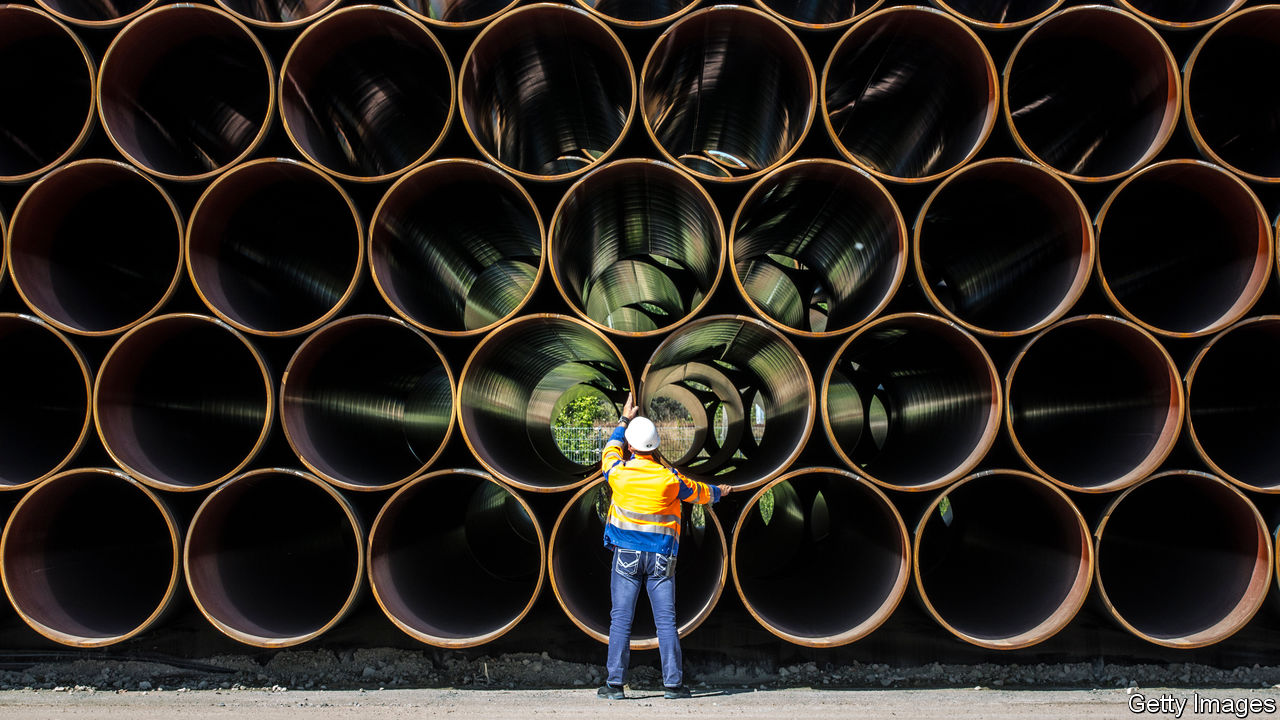
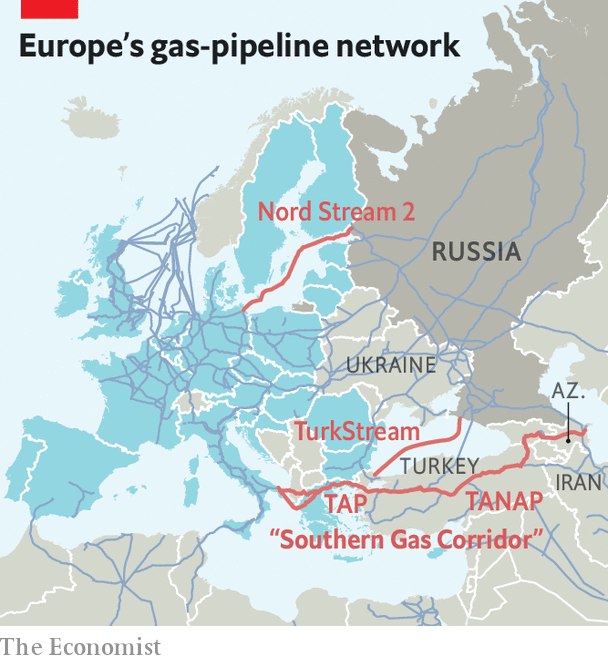
Another tack is to develop alternative conduits and supplies. On December 7th Italian authorities gave the final approval for the construction of the last leg of the Southern Gas Corridor (sgc), an eu scheme to import natural gas from the Caspian region. The project is more than three-quarters complete and workers are beginning to extend the pipeline beneath the Adriatic Sea to Italy. If all goes according to plan, a $40bn jigsaw of pipes from Azerbaijan will start supplying western Europe from 2020 (see map). But instead of increasing energy security, the sgc may do more to emphasise how hard it is for Europe to reduce its dependence on Russia.
Planners in the European Commission had initially proposed the construction of a pipeline from Iran or Turkmenistan. But Iran is under sanctions and Turkmenistan sells most of its gas production to China, hence the shift to import from Azerbaijan. The project now involves dozens of companies, including bp, an oil major, and Socar and tpao, the state oil companies of Azerbaijan and Turkey respectively.
Despite the years of planning and complexity of the project, its capacity, at 16bn cubic metres per year, is about half what European planners had hoped. The sgc is set to meet just 2% of eu demand. At market prices, sgc gas is competitive in Turkey and south-east European countries but not in the more distant western European markets. Moreover, one of its developers is Lukoil, an oil firm backed by Russia.
In its current form the sgc therefore does little to curb dependence on Russia. That is unlikely to change, for two reasons. First, in addition to ns2, Russia has devised its own plans to bring gas into southern Europe. TurkStream, a pipeline to transport Russian gas across the Black Sea to Turkey, is scheduled to become operational this year. Gazprom, Russia’s energy giant (and ns2’s sole shareholder), plans to build a second line to the eu and is negotiating its destination. That would make the eu-backed sgceven less competitive.
Second, changes that would make the sgc more commercially viable are unlikely. Advocates of the project argue that they plan to double the volume of exports if more gas becomes available, notably from Turkmenistan. But the expansion would require new infrastructure and additional costs. A way of avoiding that would be to feed new gas from Turkmenistan into sgc through a swap deal involving transit through Iran. But renewed American sanctions on Iran preclude this option. They also hinder the development of rich gas resources in Iran, which could have otherwise been exported to the eu.
At least one energy giant appears to take seriously the idea that the sgc could expand. But it will not reassure the eu that this firm is none other than Gazprom, whose chief executive has said it would bid for access. European rules require the sgc to open capacity expansion to the most cost-competitive supplier. In that event, Gazprom’s vast reserves and low costs would be hard to rival. A project touted as a way to diversify Europe’s gas supply might end up providing an additional route for its current, unloved, supplier.

Wednesday, January 09, 2019

Letter from Tim Cook to Apple investors

January 2, 2019
To Apple investors:
Today we are revising our guidance for Apple’s fiscal 2019 first quarter, which ended on December 29. We now expect the following:
  • Revenue of approximately $84 billion
  • Gross margin of approximately 38 percent
  • Operating expenses of approximately $8.7 billion
  • Other income/(expense) of approximately $550 million
  • Tax rate of approximately 16.5 percent before discrete items
We expect the number of shares used in computing diluted EPS to be approximately 4.77 billion.
Based on these estimates, our revenue will be lower than our original guidance for the quarter, with other items remaining broadly in line with our guidance. 
While it will be a number of weeks before we complete and report our final results, we wanted to get some preliminary information to you now. Our final results may differ somewhat from these preliminary estimates. 
When we discussed our Q1 guidance with you about 60 days ago, we knew the first quarter would be impacted by both macroeconomic and Apple-specific factors. Based on our best estimates of how these would play out, we predicted that we would report slight revenue growth year-over-year for the quarter. As you may recall, we discussed four factors:
First, we knew the different timing of our iPhone launches would affect our year-over-year compares. Our top models, iPhone XS and iPhone XS Max, shipped in Q4’18—placing the channel fill and early sales in that quarter, whereas last year iPhone X shipped in Q1’18, placing the channel fill and early sales in the December quarter. We knew this would create a difficult compare for Q1’19, and this played out broadly in line with our expectations.
Second, we knew the strong US dollar would create foreign exchange headwinds and forecasted this would reduce our revenue growth by about 200 basis points as compared to the previous year. This also played out broadly in line with our expectations.
Third, we knew we had an unprecedented number of new products to ramp during the quarter and predicted that supply constraints would gate our sales of certain products during Q1. Again, this also played out broadly in line with our expectations. Sales of Apple Watch Series 4 and iPad Pro were constrained much or all of the quarter. AirPods and MacBook Air were also constrained.
Fourth, we expected economic weakness in some emerging markets. This turned out to have a significantly greater impact than we had projected. 
In addition, these and other factors resulted in fewer iPhone upgrades than we had anticipated. 
These last two points have led us to reduce our revenue guidance. I’d like to go a bit deeper on both. 
Emerging Market Challenges
While we anticipated some challenges in key emerging markets, we did not foresee the magnitude of the economic deceleration, particularly in Greater China. In fact, most of our revenue shortfall to our guidance, and over 100 percent of our year-over-year worldwide revenue decline, occurred in Greater China across iPhone, Mac and iPad.
China’s economy began to slow in the second half of 2018. The government-reported GDP growth during the September quarter was the second lowest in the last 25 years. We believe the economic environment in China has been further impacted by rising trade tensions with the United States. As the climate of mounting uncertainty weighed on financial markets, the effects appeared to reach consumers as well, with traffic to our retail stores and our channel partners in China declining as the quarter progressed. And market data has shown that the contraction in Greater China’s smartphone market has been particularly sharp.
Despite these challenges, we believe that our business in China has a bright future. The iOS developer community in China is among the most innovative, creative and vibrant in the world. Our products enjoy a strong following among customers, with a very high level of engagement and satisfaction. Our results in China include a new record for Services revenue, and our installed base of devices grew over the last year. We are proud to participate in the Chinese marketplace.
iPhone
Lower than anticipated iPhone revenue, primarily in Greater China, accounts for all of our revenue shortfall to our guidance and for much more than our entire year-over-year revenue decline. In fact, categories outside of iPhone (Services, Mac, iPad, Wearables/Home/Accessories) combined to grow almost 19 percent year-over-year. 
While Greater China and other emerging markets accounted for the vast majority of the year-over-year iPhone revenue decline, in some developed markets, iPhone upgrades also were not as strong as we thought they would be. While macroeconomic challenges in some markets were a key contributor to this trend, we believe there are other factors broadly impacting our iPhone performance, including consumers adapting to a world with fewer carrier subsidies, US dollar strength-related price increases, and some customers taking advantage of significantly reduced pricing for iPhone battery replacements. 
Many Positive Results in the December Quarter
While it’s disappointing to revise our guidance, our performance in many areas showed remarkable strength in spite of these challenges. 
Our installed base of active devices hit a new all-time high—growing by more than 100 million units in 12 months. There are more Apple devices being used than ever before, and it’s a testament to the ongoing loyalty, satisfaction and engagement of our customers. 
Also, as I mentioned earlier, revenue outside of our iPhone business grew by almost 19 percent year-over-year, including all-time record revenue from Services, Wearables and Mac. Our non-iPhone businesses have less exposure to emerging markets, and the vast majority of Services revenue is related to the size of the installed base, not current period sales. 
Services generated over $10.8 billion in revenue during the quarter, growing to a new quarterly record in every geographic segment, and we are on track to achieve our goal of doubling the size of this business from 2016 to 2020.
Wearables grew by almost 50 percent year-over-year, as Apple Watch and AirPods were wildly popular among holiday shoppers; launches of MacBook Air and Mac mini powered the Mac to year-over-year revenue growth and the launch of the new iPad Pro drove iPad to year-over-year double-digit revenue growth. 
We also expect to set all-time revenue records in several developed countries, including the United States, Canada, Germany, Italy, Spain, the Netherlands and Korea. And, while we saw challenges in some emerging markets, others set records, including Mexico, Poland, Malaysia and Vietnam.
Finally, we also expect to report a new all-time record for Apple’s earnings per share.
Looking Ahead
Our profitability and cash flow generation are strong, and we expect to exit the quarter with approximately $130 billion in net cash. As we have stated before, we plan to become net-cash neutral over time.
As we exit a challenging quarter, we are as confident as ever in the fundamental strength of our business. We manage Apple for the long term, and Apple has always used periods of adversity to re-examine our approach, to take advantage of our culture of flexibility, adaptability and creativity, and to emerge better as a result. 
Most importantly, we are confident and excited about our pipeline of future products and services. Apple innovates like no other company on earth, and we are not taking our foot off the gas.
We can’t change macroeconomic conditions, but we are undertaking and accelerating other initiatives to improve our results. One such initiative is making it simple to trade in a phone in our stores, finance the purchase over time, and get help transferring data from the current to the new phone. This is not only great for the environment, it is great for the customer, as their existing phone acts as a subsidy for their new phone, and it is great for developers, as it can help grow our installed base. 
This is one of a number of steps we are taking to respond. We can make these adjustments because Apple’s strength is in our resilience, the talent and creativity of our team, and the deeply held passion for the work we do every day.
Expectations are high for Apple because they should be. We are committed to exceeding those expectations every day.
That has always been the Apple way, and it always will be.
Tim
The information presented in this letter is preliminary and our actual results may differ. Apple plans to discuss final results during our first quarter conference call on Tuesday, January 29, 2019 at 2:00 p.m. PST / 5:00 p.m. EST.
This letter contains forward-looking statements, within the meaning of the Private Securities Litigation Reform Act of 1995. These forward-looking statements include without limitation those about Apple’s estimated revenue, gross margin, operating expenses, other income/(expense), tax rate, net cash, share count and plans for return of capital. These statements involve risks and uncertainties, and actual results may differ. Risks and uncertainties include without limitation: the effect of global and regional economic conditions on Apple’s business, including effects on purchasing decisions by consumers and businesses; the ability of Apple to compete in markets that are highly competitive and subject to rapid technological change; the ability of Apple to manage frequent introductions and transitions of products and services, including delivering to the marketplace, and stimulating customer demand for, new products, services and technological innovations on a timely basis; the effect that shifts in the mix of products and services and in the geographic, currency or channel mix, component cost increases, price competition, or the introduction of new products, including new products with higher cost structures, could have on Apple’s gross margin; the dependency of Apple on the performance of distributors of Apple’s products, including cellular network carriers and other resellers; the inventory and other asset risks associated with Apple’s need to order, or commit to order, product components in advance of customer orders; the continued availability on acceptable terms, or at all, of certain components, services and new technologies essential to Apple’s business, including components and technologies that may only be available from single or limited sources; the dependency of Apple on manufacturing and logistics services provided by third parties, many of which are located outside of the US and which may affect the quality, quantity or cost of products manufactured or services rendered to Apple; the effect of product and services design and manufacturing defects on Apple’s financial performance and reputation; the dependency of Apple on third-party intellectual property and digital content, which may not be available to Apple on commercially reasonable terms or at all; the dependency of Apple on support from third-party software developers to develop and maintain software applications and services for Apple’s products; the impact of unfavorable legal proceedings, such as a potential finding that Apple has infringed on the intellectual property rights of others; the impact of changes to laws and regulations that affect Apple’s activities, including Apple’s ability to offer products or services to customers in different regions; the ability of Apple to manage risks associated with its international activities, including complying with laws and regulations affecting Apple’s international operations; the ability of Apple to manage risks associated with Apple’s retail stores; the ability of Apple to manage risks associated with Apple’s investments in new business strategies and acquisitions; the impact on Apple’s business and reputation from information technology system failures, network disruptions or losses or unauthorized access to, or release of, confidential information; the ability of Apple to comply with laws and regulations regarding data protection; the continued service and availability of key executives and employees; political events, international trade disputes, war, terrorism, natural disasters, public health issues, and other business interruptions that could disrupt supply or delivery of, or demand for, Apple’s products; financial risks, including risks relating to currency fluctuations, credit risks and fluctuations in the market value of Apple’s investment portfolio; and changes in tax rates and exposure to additional tax liabilities. More information on these risks and other potential factors that could affect Apple’s financial results is included in Apple’s filings with the SEC, including in the “Risk Factors” and “Management’s Discussion and Analysis of Financial Condition and Results of Operations” sections of Apple’s most recently filed periodic reports on Form 10-K and Form 10-Q and subsequent filings. Apple assumes no obligation to update any forward-looking statements or information, which speak as of their respective dates.

Tuesday, January 08, 2019

Indian technology talent is flocking to Canada

As immigrant techies shun the US, its neighbour has rolled out the red carpet

induce a software developer to quit a good job in Silicon Valley and trade California’s sunshine for Toronto’s wintry skies? For Vikram Rangnekar, born in India and educated in America, the triggers were the restrictions placed on immigrant tech workers holding an h-1b visa (starting companies or taking long holidays is discouraged) and what looked like a 20-year wait to get the green card he needed in order to settle down. Rising anti-immigrant sentiment under President Donald Trump’s administration did not help. Two years later he thinks he made the right choice. “I didn’t want to spend the best years of my life on a restrictive visa.”
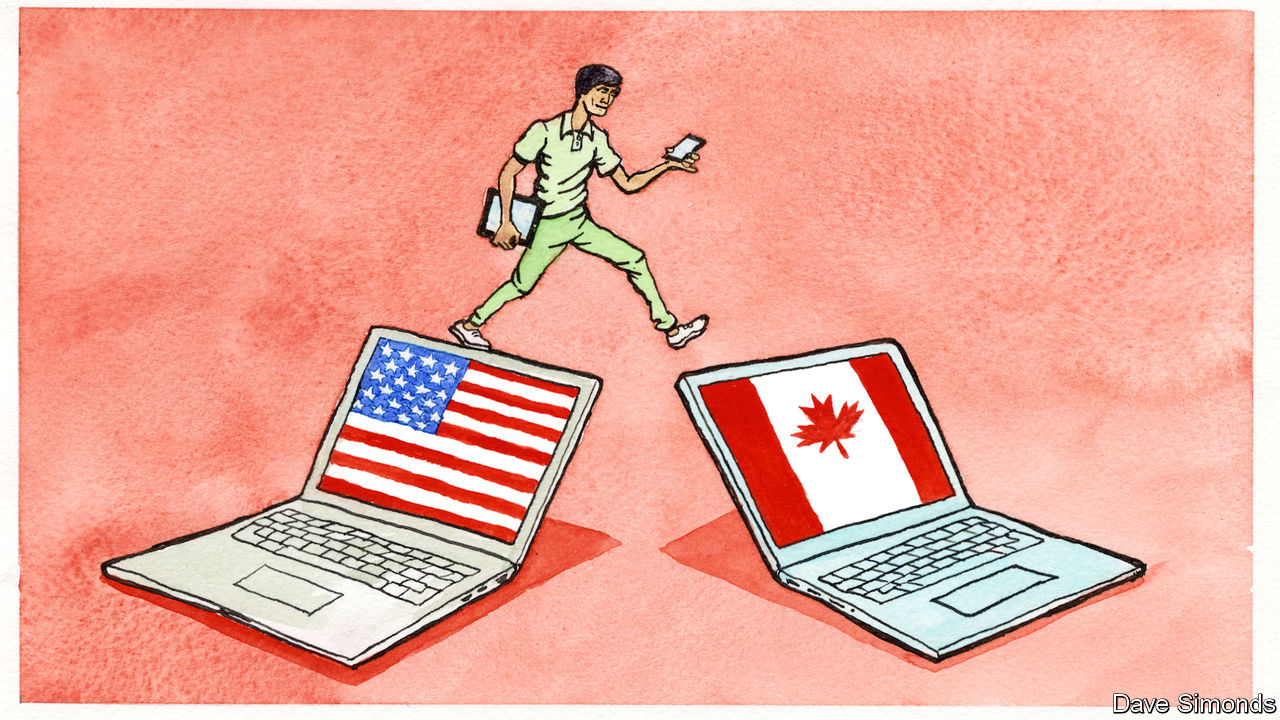
People like Mr Rangnekar are part of an exodus of tech workers from Silicon Valley. Pushed out by the cost of living as well as by a less welcoming American government, they are being pulled in by countries such as Canada, where tech vacancies are forecast to reach 200,000 by 2020. Canada is gambling that by the time America wakes up to the cost of discouraging immigrants its tech sector will have secured some of the best talent.
The starting-point is pretty promising. Toronto already has expertise in artificial intelligence (ai) and an array of promising firms such as Wattpad, a storytelling platform with 65m readers. The city added more tech jobs in 2017 than the San Francisco Bay area, Seattle and Washington, dc, combined. Ottawa is home to Shopify, a publicly traded e-commerce platform valued at C$19bn ($14bn). Montreal, another ai hotbed, has Element ai, a lab co-founded by Yoshua Bengio, a specialist in deep learning—and newish labs opened by Facebook and Samsung.
Yet Canada is in the third tier of destinations globally, says a study on venture-capital investment, “The Rise of the Global Start-Up City”, co-authored by Richard Florida, an urbanologist. To move up, the government has tweaked both its permanent and temporary immigrant programmes. Applicants for permanent residence get extra points for tech skills. Temporary visa holders are told their spouses will be allowed to work. Justin Trudeau, the prime minister, often underlines that in multicultural Canada, diversity is welcomed. Publicly funded health care sometimes gets a mention. “All of this is designed to pivot Canada away from the nativist policies of Trump,” says Ravi Jain, a Toronto immigration lawyer who has many tech clients.
Such tactics seem to be working, especially with Indians, a mighty force in Silicon Valley, where they form the largest group of immigrant tech workers. Indians from America and elsewhere snapped up almost half of the new temporary visas (processing time: two weeks) that Canada began issuing in June 2017 at the behest of the tech industry. The number of Indian nationals taking the slightly longer route to permanent residency surged between 2016 and 2017—up by 83% for those who entered under a federal skills programme, up by 122% for those selected by provinces to fill specific vacancies, and up by a whopping 538% for those who entered based on work experience. “I can clearly see the reason why people are shifting to us,” says Allen Lau, the chief executive of Wattpad. “The us is becoming less friendly.”
Still, the government knows it cannot be complacent, says Ahmed Hussen, minister of immigration, refugees and citizenship. It has set up research chairs at universities, overhauled support programmes and in its most recent budget earmarked C$2.5bn over five years in direct industry funding for innovation. It is one thing for Canada to attract disaffected immigrant tech workers from Silicon Valley. Now Maple Valley, as some call it, must make it worth their while to stay.

Monday, January 07, 2019

What the market turmoil means for 2019

Fears that the Fed will tighten too much are among the reasons the stockmarket has fallen

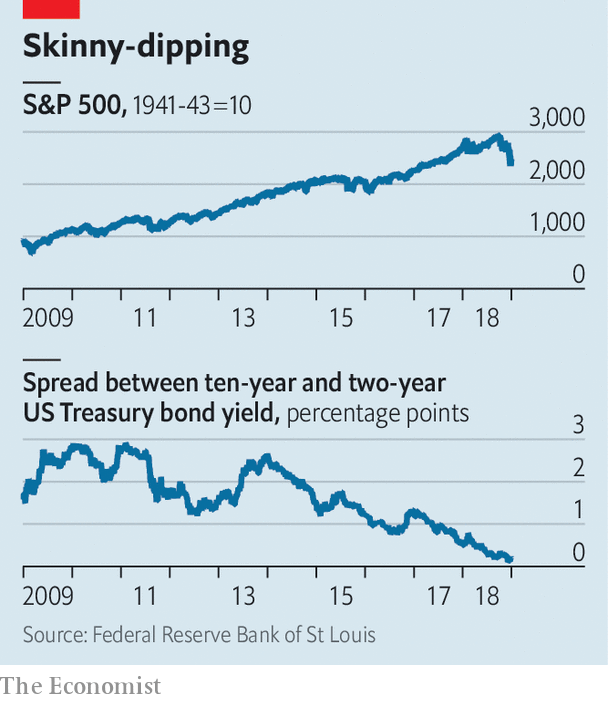
After October and limp November, the s&p 500 tumbled in value by 15% between November 30th and December 24th. Despite an astonishing bounce of 5% the day after Christmas, the index finished the year 6% below where it started (see chart). The first trading day of 2019 extended the market wobble, with stocks closing down in Asia and gyrating in Europe. After markets closed in America, Apple warned that a sharp slowdown in China’s economy, and weak sales in other emerging markets, meant revenues in the fourth quarter would undershoot expectations by up to 10%. Coming a day after news that China’s manufacturing sector contracted in December, that spooked investors globally. s&p 500 futures dipped before Wall Street re-opened on January 3rd.
That investors have become more risk-averse can also be seen in the bond markets. The high-yield spread, or excess interest rate over government debt, paid by companies with a poor credit rating has been rising. Meanwhile the yield on the ten-year Treasury bond has dropped from 2.98% to 2.63% over the past month, as investors have rushed to the safety of government paper. What is more the yield curve—the difference between yields for short- and long-dated government debt—is almost flat. The market’s response to signs of slowing growth is itself a cause of jangling nerves. Economists at J.P. Morgan have developed a model based only on the historical predictive power of the stockmarket, credit spreads and the yield curve; that implies the probability of a recession in America in 2019 is as high as 91%.
There are other reasons for investors to be skittish. The effect of President Donald Trump’s stimulus package, which came into force a year ago, is likely to fade soon. There are further signs of economic slowdowns in China and Europe. Tariffs, and the threat of further trade disputes, have probably deterred investment. Profit forecasts have been scaled back. According to Factset, a research firm, at the end of September analysts expected earnings to grow by 10.4% on average for companies in the s&p 500 in 2019. Now they reckon the figure will be 7.9%.
Missteps by the American administration have added to the sense of unease. The government shutdown may presage further political battles to come. A startlingly incompetent attempt on December 23rd by Steven Mnuchin, the treasury secretary, to calm market jitters by saying that banks have “ample liquidity” made things worse (bank liquidity had been nowhere among investors’ worries until he mentioned it). And reports that Mr Trump was considering firing Jerome Powell, the chairman of the Federal Reserve, raised questions about the administration’s competence to manage any downturn.
Perhaps the main concerns, though, are provoked by the Fed itself. On December 19th its Open Markets Committee (fomc) delivered its fourth interest-rate increase of 2018, even though financial conditions have tightened to become less supportive of growth. Mr Powell also said he did not see an imminent change to the Fed’s policy of running down its balance-sheet “on automatic pilot”.
That added to fears that monetary policy will tighten beyond what the economy can bear. Of the forecasters surveyed by the Wolters Kluwer Blue Chip Financial Forecasts, 46% reckon the Fed’s landing point for interest rates will be above their estimate of the long-run neutral Fed funds rate (a level at which the bank is trying neither to boost nor to slow activity). Only 10% thought it would be below. The median expectation of members of the fomc for the number of interest-rate hikes in 2019 has fallen from three to two. The futures market suggests investors expect none at all.
The reason monetary policymakers seem so blasé compared with investors is that, setting aside the financial indicators flashing amber, America’s economy appears to be doing well. The labour market went from strength to strength in 2018, and most indicators of consumer confidence remain at ten-year highs. A different model built by J.P. Morgan analysts, this time based on short-term economic indicators such as car sales, building permits and the unemployment rate, put the probability of recession in 2019 much lower, at 26%.
There are several ways this disconnect between market jitters and robust economic indicators could disappear. The direct effect of stock-owners feeling poorer could cut spending. The plunging stockmarket could hit consumer and business confidence, crimping spending and investment. Predictions of recession based on markets and financial indicators could influence economic behaviour and thus become self-fulfilling.
Judging by the past couple of decades, if stockmarket turmoil persists the Fed will respond by lowering its forecasts for growth. That would feed into a looser policy stance. After announcing the rate rise on December 19th, Mr Powell reminded listeners that “some volatility” is unlikely to leave a mark on the economy, but also that the Fed had already lowered its forecast for growth and inflation “a little bit”.
Fortunately for the Fed, inflation remains subdued, having come in at or below expectations in recent months. That gives the Fed’s policymakers room to be lenient, meaning they can avoid the premature tightening they have often been criticised for. Investors may sense something the Fed does not. Playing it safe will give it time to correct course if needed.
There is a chance that the stockmarket will rouse itself from its slump in coming weeks. But even if it does, the Fed has re-emphasised its “data-dependent” approach to interest rates. That is central-banker speak for “less predictable”. The coming year is likely to be bumpier than investors have become accustomed to.

Friday, January 04, 2019

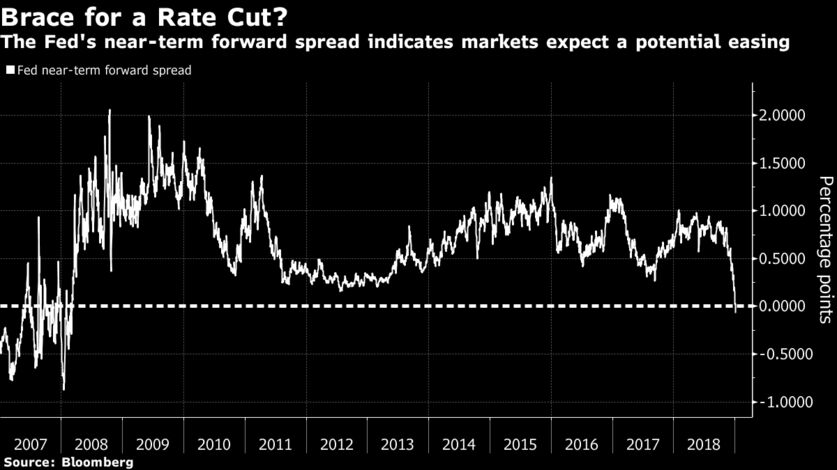
Key Fed Yield Gauge Points to Rate Cuts for First Time Since 2008

Some of the most accurate gauges of economic health are pricing in lower Fed rates for the first time in more than a decade.
The little-known near-term forward spread, which reflects the difference between the forward rate implied by Treasury bills six quarters from now and the current three-month yield, fell into negative territory on Wednesday for the first time since March 2008. Two-year yields dipped below those on one-year paper in December.
“This is a crystal ball, it’s telling you about the future and what the market thinks of the Fed and what it will do with its policy rate,” Tony Crescenzi, market strategist and portfolio manager at Pimco, said in an interview with Bloomberg TV. “The market is predicting a rate cut at the beginning part of next year.”
Federal Reserve economists said looking at forward rates relative to those on current Treasury bills has served traders well in the past.
When the near-term forward spread turns negative, it indicates bets on easier policy “over the next several quarters, presumably because they expect monetary policymakers to respond to the threat or onset of a recession,” they wrote.
Money markets have been paring back expectations of rate hikes as economic data weaken and equities whipsaw. Last week, traders priced in no move in the Federal Funds rate this year and more than a 50 percent chance of a rate cut in 2020.
“We won’t be roaring into the 20s like we did a hundred years ago, we could be stumbling into the 20s, is what the market is saying,” said Pimco’s Crescenzi

Thursday, January 03, 2019

The perils of trying to time the market

In practice, it is surprisingly hard

Jesse livermore earned his reputation as a talented speculator by pocketing a tidy sum during the Panic of 1907. Mindful that a scarcity of credit and a giddy stockmarket were a dangerous mix, he began to sell stocks short that autumn. When share prices crashed on October 24th, Livermore was up by $1m ($27m in today’s money). He then changed course. He started to buy stocks, which were now a lot cheaper. The market rallied. By the end of the year Livermore had made $3m.
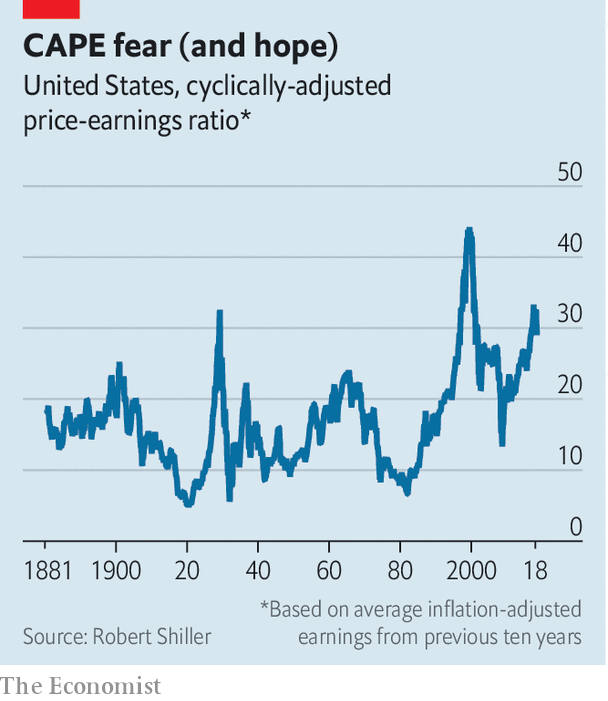
Anyone who has ever invested in stocks has at one time fancied that they can time the market as exquisitely as Livermore did. Very often, they hope that a benchmark of fair value, such as the cyclically-adjusted price-earnings ratio, or cape, will be their guide. History shows that when stock prices rise a lot faster than profits—as they did in the 1920s, 1960s and 1990s—they tend subsequently to fall back (see chart). So the market-timer will sell when the cape is high and buy them back when it is low.
It seems simple. In practice, it is surprisingly hard to use valuation gauges to time the market. Investors who try often sell far too early. As a consequence, they miss out on some of the richest returns. Selling stocks when everyone is still buying may actually be the easy bit. It is harder to find the nerve to buy stocks when others are selling them in a panic.
The purist view is that market timing is a mug’s game. It says stocks are a random walk: their past indicates nothing about their future path. In the 1980s academics questioned this creed. Since stock prices tend to revert to a mean value, they must be somewhat predictable. They deviate from this fair value only because investors over-react to news. When profits are strong and stocks are rising, there will be keen buyers almost regardless of value. The reverse is true in recessions. This herding—or, if you prefer, this rational pricing of risk—creates the opportunity for market timing.
There is a drawback. What is “cheap” or “dear” is defined by reference to the full history of prices. But an investor active in any period could not have known this in advance. Nor is it obvious at the time whether the cape is close to a peak or trough. Without the benefit of hindsight, timing produces disappointing results.
A study in 2017 by Cliff Asness, Antti Ilmanen and Thomas Maloney of aqr Capital Management tested a timing strategy. Their gauge was a rolling 60-year average of the cape. When the cape was below its historical median—that is, below fair value—the strategy would borrow to buy stocks. When it was above fair value, it would lighten up on stocks in favour of cash. Over the whole period (1900-2015), returns to the market-timing strategy were scarcely better than to a buy-and-hold portfolio with a constant 100% stockholding. And over the latter half (1958-2015), returns were no better at all.
A big failing was that the strategy was under-invested in stocks for too much of the time. The average cape has trended upwards since the 1950s. Too often stocks were deemed dear based on historical valuations. Timing works no better in countries other than America. A study in 2013 by three academics, Elroy Dimson, Paul Marsh and Mike Staunton, found no consistent link between valuation and subsequent returns in 23 stockmarkets.
Value is too weak a signal to be much use. But it can be improved upon. The aqr researchers found that combining the value benchmark with a “momentum” signal of the underlying trend in stock prices yields better results. This is intuitive. The problem with value benchmarks is that prices drift away from them for long periods. But a blend of value and momentum represents “value with a catalyst”, as the authors put it.
This strategy is too complex for ordinary investors to profit reliably from it. But there is a simpler form of market timing, which has some empirical support: rebalancing. It requires investors to decide first how they want to divide their investments. It could be, say, an equal split between American and non-American stocks. The precise weights matter less than that they are stuck to. That requires regular rebalancing to restore the original weights. It means shedding assets that have risen a lot in favour of those that have gone up by less.
The virtue of rebalancing is that it is simple. You are less likely to make a costly mistake than if you follow a more complex strategy. The drawback is that you must give up the delusion that you can time it like Livermore. To do what he did takes nerve and a rare feel for markets. You may think you have such talents. You almost certainly don’t.

Wednesday, January 02, 2019

India’s wine industry is growing in the most delightful way

Sula’s rich vintages are drawing in the middle classes

Ranging from the soaring Himalayas to the swampy jungles of Bengal, India’s landscape has few rivals for variety. More recently however, tourists have been drawn to a surprising sight, of vines growing on their preferred terrain of gentle hill slopes. Outside Nashik, a city around 160 kilometres north-east of Mumbai, dozens of billboards advertise wineries along the country roads. At Sula, the biggest and oldest of the farms, some 350,000 people visit each year for tours and wine tastings, which happen on the hour. A majority, say staff, will never have tasted wine before.
India is consuming more booze than ever. In 2016, according to the World Health Organisation, each resident on average drank their way through about six litres of pure alcohol per year, mostly whiskies with faux-Scottish names such as “Royal Stag”. That is more than double the figure a decade before. Yet almost nobody drinks wine—last year each Indian consumed on average a little more than a tablespoon. Trying to change that is Sula, which now produces roughly half of the wine consumed in India. In 2018 it became the first Asian winery outside China to sell 1m cases in a year. It is largely thanks to Sula that consumption has grown from a thimbleful to a tablespoon.
Making wine in India is not for the faint-hearted, admits Rajeev Samant, who founded Sula after returning to India from California in 1999. Whereas grapes grown in temperate climates are harvested quickly around September, in Nashik, they are grown in winter, not summer, so are harvested between January and March, an unfamiliar schedule. Intense heat means that, once bottled, the wine has to be transported in lorries filled with dry ice to stop it oxidising on the way. Then there are the regulations: each of India’s 29 federal states has its own alcohol policy, and alcohol-sellers require licences from each.
Most of Sula’s wines are not going to take the world by storm. They tend too far towards the sugary side for most mainstream taste. “The Indian consumer does have a sweet tooth,” admits Karan Vasani, the firm’s chief winemaker. But that probably does not matter. Mr Vasani sees his mission as making wine accessible. His market is the fast-growing English-speaking middle class, not wine snobs. Clever marketing, as well as sugar, helps the medicine go down: among other things, the firm runs one of the biggest annual dance-music festivals.
Why make wine in India at all, when places like Australia have plenty to spare? It is true that without import tariffs of 150% the business might not exist. A bottle of Sula still costs a lot more than a bottle of decent imported wine would if it were traded freely. But before Sula, almost no Indians thought to try wine, and would have struggled to find it. Today it is available in bars in big cities. Foreign winemakers should hope the new taste does not wither on the vine.

Tuesday, January 01, 2019

Investing Ideas That Changed My Life

You spend years trying to learn new stuff but then look back and realize just a few big ideas changed how you think and drive most of what you believe.
A few ideas that had a big impact on how I think about investing:
Markets have to be pushed to crazy extremes once in a while, but it’s never as crazy as it looks. It’s the result of five innocent things playing out:
  • Investors have different time horizons. Day traders, generational buy-and-holders, and everything in between.
  • Each group tries to exploit profit opportunities within their own timeframe.
  • Short-term investors are often after momentum. They can reasonably chase prices higher even when those prices are detached from a business’s intrinsic value.
  • Sometimes that momentum, and those profits, are strong enough to capture the attention of investors with longer time horizons whose strategy relies on businesses trading at or near their intrinsic value.
  • Things get crazy when the actions of long-term investors playing one game become influenced by the actions of short-term investors who are playing a different game and appear to know something the long-termers don’t. The long-termers usually don’t realize this, which is why the process is both innocent and bewildering, even in hindsight.
When viewed this way, bubbles stop looking like the actions of crazy people and more like people being unwittingly influenced by false signals. Which hopefully helps you avoid those signals yourself.
Keeping money is harder than making money, because you can get rich by luck, but staying rich is almost always due to a series of good, hard decisions. The skills needed for getting rich and staying rich are often opposites—be bold and brave, then diversify and remain paranoid. Then there’s the mental momentum that getting rich creates that staying rich has to step in and try to block. It goes like this: The more successful you are at something, the more convinced you become that you’re doing it right. The more convinced you are that you’re doing it right, the less open you are to change. The less open you are to change, the more likely you are to trip in a world that changes all the time. I’d be more impressed with a Forbes list of billionaires ranked by longevity vs. amount.
Investing brings out the gullible side of people because the stakes are high and it’s hard to measure the odds of specific outcomes. So otherwise-smart people hang on the words of wild forecasts … just in case. If something has a chance of either destroying you or making you very wealthy and you don’t know how to measure what that chance is, it’s understandable that people default to high levels of credulity.
You can’t believe in risk without also believing in luck, because they are fundamentally the same thing—an acknowledgment that you are one person in a 7 billion player game, and the accidental impact of other people’s actions can be more consequential than your own. But the path of least resistance is to be keenly aware of risk when it affects you, and oblivious to luck when it helps you. Investors adjust returns for risk; never for luck. Companies disclose known risks in their annual reports; lucky breaks are rarely mentioned. The danger is that experiencing risk reduces confidence when it should merely highlight reality, which can make future decisions more conservative than they ought to be. Luck increases confidence without increasing ability, which makes people double down with less room for error than before. Realizing that luck and risk are ever-present and normal makes you accept that not everything is in your control, which is the only way to identify whatever is in your control.
There’s an art and a science to investing. Part of good investing is just arbitraging other peoples’ future behaviors, and those people—all people—make decisions with some facts and some dopamine. Figuring out what’s likely to happen next, to the extent it can be done, is the intersection of, “X is factually true, but people pay more attention to Y and respond by doing Z.” It’s a mix of the science of finance (earnings, discount rates, credit spreads) and the art of how people behave with that science (FOMO, extrapolation, embarrassment, career risk). I think it’s fine to make decisions for yourself, and assume others will make decisions for themselves, based on things that can’t be rationalized by data and facts. That’s how the world often works whether you like it or not. If you think the world is all art, you’ll miss how much stuff is too complicated to think about intuitively. But if you think the world is all science, you’ll miss how much people like to take shortcuts, believe only what they want to believe, and have to deal with stuff that is too complicated for them to summarize in a statistic. Another way to think about this: Investing is not physics, which is guided by cold, immutable laws. It’s like biology, guided by the messy mutations and accidents of evolution, constantly adapting and sometimes defying logic.
There are two types of information in investing: stuff you’ll still care about in the future, and stuff that matters less and less over time. Long-term vs. expiring knowledge. There’s so much information these days that it’s vital to align what you read with how relevant that reading will remain over time. Quarterly earnings are important, but their relevance declines over time and expires with a long enough time horizon. Same with economic news, market news, and many company missteps—asking whether news is important misses the bigger question of, “How long will this remain important given my strategy and time horizon?” I have a rule of thumb: Read more books and fewer articles. It’s not that articles are bad. But books tend to be about timeless principles; articles tend to be more newsy. And the only way to know what kind of news is relevant to you is to have a deep understanding of the principles that will have the biggest impact on your strategy over the longest period of time.