About Me

My photo
An Investor and counsellor in Financial Market

Thursday, June 13, 2019

Trump's Feud With China Is A Carbon Copy Of Reagan's Trade War With Japan: Is A New Plaza Accord Imminent?

Name the US trade-war adversary in the following real-life scenario:
  • Trade tensions were precipitated by a large bilateral trade imbalance and a perception of an “unfair” advantage, which were exacerbated by new US administrations that pursued tax cuts even as the Federal Reserve was in tightening mode.
  • Targeted US trade actions have failed to significantly reduce the US trade imbalance with this nation
  • As the US trade deficit with this country has continued to grow, so has bipartisan political pressure to do something about it.
  • Dollar depreciation coincided with a fading fiscal boost and more accommodative monetary policy that was directionally consistent with the political aim of boosting exports.
  • Under growing bipartisan support, the US pushed this nation to take more sweeping action such as pledging to increase imports, and significantly cut its trade surplus, or potentially face a 25% tariff on all of its exports.
If you said the nation in question is China, and the year is 2019, you are wrong (well, partially), because the events described above represent Ronald Reagan's bilateral trade dispute with Japan in the early 1980s.
The fact that the biggest geopolitical conflict of modern times is running off a 35-year-old script This has profound implications for not only how Trump's own trade war with the world's second most powerful nation will conclude, but also for the dollar, because it was against the above-described backdrop that authorities signed the historic "Plaza Accord" in 1985, and according to Goldman, a similar outcome may be coming, one which would result in "choppy dollar downside in the months ahead."
But let's back up.
As Goldman's Michael Cahill writes today, there is never anything really new under the sun, and trade negotiations between the US and China "have so far followed a strikingly similar pattern to the bilateral US-Japan trade dispute" in the early 1980s: in both cases, talks were precipitated by a large bilateral trade imbalance and a perception of an “unfair” advantage, which were exacerbated by new US administrations that pursued tax cuts even as the Federal Reserve was in tightening mode. In another parallel, what began as trade negotiations ultimately sprawled into other areas including market access, government subsidies and currency policy.
However, there are also important structural differences, first and foremost among them is that the US and Japan have been strategic allies for decades (and Japan depends heavily on the US for its national security), and this likely explains why Japan ultimately acquiesced to a number of US demands—including the “Plaza Accord” to dramatically strengthen its exchange rate. These differences help explain why so far the Yuan’s behavior has been very different from the Yen’s dramatic appreciation in the late 1980s, and prompt the question if Trump isn't making a huge gamble in assuming that China will fold, just like Japan did three and a half decades ago.
For those who were too young, or too stoned, to remember, here is a brief recap of the US-Japan trade conflict.
In the 1970s, the US had been targeting Japanese exports of specific industries, using a “trigger price mechanism” on steel products and “voluntary export restraints” (VERs) on color TVs, which Japan introduced to avoid steep tariffs. But things intensified in the early 1980s. As a Presidential candidate, Ronald Reagan (whose chief economic advisor, Martin Feldstein passed away today at the age of 79) pitched himself as a free-trader, but said there was room for the government to be “legitimately involved” in certain industries—specifically autos—where US companies faced stiff (and potentially unfair) competition from abroad. In May 1981, Japan introduced VERs on autos to set a positive tone ahead of the Prime Minister’s trip to Washington to meet the new president. This pattern repeated itself a number of times over the next few years; bilateral talks led to a gradual reduction in Japan’s trade barriers or new restrictions on exports to the US.
Nevertheless, in another early echo of events taking place today, the US trade deficit continued to grow, causing intense scrutiny from across the US political spectrum. At the end of Reagan’s first term (December 1984), US Trade Representative Bill Brock wrote that “it is not unreasonable to ask if we have wasted four years.” Brock said that, given the political climate, it was “vital” that Japan committed to double imports from the US and cut the bilateral trade deficit in half, or he feared things were approaching a “flash point.”
By late summer 1985, those predictions looked prescient. As Goldman recalls, the US Congress had drafted over 200 pieces of trade-related legislation, including a prominent one that would have required Japan to reduce its trade surplus or face a 25% tariff on all exports (sound familiar?). Congress pledged to take action by mid-October unless there were clear signs of progress.
And yet something is missing from this historical comparison: against this backdrop, global authorities signed the historic “Plaza Accord” in late September 1985, one which sent the dollar plunging over the next few years.
Is another Plaza accord in the cards? According to Goldman, the answer is yes.
But if Goldman is right, and the fate of the dollar and yuan are about to be thrown for a major loop, that means learned from the fate of the yen in the 1980s.
Sure enough, in the years before the Plaza Accord, USDJPY was roughly stable against an appreciating Dollar. There were a few concentrated cases of Yen appreciation in response to lower trade barriers, such as when Japan agreed to limit export credits (effectively hiking some domestic interest rates). But, in general, the Yen did not depreciate in response to escalating trade tensions. Even in early 1985, when pressures were particularly intense, JPY depreciated less than other major currencies, according to Goldman's Cahill who charts the value of the yen and the dollar in the chart below:
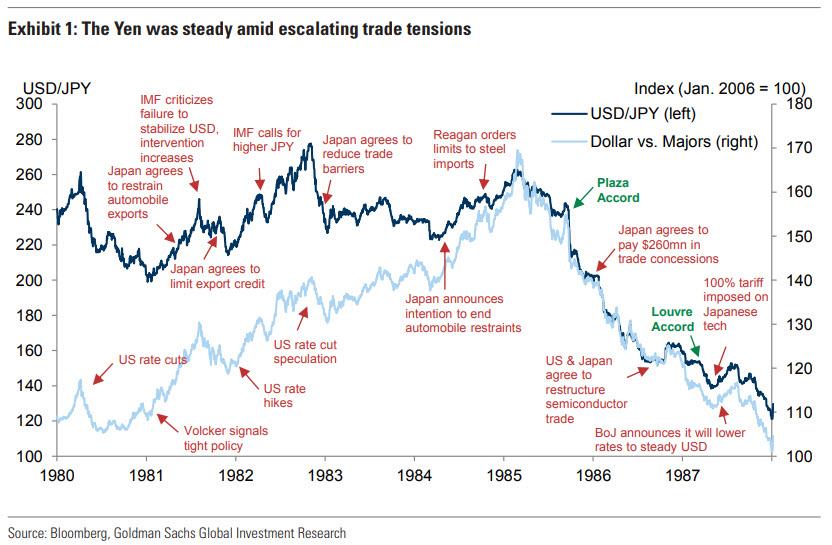
To be sure, it wasn't just trade tensions that help send the dollar surging in the early 1980s: Early in the decade, the combination of tax cuts and the hawkish policies of the Federal Reserve boosted the Dollar against most trading partners: just like much of 2018.
And just like now, growth in the US rose sharply, while growth in the rest of the world picked up only moderately.
Later, the Fed was engaged in a cutting cycle around the time of the Plaza Accord, and the Accord’s success is widely attributed at least in part to the alignment of monetary and currency policy.
So is a Plaza Accord 2.0 imminent, and if so, is the yuan, just like the yen, set to appreciate much higher as the dollar slides? According to Goldman, there are three reasons why the experience with the Yuan has so far been very different to that of the Yen in the 1980s, despite the obvious parallels between the two trade conflicts.
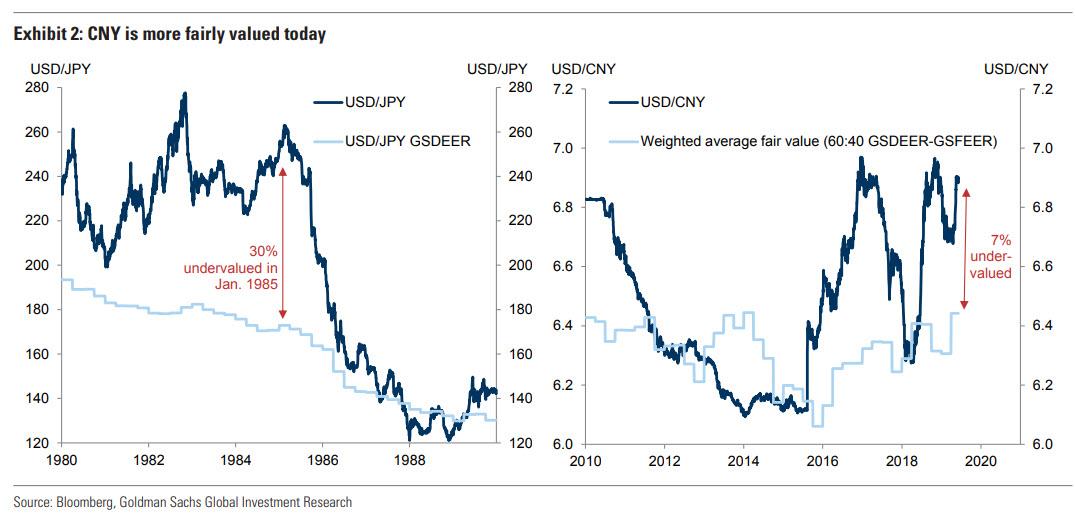
  • First, from a valuation standpoint, it was generally accepted that the Yen was exceptionally cheap before the Plaza Accord was implemented. By contrast, Goldman's  FX strategists think CNY is only slightly undervalued at present levels, so the currency might need to react more to offset new trade barriers.
  • Second, while broad tariffs were occasionally threatened in the 1980s, the “tools of choice” were generally narrow export restrictions against specific industries. In that regime, currency moves cannot directly offset protectionist trade actions, and should be smaller due to their concentrated nature.
  • Finally, and most importantly, the US and Japan were strategic allies even during the trade conflict (especially because Japan relies on the US for military defense). While trade tensions strained the relationship at times, markets likely perceived only a small risk of serious escalation, and Japan often acquiesced to US demands (most prominently in the Plaza Accord itself).
By contrast, the US and China are seen as chief rivals in many ways, and the strategic ties do not run nearly as deep. As a result, markets might more readily price that trade tensions will escalate and sprawl into other policy areas, and China appears less willing to accommodate US requests to change domestic policy. In addition, while Japanese companies were able to offset new trade measures by moving production to the US, Chinese companies would not be able to do this as easily because of security concerns.
It is also is likely that Chinese policymakers might view Japan’s experience with the “lost decade” as a cautionary tale for what might happen if it makes sweeping changes too quickly, and that is setting Goldman's trading strategy today. Taken together, China seems unlikely to be as accommodating as Japan was in the 1980s, and even speculation about potential currency agreements in the now-stalled trade negotiations fell well short of the Plaza Accord.
And yet, as Goldman concludes, there are a number of notable parallels between now and trade tensions in the 1980s, with several key takeaways.
  • First, the US focus on trade deficits—both then and now—is ultimately about competitiveness. The last time around, political pressure on Japan grew, and even prominent “free traders” eventually supported interventionist policies. There is evidence that this is also becoming the case today.
  • Second, while trade policies had some impact, the Dollar traded mostly with economic fundamentals. In the late 1980s, Dollar depreciation coincided with a fading fiscal boost and more accommodative monetary policy that was directionally consistent with the political aim of boosting exports.
So while a Plaza Accord 2.0 may not be imminent - mostly because China would never concede to a treaty that Japan did in the 80s for a very specific set of reasons - Goldman believes that same environment today could result in even more FX volatility, one where the race to the bottom is not contained to an international "accord", but a chaotic race of every man for himself, leading to "choppy Dollar downside in the months ahead."
One final observation: the US trade feud with Japan, and the subsequent Plaza accord, all resulted in the build up of systemic imbalances that eventually culminated with in 1987's Black Monday. What will happen to today's hyperfinancialized world if one Monday morning the market drops 20%, wiping out almost $20 trillion in value in minutes?

Wednesday, June 12, 2019

Big Real Estate Developers Stand Out Amid Liquidity Gloom

Even as India’s developers were hoping for revival from a prolonged slowdown, a cash crunch aggravated the slump last year. But for bigger builders, that’s not a worry. Most large publicly listed developers reported a revenue growth in the quarter ended March. While that was driven by new accounting provisions, the number of units sold and sales value also jumped to its highest in at least five quarters, suggesting a revival in demand. 
That comes when developers are finding it tough to raise money, leading to a consolidation in the industry. Non-bank lenders, their biggest source of cash, face a credit crunch as borrowing costs rose after the surprise defaults of AAA-rated infrastructure conglomerate IL&FS. It worsened the slump triggered by Prime Minister Narendra Modi’s November 2016 move to scrap 86 percent of the currency overnight and a stricter housing law.
 “Stress in levels of demand still continues and a revival has happened in the affordable segment,” Shishir Baijal, chairman and managing director at property consultant Knight Frank, said. 
The luxury and premium segments in Mumbai, the National Capital Region and Pune—the largest real estate markets in India—are yet to pick up, he said. “There is a need to kick-start a stimulation in demand for a total revival.” Anuj Puri, chairman at property consultant Anarock, is optimistic. “It’s a flight to quality,” he said, referring to consolidation amid liquidity crunch. 

“Good developers are doing well, while average developers are doing badly.”
An Anarock survey found that time taken to sell housing inventory across seven metros fell to 30 months as of March, the lowest in the last two years. That suggests homebuyers are returning to the market, taking advantage of favourable property prices, a lower GST rate and cheaper home loan rates, it said.
Investors are betting on growth. Shares of most real estate developers have jumped since September despite the liquidity crunch till election uncertainty led to a pullback. 
And Nifty Realty is the best performing index so far this year with more than 22 percent gains. Prime Minister Narendra Modi’s return to power has further driven expectations as his focus on housing and infrastructure would help developers.
Big Real Estate Developers Stand Out Amid Liquidity Gloom
Fourth-quarter numbers justify the optimism. While revenue rose because of an accounting boost, the number of units sold and sales value jumped.


Godrej Properties 
Six new launches aided Godrej Properties’ operational performance. The developer sold almost 2,900 homes in the quarter ended March, according to its filings. The area sold rose 2.5 times to 3.7 million square feet and booking value crossed Rs 2,100 crore. 

Sobha 
The Bangalore-based developer reported the highest pre-sales at 1.13 million square feet worth Rs 920.5 crore in the fourth quarter. That, the company said in a statement, was buoyed by launches in the affordable segment, especially in Bangalore.

Brigade Enterprises 
Volumes rose to 0.96 million square feet, the highest in at least five quarters. The management said in a conference call that margins expanded by more than 10 percentage points for the hospitality and the leasing segment to 22 percent to 36 percent.

Prestige Estates 
Both area sold and sales value were the highest in at least five quarters at 2.43 million square feet and Rs 1,372.6 crore, respectively. Its margin expanded to 25 percent because of lower management expenses for its commercial properties.

Oberoi Realty
 After adjusting for the benefit of Ind AS 115, revenue jumped 30 percent because of higher bookings for its project in Borivali, Mumbai and better sales at Oberoi Esquire in Goregaon, Mumbai.

Laggards
 DLF Ltd.’s revenue rose 82 percent because of Ind AS 115 boost to Rs 1,832 crore. Its rental portfolio grew on stable occupancy levels, ICICI Direct Research said in a note. But the company is still restructuring its debt.

The management said in an analyst conference that its Rs 3,170 crore qualified institutional placement and rental portfolio led to better cash flows. DLF became a key beneficiary in the consolidation of the industry, it said. Indiabulls Real Estate’s revenue fell 10 percent to Rs 1,822 crore. The company is yet to disclose quarterly sales details.

Outlook Developers expect sentiment to improve in the ongoing financial year. Higher sales in Bangalore will lead to double-digit operational growth, JC Sharma, managing director at Sobha, told BloombergQuint in an interview.

Venkat Narayana, chief financial officer at Prestige Estates, said the revival is seen in the mid-income realty projects with good demand in Bangalore and Hyderabad. The organised players, he said, are gaining from supply consolidation.

Godrej Properties is seeing traction in the affordable and mid-income housing segment. Pirojsha Godrej, executive chairman at the company, said the developer has a robust launch portfolio for 2019-20. Stressed assets and liquidity crunch will provide opportunity for consolidation, she said.

Tuesday, June 11, 2019

"In Gold We Trust": Waning Confidence In US Sends World's Central Banks On Buying Spree.

Governments around the world have recently been on a “gold-buying spree.” These countries have a tactful reason for doing so, and this reason is directly tied to the anticipation of the inevitable end of US hegemony.
Central banks are among the largest purchasers of gold. So far in 2019, they have bought 145.5 tons of gold, which is more, in a quarter of a year, than central banks have purchased in the preceding six years. To put it bluntly, this figure represents a 68 percent increase from the year before. Last year, central banks increased their reserves by 651.5 tonnes compared to 375 tonnes in 2017. Reportedly, this is the largest net purchase of gold since 1967.

Most interesting, however, is the class of countries that we find are turning to hoarding more and more gold, many of which are deemed to be adversaries of Washington.
As always, Russia is the largest buyer of gold. In 2018, Russia’s Central Bank purchased 274.3 tons of gold. It also dumped 84 percent of its US treasury debts (we will come back to why this is important later.)
Turkey, another country which has signalled a shift away from the US-EU alliance and a greater willingness to cooperate with US economic and military rivals such as Russia, China, and even Iran, has sold off around 38 percent of its US debt and purchased more and more gold.
Other notable nations increasing their gold supply include Kazakhstan , Ecuador, Qatar, Serbia and Colombia, according to recent statistics. Even the Philippines has joined the gold-bandwagon, increasing its gold holdings in foreign reserves, as well as passing gold-specific legislation to assist small-scale miners in the country.

Why gold?

As a commodity, gold is interesting for a number of reasons. While many countries may have a vested interest in moving away from the stranglehold of the US and rely less and less on the dollar, we still have to ask ourselves: why would gold provide a meaningful solution in the interim?
Well, as Incrementum AG’s annual “In Gold We Trust” report explains:“trust looks to the future, forms itself in the present, and feeds itself from the past. As monetary asset, gold can look back on a successful five-thousand-year history in which it was able to maintain its purchasing power over long periods of time and never became worthless. Gold is the universal reserve asset to which central banks, investors, and private individuals from every corner of the world and of every religion and every class return again and again.”
You see, this isn’t just about a secret, twisted desire of a handful of nations who seek the destruction of the United States economy. In fact, I would venture to say it is the complete opposite. It is about the erosion of trust. The United States can no longer be trusted to act fairly on the international stage. It imposes its will on other nations, using the leverage it maintains over the US dollar to strongarm countries into submission. As Iranian Foreign Minister Mohammad Javad Zarifsaid in a recent interview:
“This is what I believe is happening to the international community…that is people think twice before they talk to the United States because the know that what they agree today may not hold tomorrow.”
Essentially, gold gives people “comfort.” You don’t have to go too far to see this type of thinking spreading to nations which once were regarded as close allies of Washington. According to a Malaysian outlet called Free Malaysia Today, Malaysian Prime Minister Dr Mahathir Mohamad recently called for the formation of a new currency backed by gold, which he believed would protect East Asian economies from trader manipulation.
He also reportedly spoke about the influence of the US and how it was not advantageous for the international financial markets to be tied to a single currency belonging to a nation state.
“You [the US] are not democratic,” Mohamad said. “That is not for any single power to decide. If you want to live in a united world, a stable world, we must resort to sustainability through agreement between all nations that have a stake in that problem.”

Washington’s economic Achilles heel

Once upon a time, the US dollar was backed by the gold standard in a framework known as the Bretton-Woods agreement. The system ended up being short-lived, as President Richard Nixon announced that the US would be abandoning the gold standard in 1971. Instead, the Nixon Administration reached a deal with Saudi Arabia which became known as the Petrodollar Recycling system as the nations involved would have to invest excess profits back into the US. Sooner or later, every single member of OPEC had begun trading oil in US dollars.
While typically written off as a conspiracy theory, a widely undervalued economic theory stipulates that Washington’s ability to dominate the global financial markets is predominantly explained by the fact that all oil exports are conducted in transactions involving the US dollar on the international market (with only a small number of exceptions). The US dollar is also the world reserve currency, meaning most global transactions are done using the dollar anyway.
Even mainstream magazines who reject the theory – such as Foreign Policy – are forced to note that:
“It does matter slightly that the trade typically takes place in dollars. This means that those wishing to buy oil must acquire dollars to buy the oil, which increases the demand for dollars in world financial markets.”
Those people who write this arrangement off as a conspiracy theory just aren’t reading the right commentaries. As far back as 1989, writing in his book The Roaring ‘80s, former Rhodes Scholar, Emmy Award-winning TV host, and Wall Street insider George Goodman (a.k.a. Adam Smith) brilliantly explained why the US dollar was so strong and had yet to have had its bubble popped:
“First, we have a large reservoir of moral credit from our position as a world military leader and from our past as an investor and lender. Second, the dollar is the key currency. Dollars are what the world banks in, insures in, denominates. Before the dollar, it was the pound sterling, and the British got an extension on the tenure of their empire because the world hadn’t found another currency in which to denominate. If you operate in the key currency, it takes longer for the whistle to blow.” 
Even if it was a crazy, baseless conspiracy theory for fringe YouTube communities, these are the terms in which the rest of the world certainly views this one-sided financial arrangement. This line of thinking also explains why the US uses its stranglehold over the dollar to bully other countries into submission through the use of sanctions. It also explains why other nations see Washington’s power over the global financial sector as its Achilles heel ultimately.
As stated by the head of Russia’s second largest bank Andrei Kostin in a speech last year:
“The reign of the dollar must end...This whip that the Americans use in the form of the dollar would then, to a great extent, not have such a serious impact on the global financial system.”

Monday, June 10, 2019

Paul Craig Roberts: "That America" Is Gone

The story line is going out that the economic boom is weakening and the Federal Reserve has to get the printing press running again.  The Fed uses the money to purchase bonds, which drives up the prices of bonds and lowers the interest rate.  The theory is that the lower interest rate encourages consumer spending and business investment and that this increase in consumer and business spending results in more output and employment.
The Federal Reserve, European Central Bank, and Bank of England have been wedded to this policy for a decade, and the Japanese for longer, without stimulating business investment.  Rather than borrowing at low interest rates in order to invest more, corporations borrowed in order to buy back their stock.  In other words, some corporations after using all their profits to buy back their own stock went into debt in order to further reduce their market capitalization!  
Far from stimulating business investment, the liquidity supplied by the Federal Reserve drove up stock and bond prices and spilled over into real estate.  The fact that corporations used their profits to buy back their shares rather than to invest in new capacity means that the corporations  did not experience a booming economy with good investment opportunities. It is a poor economy when the best investment for a company is to repurchase its own shares.

Consumers, devoid of real income growth, maintained their living standards by going deeper into debt.  This process was aided, for example, by stretching out car payments from three years to six and seven years, with the result that loan balances exceed the value of the vehicles.  Many households live on credit cards by paying the minimum amount, with the result that their indebtedness grows by the month. The Federal Reserve’s low interest rates are not reciprocated by the high credit card interest rate on outstanding balances.
Some European countries now have negative interest rates, which means that the bank does not pay you interest on your deposit, but charges you a fee for holding your money.  In other words, you are charged an interest rate for having money in a bank.  One reason for this is the belief of neoliberal economists that consumers would prefer to spend their money than to watch it gradually wither away and that the spending will drive the economy to higher growth.
What is the growth rate of the economy?  It is difficult to know, because the measures of inflation have been tampered with in order to avoid cost-of-living adjustments for Social Security recipients and the payment of COLA adjustments in contracts. The consumer price index is a basket of goods that represents an average household’s expenditures.  The weights of the items in the index are estimates of the percentage of the household budget that is spent on those items.  A rise in the prices of items in the index would raise the index by the weight of those items, and this was the measure of inflation.
Changes were made that reduced the inflation that the index measured.  One change was to substitute a lower price alternative when an item in the index rose in price.  Another was to designate a rise in price of an item as a quality improvement and not count it as inflation. 
Something similar was done to the producer price index which is used to deflate nominal GDP in order to measure real economic growth.  GDP is measured in terms of money, and some of the growth in the measure is due to price increases rather than to more output of goods and services.  In order to have a good estimate of how much real output has increased, it is necessary to deflate the nominal measure of GDP by taking out the price rises.  If inflation is underestimated, then real GDP will be overestimated. When John Williams of Shadowstats adjusts the real GDP measure for what he calculates is a two-percentage point understatement of annual inflation, there has been very little economic growth since 2009 when a recovery allegedly began, and the economy remains far below its pre-recession level in 2008.
In other words, the belief that the US has had a decade long economic recovery is likely to be an illusion produced by underestimating  inflation.  Indeed, every day experience with the prices of food, clothing, household goods, and services indicates a higher rate of inflation than is officially reported.
The low unemployment rate that is reported is also an illusion.  The government achieves the low rate by not counting the unemployed.  The economic and psychological cost of searching for a job are high.  There are the economic costs of a presentable appearance and transport to the interview. For a person without a pay check, these costs rapidly mount.  The psychological costs of failure to find a job time after time also mount.  People become discouraged and cease looking.  The government treats discouraged workers who cannot find jobs as no longer being in the work force and omits them from the measure of unemployment.  John Williams estimates that the real rate of US unemployment is 20%, not 3.5%
The decline in the labor force participation rate supports Williams’ conclusion.  Normally, a booming economy, which is what 3.5% unemployment represents, would have a rising labor force participation rate as people enter the work force to take advantage of the employment opportunities.  However, during the alleged ten year boom, the participation rate has fallen, an indication of poor job opportunities.
The government measures jobs in two ways: the payroll jobs report that seeks to measure the new jobs created each month (which is not a measure of employment as a person may hold two or more jobs)  and the household survey that seeks to measure employment. The results are usually at odds and cannot be reconciled.What does seem to emerge is that the new jobs reported are for the most part low productivity, low value-added, lowly paid jobs. Another conclusion is that the number of full time jobs with benefits are declining and the number of part-time jobs are rising. 
A case could be made that US living standards have declined since the 1950s when one income was sufficient to support a family.  The husband took the slings and arrows of the work experience, and the wife provided household services such as home cooked nutritious meals, child care, clean clothes, and an orderly existence.  Today most households require two earners to make ends meet and then only barely.  Saving is a declining option.  A Federal Reserve report a couple of years ago concluded that about half of American households could not produce $400 cash unless personal possessions were sold.
As the Federal Reserve’s low interest rate policy has not served ordinary Americans or spurred investment in new plant and equipment, who has it served? The answer is corporate executives and shareholders.  As the liquidity supplied by the Federal Reserve has gone mainly into the prices of financial assets, it is the owners of these assets who have benefited from the Federal Reserve’s policy.  Years ago Congress in its unwisdom capped the amount of executive pay that could be deducted as a business expense at one million dollars unless performance related.  What “performance related” means is a rise in profits and share price.  Corporate boards and executives achieved “performance” by reducing labor costs by moving jobs offshore and by using profits and borrowing in order to buy back the company’s shares, thus driving up the price.
In other words, corporate leaders and owners benefited by harming the US economy, the careers and livelihoods of the American work force, and their own companies.
This is the reason for the extraordinary worsening of the income and wealth distribution in the United States that is polarizing the US into a handful of mega-rich and a multitude of have-nots.
The America I grew up in was an opportunity society.  There were ladders of upward mobility that could be climbed on merit alone without requiring family status or social and political connections.  Instate college tuition was low.  Most families could manage it, and the students of those families that could not afford the cost worked their way through university with part time jobs. Student loans were unknown.
That America is gone.
The few economists capable of thought wonder about the high price/earnings ratios of US stocks and the 26,000 Dow Jones when stock buy-backs indicate that US corporations see no investment opportunities.  How can stock prices be so high when corporations see no growth in US consumer income that would justify investment in the US? 
When President Reagan’s supply-side economic policy got the Dow Jones up to 1,000 the US still had a real economy. How can it be that today with America’s economy hollowed out the Dow Jones is 25 or 26 times higher?  Manipulation plays a role in the answer. In Reagan’s last year in office, the George H.W. Bush forces created the Working Group on Financial Markets, otherwise known as the “plunge protection team,” the purpose of which was to prevent a stock market fall that would deny Bush the Republican nomination and the presidency as Reagan’s successor.  The Bush people did not want any replay of October 1987. 
The plunge protection team brought together the Federal Reserve, Treasury, and Securities and Exchange Commission in a format that could intervene in the stock market to prevent a fall. The easiest way to do this is, when faced with falling stock prices, to step in and purchase S&P futures. Hedge funds follow the leader and the market decline is arrested.
The Federal Reserve now has the ability to intervene in any financial market.  Dave Kranzler and I have shown repeatedly how the Federal Reserve or its proxies intervene in the gold market to support the value of the excessively-supplied US dollar by printing naked gold contracts to drop on the gold futures market in order to knock down the price of gold. A rising gold price would show that the dollar support arrangements that the Federal Reserve has with other central banks to maintain the illusion of a strong dollar is a contrived arrangement rejected by the gold market.
What few, if any, economists and financial market commentators understand is that today all markets are rigged by the plunge protection team.  For at least a decade it has not been possible to evaluate the financial situation by relying on traditional thinking and methods.  Rigged markets do not respond in the way that competitive markets respond.  This is the explanation why companies that see no investment opportunities for their profits better than the repurchase of their own shares can have high price/earnings ratios.  This is the explanation why the market’s effort to bring stock prices in line with realistic price/earnings ratios is unsuccessful.
As far as I can surmise, the Federal Reserve and plunge protection team can continue to rig the financial markets for the mega-rich until the US dollar loses its role as world reserve currency.

Friday, June 07, 2019

Why managers should listen to shareholders

Ignoring investor concerns often does more harm than good.


ARTHUR BALFOUR was a British prime minister who did not think much of his party members. “I’d rather take advice from my valet than from the Conservative Party conference,” he said. Corporate executives, particularly in America, seem to take a similar attitude towards their shareholders, believing that, like children, they should be seen but definitely not heard.
Maybe managers should get their fingers out of their ears and start listening to their investors. That is the conclusion of a recent paper by Clifford Holderness of the Carroll School of Management at Boston College.
In America and a few other countries, boards can issue additional shares without shareholder approval. In some countries, shareholders must approve issuance above a certain threshold. And in yet others, investors must agree before any new stock can be created. So what happens to a company’s share price when new shares are issued? Mr Holderness performed a meta-analysis of more than 100 studies of stock reactions around the world. He found that, when shareholders approved issuance in advance, the price tended to rise by an average of 2%. But when managers issued stock without shareholder approval, the share price declined by an average of 2%.
The simplest explanation for this differential lies in the agent-principal conflict between executives and investors. As Mr Holderness writes, if agency conflicts did not exist, “shareholder voting on equity issuance should not matter.” However, managers may want to issue shares to fund expansion of the company, allowing them to control more assets and demand a higher salary. Investors, meanwhile, may worry about the impact of such expansion on long-term returns and dislike the dilution of their control.
Another sign of agent-principal conflicts are shares that are privately placed with selected investors or used to pay for takeovers. In Australia, any offering of more than 15% of the equity must be subject to shareholder approval; in America, the threshold is 20%. In both countries, there is a clustering of share issuance just below the limit; managers go out of their way to avoid asking for approval. In April Occidental Petroleum promised $10bn worth of preferred shares to Berkshire Hathaway, Warren Buffett’s conglomerate, should the oil company’s bid for Anadarko, a rival, succeed. This injection helped it avoid asking shareholders to authorise the Anadarko deal.
This disdain for shareholders’ views contradicts the ethos of American capitalism. The system works, it is usually argued, because companies respond to shareholder pressure and because broad share ownership gives everyone, including workers, a stake in the American dream. One of the reasons for the success of the private-equity model is that investors enjoy greater scrutiny over what managers do.
But when it comes to public companies, shareholders tend to be treated like an awkward uncle at a family gathering. Their only rights are to sell their shares or to vote against the reappointment of directors. In any other field, this would be extraordinary. Imagine you appointed a letting agent to look after your house and they decided to spend lots of your money on gold taps and chandeliers. When you complain, they respond that you are only entitled to sell the house, or fire them at the end of their contract.
Managers have long grumbled that shareholders want to interfere too much. A new complaint is that socially conscious investors may insist that firms concentrate on non-financial factors, like treating workers better or cutting emissions. This concern seems ill-founded. For example, research shows that companies voted the “best to work for” produce superior subsequent long-term returns.
More generally, the majority of metastudies have found that companies with better ESG (environmental, social and governance) records improved their financial performance. Mr Holderness’s work puts the tin lid on the argument that managers should ignore investors. When it comes to shareholders, managers should remember the words of Diogenes: “We have two ears and one tongue so that we would listen more and talk less.”