About Me

My photo
An Investor and counsellor in Financial Market

Thursday, November 15, 2018

What Will The Next Global Economic Crisis Look Like?

Bubble

With the 10th anniversary of the Lehman Brothers bankruptcy having just passed and the recent stock market drop, the fear of a new financial crisis is palpable.
And those fears are justified. The question is not whether there will be a crisis, but when? In the past 50 years, we have seen more than eight global crises and many more local ones, so the likelihood of another one is quite high. Not just because of the years passed since the 2007 crisis, but because the factors that typically lead to a global crisis are all lining up.
What Leads to a Financial Crisis?
There are primarily three factors.
First, demand-side policies that lead investors and citizens to believe that there is no risk. Complacency and excess risk-taking cannot happen without the existence of a widespread belief that there is a safety net, a government or central bank cushion that will support risky assets. Terms like “search for yield” and “financial repression” come precisely from artificial demand signals created from monetary and political forces.
Second, excessive risk-taking in assets that are perceived as risk-free or bullet-proof. It is impossible to build a bubble on an asset where investors and companies see an extraordinary risk. It must happen under the belief that there is no risk attached to rising valuations because “this time is different,” “fundamentals have changed” or “there is a new paradigm,” sentences we have all heard more times than we should in the past years.


And the third factor, the realization that this time is different. Bubbles do not burst because of one catalyst, as we are taught to believe. The 2007–2008 crisis did not start because of Lehman; it was just a symptom of a much wider problem that had started to cause small bursts months before—excess leverage to a growth cycle that fails to materialize as the consensus expected.
What Are Immediate Triggers of the Next Financial Crisis?
Sovereign debt. The riskiest asset today is sovereign bonds at abnormally low yields, compressed by central bank policies. With $6.5 trillion in negative-yielding bonds, the nominal and real losses in pension funds will likely be added to the losses in other asset classes.
The incorrect perception of liquidity and value at risk. Years of high asset correlation and synchronized bubble spearheaded by sovereign debt have led investors to believe that there is always a massive amount of liquidity waiting to buy the dips to catch the rally.
This is simply a myth. That “massive liquidity” is just leverage, and when margin calls and losses start to appear in different areas—emerging markets, European equities, U.S. tech stocks—the liquidity that most investors count on to continue to fuel the rally simply vanishes. Why? Because value at risk is also incorrectly calculated.
When assets reach an abnormal level of correlation and volatility is dampened due to massive central bank asset purchases, the analysis of risk and probable losses is simply ineffective. When markets fall, they fall in tandem, as we are seeing lately. The historical analysis of losses is contaminated by the massive impact of monetary policy actions in those years. When the biggest driver of asset price inflation—central banks—starts to unwind or simply becomes part of the expected liquidity—like in Japan—the placebo effect of monetary policy on risky assets vanishes and losses pile up.
The fallacy of synchronized growth triggered the beginning of what could lead to the next recession - a generalized belief that monetary policy had been very effective, growth was robust and generalized and debt increases were just collateral damage but not a global concern. With the fallacy of synchronized growth came excess complacency and acceleration of imbalances.
The 2007 crisis erupted because in 2005 and 2006 even the most prudent investors gave up and surrendered to the rising-market beta chase. In 2017 it was accelerated by the incorrect belief that emerging markets were fine because their stocks and bonds were soaring despite the Federal Reserve interest rate normalization.
What Will the Next Financial Crisis Look Like?
Nothing like the last one, in my opinion. Contagion is much more difficult because there have been some lessons learned from the Lehman crisis. There are stronger mechanisms to avoid a widespread domino effect in the banking system.
When the biggest bubble is sovereign debt, the crisis we face is not one of the massive financial market losses and real economy contagion, but a slow fall in asset prices—as we are seeing—and global stagnation.
The next crisis is not likely to be another Lehman, but another Japan - a widespread zombification of global economies to avoid the pain of a large repricing of sovereign bonds, which leads to massive tax hikes to pay the rising interests, economic recession, and unemployment.
Future Risks
The risks are obviously difficult to analyze because the world entered into the biggest monetary experiment in history with no understanding of the side effects and real risks attached. Governments and central banks saw rising markets above fundamental levels and record levels of debt as small but acceptable problems in the quest for a synchronized growth that was never going to happen.
The next crisis, like 2007-2008, will be blamed on a symptom (Lehman in that case), not the real cause - aggressive monetary policy incentivising risk-taking and penalizing prudence. The next crisis, however, will find central banks with almost no real tools to disguise structural problems with liquidity and no fiscal space in a world where most economies are running fiscal deficits for the 10th consecutive year, and global debt is at all-time highs.
When will it happen? We do not know, but if the warning signs of 2018 are not taken seriously, it will likely occur earlier than expected.
However, the governments and central banks will not blame themselves; they will present themselves - again - as the solution.

Wednesday, November 14, 2018

Why house prices in global cities are falling

Housing in the posher parts of global cities has become a distinct asset class

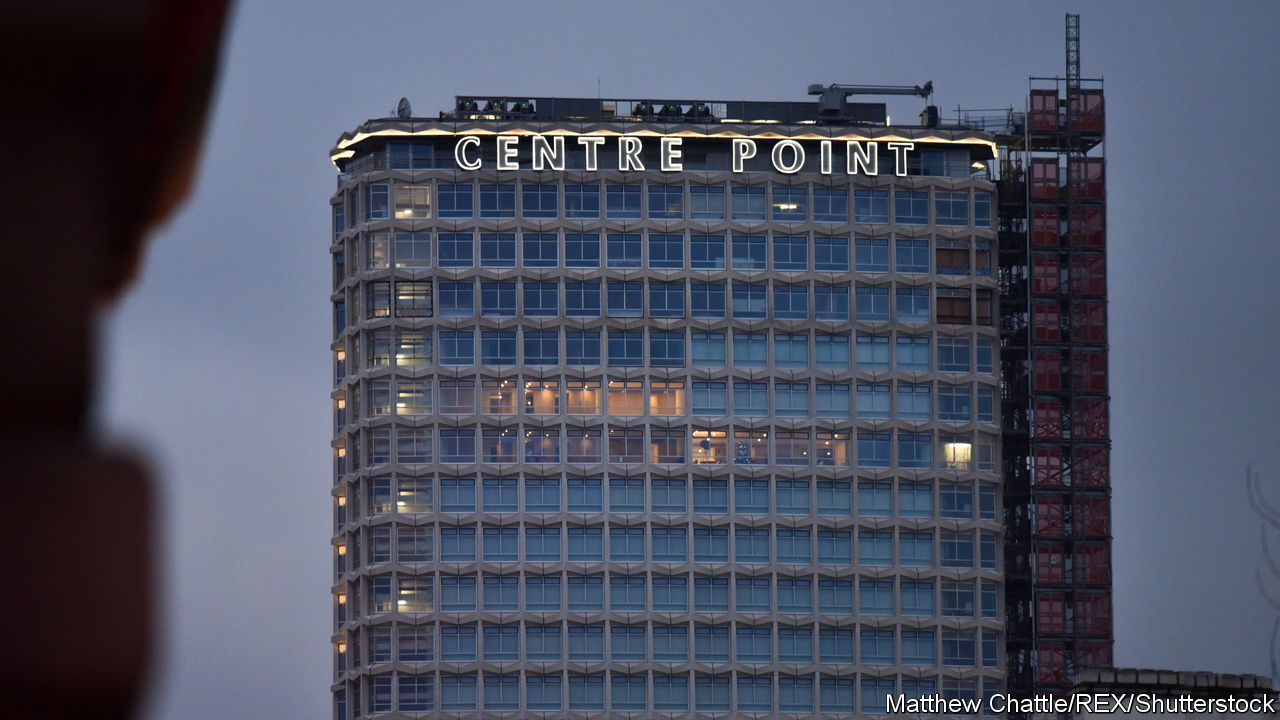
Centre Point, a tower that looms over central London, was empty for so long in the 1970s that it lent its name to a homelessness charity. Recently it was converted from offices to flats. Half are yet to find buyers. So the developer has taken them off the market pending a clearing of the political fog over Britain. Its boss complained to Estates Gazette, a trade paper, of bids that were “detached from reality”. One-bedroom flats were on sale for £1.8m ($2.4m).
Even flats with less hefty price tags have been hard to shift lately. Property prices in London are falling. Sellers are waiting for better prices. It is tempting to put all the blame on Brexit, but that would ignore the broader picture. House prices in big global cities increasingly move together. What happens in London has a growing influence on what happens in New York, Toronto and Sydney—and vice versa. And trouble is brewing in some of these other markets, too.
Property used to be thought of as an inflation hedge. But in recent years it has become a substitute for low-yielding Treasury bonds—a safe asset in which the globally mobile can store their wealth. After years of rapid price rises, houses in the most favoured markets are overvalued. Rising bond yields, tighter mortgage credit and shifting politics are now combining to push prices down.
The value of homes in the posher parts of global cities move in sync because they have become a distinct asset class. Private-equity firms and investment trusts, not just individuals, own them. Prices in such cities are explained more by global factors, such as the yields on the safest government bonds, than by local conditions. This global influence is particularly marked in financial centres that are open to capital flows, such as London, New York, Toronto and Sydney. It has extended into smaller European cities, such as Amsterdam.
Demand from emerging markets such as China and Russia has been growing. Buyers are willing to pay steeply to secure a safe place for their savings—or a bolthole for themselves. Cristian Badarinza of the National University of Singapore and Tarun Ramadorai of Imperial College London have shown that political trouble in Russia, parts of Africa and the Middle East predicts a rise in the price of prime London property. The same sort of influence is also found in less ritzy neighbourhoods, says Mr Ramadorai. For instance, property prices in Hounslow and Southall, which have lots of settlers from South Asia, picked up in the early 2000s, a period of political tensions in India.
Foreign demand has spillovers. If an oligarch buys a house, it drives up the prices of smaller properties nearby. A paper by Dragana Cvijanovic of the University of North Carolina and Christophe Spaenjers of hec Paris finds similar effects in Paris’s property market. Foreign buyers, mostly from China, have been a force behind booms in the big cities of Australia and Canada.
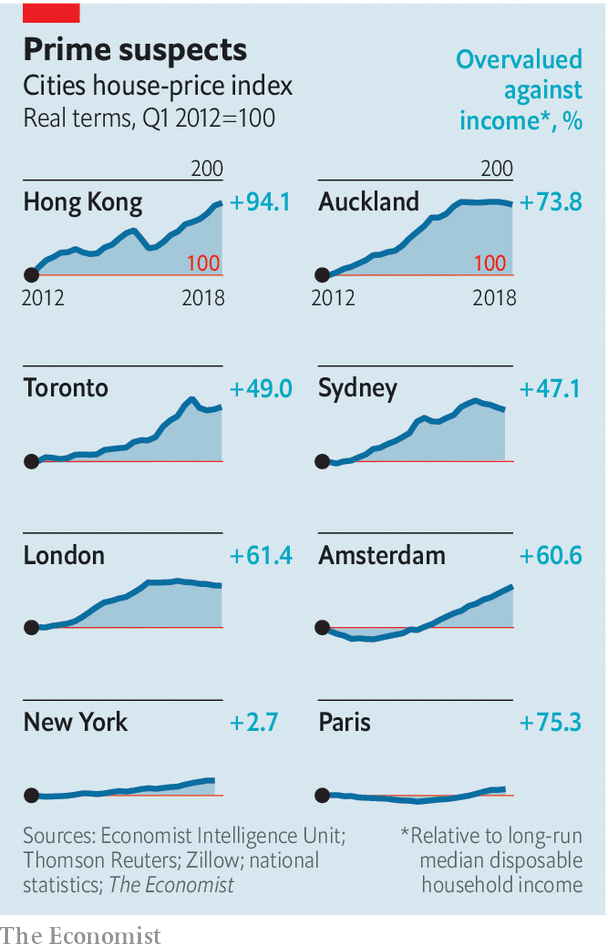
But the tide has changed. Global cities look awfully dear. The rental yield on investment homes worldwide fell below 5% for the first time ever in 2016, according to msci ipd, a financial-information firm. House prices relative to incomes are well above their long-run average in Amsterdam, Auckland, London, Paris, Sydney and Toronto (see chart).
And prices are falling in some of the dearer cities, in response to a variety of forces. The yield on Treasury bonds, the world’s benchmark safe asset, is rising. A tightening of credit standards on mortgages in Australia and Canada has squeezed housing in cities there. Uncertainty about Brexit has made London a place of political risk rather than a refuge from it. Meanwhile, capital is moving less freely. Governments are charier of Russian money. China is shaking down its super-rich for taxes and is zealous in its policing of capital outflows.
A corollary of stronger links between global cities is a kind of “waterbed” effect. For instance, when taxes were levied on foreign homebuyers in Vancouver in 2016, the market cooled, but Toronto took off. There are buyers who will compare prices in, say, Mayfair in London and Park Avenue, New York. They look for value. But it is vanishingly scarce. The market is turning. Those who bought at the peak, or are hoping to sell, will slowly adjust to a new reality.

Tuesday, November 13, 2018

The mid-terms produce a divided government for a divided country

A recipe for gridlock, poor governance and disenchantment with the political system.

 For once the outcome that was predicted actually occurred. Democrats took the House of Representatives in America’s mid-term elections on November 6th, and will provide some welcome oversight of the White House when members of the new Congress take their seats in January. Republicans held the Senate—with a bigger majority, which will make presidential appointments easier to confirm. Both sides declared victory. A starkly divided country now has a divided government. Underpinning the results, though, is the deepening of a structural shift in American politics that will make the country harder to govern for the foreseeable future. Democrats represent a majority of America’s voters, but Republicans dominate geographically.
Democrats won the popular vote for the House of Representatives by a comfortable margin. Their position as the party that enjoys most support among Americans, thanks to its strength in urban centres, was reinforced by a surge in support from the suburbs, where revulsion with President Donald Trump was evident. Meanwhile Republicans tightened their grip on less populous, more rural states, easily beating Democratic senators in Indiana, Missouri and North Dakota. In a country where one chamber of the legislature is based on population and the other on territory, this division is a recipe for gridlock, poor governance and, eventually, disenchantment with the political system itself.
The breadth of the divide is striking. Ten years ago there were 17 states with one Republican senator and one Democratic one. From January 2019 there will be just seven. In federal elections hardly any candidates seem able to survive in opposition-party territory. Only six Democratic senators won their elections in states carried by Mr Trump in 2016. The picture is less stark for governors, but in statehouses the pattern reasserts itself. From January Minnesota will be the only state where one chamber is controlled by Democrats and the other by Republicans. The last time that was the case was back in 1914.
This equilibrium may be stable, but it is damaging for the country and for both parties. For the Republicans, the danger is a long-term one. For now, they hold the White House and have an increased majority in the Senate. But in a two-party system, a party that prevails while consistently failing to capture a majority of votes will one day find it is no longer seen as exercising power legitimately by a majority of voters. For the Democrats, the challenge is immediate. They may rail against a system that disadvantages them in structural ways, but cannot change that system until they can work out how to win within it. Running up vast vote shares in New York and California is all very well, but on its own will not deliver a governing majority.
What is the way out of this impasse? The main onus is now on the Democrats. For their own good, not to mention the country’s, they have to find ways to appeal in America’s heartland.
That starts with exercising restraint. Yes, they should use their majority in the House to scrutinise a president who shows contempt for the norms that have constrained past presidents. They should look carefully at what has been going on in federal agencies, and investigate possible presidential abuses of power or misuse of the office for personal aggrandisement. But Democrats should resist the urge to use their majority in the House to take revenge, hounding the president in the way that Newt Gingrich and his Republican colleagues once hounded Bill Clinton. Prosecution should be left to prosecutors. It is not obvious, for instance, that there would be much to gain by investigating the circumstances of Justice Brett Kavanaugh’s confirmation to the Supreme Court. There is certainly no ground to impeach him, as some Democrats want.
A second Democratic priority should be to show that they have the ideas and capacity for governing that can appeal to a broader swathe of voters. One way to do so is to make a good-faith effort to work with the president and the Republicans. There are deals to be done on infrastructure and on drug prices. They also need to make immigration less toxic (see article).
In 2010, when Republicans won the House during Barack Obama’s presidency and proceeded to block everything Democrats wanted to do, the White House argued that it was unjust for half of one branch of the federal government to stand in the way of everything else. That was right then and it is right now. House Democrats should not declare, as Mitch McConnell once did, that they will oppose everything the president does. There should be no repeat of the hostage-taking that saw the Republican House flirt with a sovereign default during Mr Obama’s second term.
Plenty of Democrats will counsel against holding back, arguing that the scorched-earth strategy that the Republicans used when they had a majority in the House worked perfectly well for them. Why, they will ask, should Democrats be the party of compromise in the name of better government, when their opponents have so often refused to give an inch?
For two reasons. First, it might just yield results. Admittedly, Mr Trump’s recent behaviour does not bode well. Accusing Democrats of facilitating the murder of policemen, as he did in the closing stages of the campaign, is not the best way to foster bipartisan spirits. Mr Trump could give up on the idea of signing any legislation in the next two years, preferring to rule by executive order, while ranting against the opposition.
But he may also surprise, proving more willing to deal with Democrats than other Republican presidents have been. The Trump motivating principle is self-interest rather than party loyalty. He has proved willing to discard some long-standing party positions, for good and ill. The role of dealmaker-in-chief could rather suit his ego.
Second, even if bipartisan efforts fail, behaving responsibly is in Democrats’ long-term interests. By and large, Democrats want the federal government to work well. Republicans, by contrast, still consider the words “I’m from the government and I’m here to help” to be a micro-aggression. Gridlock does nothing for confidence in government, which is something Democrats need if they are to win more voters’ confidence. Like it or not, they have more to lose from dysfunction than Republicans do.

Monday, November 12, 2018

When does the case for long-term investment make sense?

Paul Samuelson showed why time horizons matter less than commonly thought

ONE LUNCHTIME around 1960 a professor proposed a wager to a colleague. Flip a coin and call “heads” or “tails”. If you call right, you win $200. If you call wrong, you pay $100. This is a favourable bet for anyone who would take it. Even so, his colleague refused. He would feel the loss of $100 more than the gain of $200. But he would be happy, he said, to take 100 such bets.
The professor who offered the bet, Paul Samuelson, understood why it might be refused. A person’s capacity for risk could no more be changed than his nose, he once said. But he was irked by his colleague’s willingness to take 100 such wagers. Yes, the likelihood of losing money after that many tosses of the coin is vanishingly small. But someone who takes very many bets is also exposed to a small chance of far bigger loss. A lot of bets, reasoned Samuelson, were no safer than a single bet.

This lunchtime wager was of more than academic interest. It drew the battle lines in a debate on the merits of long-termism. Samuelson challenged the conventional wisdom that his colleague embodied. In later work, he used the bet as a parable. He showed that, under certain conditions, investors should keep the same fraction of their portfolios in risky stocks whether they are investing for one month or a hundred months. But what Samuelson’s logic assumed does not always hold. There are cases where a long-term horizon works in investors’ favour.

To understand the debate, start with the law of large numbers. It means that the more often a favourable gamble is repeated, the more likely it is that the person who takes it comes out ahead. Though a casino may lose on a single spin of the roulette wheel, over a large number of spins its profits are determined by the slight advantage in odds (the “house edge”) it enjoys. But a casino that would take a hundred $100 bets would not refuse a single bet of the same size. That was part of Samuelson’s beef. If his colleague dislikes a single bet, after 99 bets he should refuse the 100th. By this logic he should also refuse the 99th bet, after 98 bets. And so on until all bets are spurned.

Clouds on the horizon
Only a naive reading of the law of large numbers would support a belief that risk is diminished by more bets, said Samuelson. The scale of potential losses rises with the number of bets. “If it hurts much to lose $100,” he wrote, “it must certainly hurt to lose 100 x $100.” Similarly, it is foolish to believe that by holding stocks for the long haul—taking multiple bets on them—you are sure to come out ahead. It is true that stocks have usually yielded higher returns than bonds or cash over a long period. But there is no guarantee they will always do so. Indeed if stock prices follow a “random walk” (ie, an erratic and unpredictable path), long-term investing holds no advantage, said Samuelson.

This logic begins to fray if you relax the random-walk assumption. Stock prices appear to fluctuate around a discernible trend; they have a tendency, albeit weak, to revert to that trend over very long horizons. That means stocks are somewhat predictable. If they go up a long way, given enough time they are likely to fall, and vice versa. In that case, more nervous sorts of investors are able to bear a higher exposure to stocks in the long run than they would be able to in the short run.

Samuelson’s reasoning also assumes that people’s taste for risk does not vary with how rich or poor they are. In reality, attitudes change when a target level of wealth is within reach (say, to pay for retirement or a child’s education) or when outright poverty looms. When such extremes are far off, it is rational to take on more risk than when they are close. The calculus also changes with a broader reckoning of wealth. Young people, with decades of work ahead, hold most of their wealth in “human capital”, their skills and abilities. This sort of wealth is a hedge against riskier kinds of financial wealth. Indeed the more stable a person’s career earnings are, the greater the hedge. It follows that young people should hold more of their wealth in risky stocks than people who are close to retirement.

Samuelson vigorously disputed the dogma of long-termism, which says that the riskiness of stocks diminishes as time passes. It doesn’t. That is why long-dated options to insure against falling stocks are dearer than short-dated ones. The odds of winning favour risk-takers over time. But they are exposed to big losses in the times when they lose. Still, it would also be dogmatic to say that time horizon does not matter. It does—in some circumstances. What Samuelson showed is that it matters less than commonly thought.

Friday, November 09, 2018

Energy efficiency is good for consumers. And for the planet?

Rebound effects are tricky to estimate

On oct 19th the International Energy Agency reported that doubling world gdp by 2040 would require only a small rise in energy demand if everyone adopted strict standards, like Japan’s for vehicle-fuel efficiency. That, the forecaster says, would be great news for consumers and the climate alike. Higher efficiency means less fossil fuel must be burned—and less planet-cooking gas belched—to power the global economy. But some economists are not so sure.
As nations grow wealthier, they have used more energy. Whether some of the extra joules consumed can be attributed to a more efficient use of energy has been debated since 1865, when William Stanley Jevons, a British economist, postulated that better steam engines would raise Britain’s overall demand for coal, rather than lower it. A new paper by Sebastian Rausch and Hagen Schwerin, of the Swiss Federal Institute of Technology, argues that something similar has happened in post-war America.
Greater efficiency in effect makes energy cheaper. So consumers want more: as cars guzzle less petrol, motorists drive further. Lower fuel costs also free cash for other things. Some of these—air travel or steaks—are also energy-hungry.
Such “rebound effects” mean that efficiency gains calculated by engineers are seldom realised in full. For households in the rich world, measured rebound rarely exceeds 30% of the potential savings; people have the inclination (or time) to drive only so many miles. It may be higher in developing countries, where consumers are further from satiating their appetite for travel or air-conditioning. Even there, it does not appear to eat up all the gains.
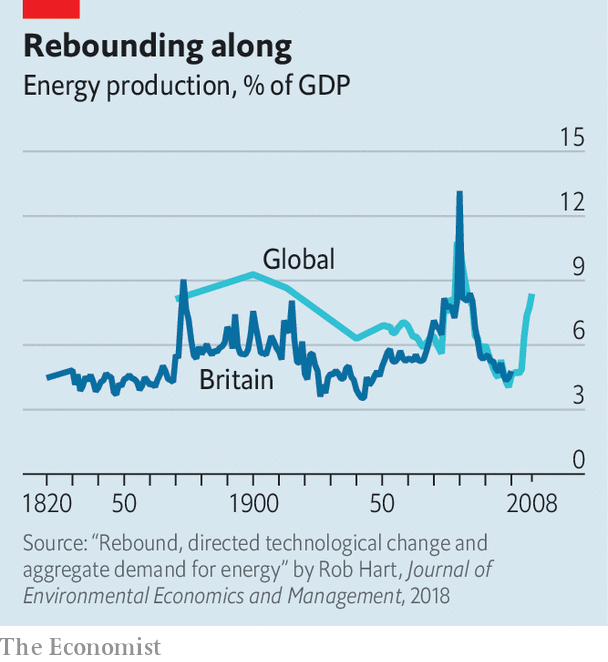
Economies are composed of more than households, however. Businesses, too, react to changes in relative prices, often in complicated ways. Greater energy efficiency translates into higher productivity—and higher returns to firms, making them attractive to capital. Resources freed by innovation may be allocated elsewhere. Over the long term, demand for energy appears much more responsive to changes in price than household studies imply. Were it less “elastic”, in economists’ parlance, the share of output going to energy production would not, outside a few oil shocks, have remained so stable over the past 150 years (see chart).
Resource reallocation—and any concomitant uptick in energy use—can be caused by other things, including economic growth plain and simple. To disentangle the impact of energy efficiency, Messrs Rausch and Schwerin have created what they think is the first macroeconomic model to link energy use to efficiency-enhancing technological change.
The provision of energy-dependent services requires combining capital (say, an electricity generator or a car) with energy (coal or petrol). Although it relies on complicated maths, in essence the model predicts energy consumption using energy efficiency and the relative cost of capital and energy. Fix energy efficiency, and you can calculate the energy use that would have happened in the absence of technological progress. When this counterfactual scenario is compared with what actually occurred in America between 1960 and 2011, the duo found that, as Jevons might have predicted, efficiency gains added to total energy use, offsetting 102% of the savings.
This is unlikely to be the last word. For one thing, the rebound depends on how easily energy can be swapped for other inputs (like capital or labour). The model assumes this is quite easy, but economy-wide empirical data are scarce. The authors also acknowledge that they have not considered policy-driven changes to efficiency, such as those in Japan. These, unlike technological progress, can raise producers’ costs. And no one denies that greater energy efficiency benefits today’s consumers. But settling whether it is a boon for the planet will, with luck, not take another 150 years.

Wednesday, November 07, 2018

HAPPY DIWALI TO ALL OUR FOLLOWERS, TRADERS AND INVESTORS.


Our Diwali Rockets for the year are:


1. Buy State Bank Of India cmp Rs 286


2. Buy Deepak Nitrite cmp Rs 276


3. Buy Ncdex Castorseed Jan cmp Rs 6060


HAVE A PROFITABLE YEAR AHEAD!


 Disclosures

All site content shall not be construed as a recommendation to buy or sell any security or financial instrument, or to participate in any particular trading or investment strategy. The ideas expressed on this site are solely the opinions of the author(s) and do not necessarily represent the opinions of sponsors or firms affiliated with the author(s). The author may or may not have a position in any company or advertiser referenced above. Any action that you take as a result of information, analysis, or advertisement on this site is ultimately your responsibility. Consult your investment adviser/analyst before making any investment decisions. This site/blog contains the current opinions of the author but not necessarily those of RSA. The author’s opinions are subject to change without notice. This site is for informational purposes only and should not be considered as investment advice or a recommendation of any particular security, strategy or investment product. The charts and comments are only the author’s view of market activity and aren’t recommendations to buy or sell any security. Market sectors and related ETFs are selected based on his opinion as to their importance in providing the viewer a comprehensive summary of market conditions for the featured period. The above given ideas and highly liquid and We have/may have positions for the same in our personal and private accounts and may continue having them in coming few days. Chart annotations aren’t predictive of any future market action rather they only demonstrate the author’s opinion as to a range of possibilities going forward. All material presented herein is believed to be reliable but we cannot attest to its accuracy. The information contained herein (including historical prices or values) has been obtained from sources that RSADVISORIES (RSA) considers to be reliable; however, RSA makes no representation as to, or accepts any responsibility or liability for, the accuracy or completeness of the information contained herein or any decision made or action taken by you or any third party in reliance upon the data. Some results are derived using historical estimations from available data. Investment recommendations may change and readers are urged to check with tax advisers before making any investment decisions. Opinions expressed in these reports may change without prior notice. This memorandum is based on information available to the public. No representation is made that it is accurate or complete. This memorandum is not an offer to buy or sell or a solicitation of an offer to buy or sell the securities mentioned. The investments discussed on this site/blog may be unsuitable for investors depending on their specific investment objectives and financial position. Past performance is not necessarily a guide to future performance. The price or value of the investments to which this report relates, either directly or indirectly, may fall or rise against the interest of investors. All prices and yields contained in this report are subject to change without notice. This information is based on hypothetical assumptions and is intended for illustrative purposes only. PAST PERFORMANCE DOES NOT GUARANTEE FUTURE RESULTS.


Tuesday, November 06, 2018

India’s central bank faces a major test of its independence

The cash-strapped government is threatening to gut the RBI

Central bankers are not normally fiery types. But on October 26th Viral Acharya, the deputy governor of the Reserve Bank of India (rbi), brought a dispute between it and India’s government into the open with a flaming speech. Mr Acharya said that “governments that do not respect central-bank independence will sooner or later incur the wrath of financial markets, ignite economic fire and come to rue the day they undermined an important regulatory institution.” His words, which he made clear had been approved by his boss, Urjit Patel, have had incendiary effects.
Arun Jaitley, the finance minister, seems to have taken them as an invitation to a trial of strength. “The nation that is India is higher than any institution,” he said the following day. Local papers reported that the government had invoked a law dating to the establishment of the rbi in 1934, never before used, that allows it to issue directions to the governor. As The Economist went to press, rumours were flying that Mr Patel might step down.
The row, which has simmered in private for months, threatens to wreck one of the government’s main policy achievements. Three years ago, after a short bout of double-digit inflation, the rbi and the government agreed on a target for annual inflation of 4% and created a monetary-policy committee to set interest rates. Inflation has remained subdued ever since.
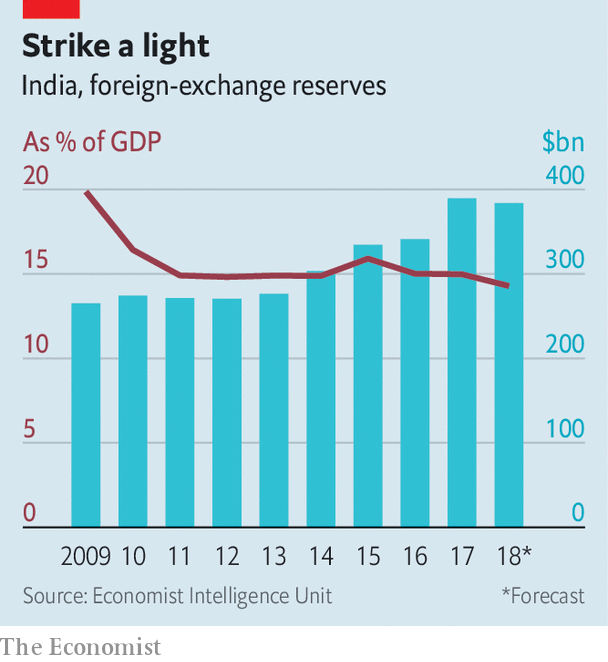
But now the government wants to meddle. Various economic indicators are moving the wrong way. The central-government deficit has widened recently. That has sucked in imports, increasing the current-account deficit. Since January the rupee has fallen by 12.5% against the dollar. The rbi’s foreign-exchange reserves, which had been rising, have started to fall (see chart).
Credit is tightening, too. The main reason is banking regulation. State-owned banks, which have about 70% of total deposits, are weighed down by rotten loans; 11 of them are subject to “prompt corrective action”, which means that they cannot lend. Last month the government took over il&fs, a large infrastructure lender, after it defaulted on debt payments, chilling commercial credit.
The government, and many businesspeople, would like the rbi to compensate by cutting rates or perhaps by easing up on public banks. Yet India’s economy is growing at 8.2% annually, faster than any other big country. This growth has been fuelled by a pre-election splurge in government spending, and the politicians will soon need even more cash. In September, for example, the government launched a huge new health-insurance scheme, which it claims will somehow cost almost nothing. A particular worry for the rbi is that some government officials have raised the idea of increasing the dividend that the bank pays to the government, or even confiscating its “excess” reserves. In his speech, Mr Acharya referred pointedly to the dire consequences when Argentina’s government made a similar move in 2010.
The row goes beyond policy and into nationalist politics. Two years ago the rbi’s previous governor, Raghuram Rajan, left after the government refused to renew his term. An ally of Narendra Modi, the prime minister, had called him “mentally not Indian”. Both Mr Rajan and his successor are American-educated economists. Some nationalists think Mr Patel is a cosmopolitan technocrat who wants to wreck their chances in next year’s election.
Petty arguments, for example about whether the rbi should switch from millions and billions to lakhs and crores (Indian terms for 100,000 and 10m), are indicative of the culture clash. So too is the appointment of Swaminathan Gurumurthy, a firebrand nationalist journalist who was among the architects of Mr Modi’s ill-conceived demonetisation policy (whereby 86% of banknotes were suddenly withdrawn in 2016), as a part-time director on the rbi’s board.
If Mr Patel is forced out, it will be an “incalculable disaster”, says Vivek Dehejia of the idfc Institute, a think-tank in Mumbai. For his replacement, “they’d be sure to appoint essentially a stooge”. Confidence in the rupee would crumble; that in turn could cause inflation to shoot up. Having granted the central bank independence, India’s government would have undermined it for short-term gain—precisely the risk that Mr Acharya warned against.

Monday, November 05, 2018

Skyscraper Farms Are About to Go Global

High-rise indoor farms for vegetables are spreading across the world.
In a suburb of Kyoto in Japan, surrounded by technology companies and startups, Spread Co. is preparing to open the world’s largest automated leaf-vegetable factory. It’s the company’s second vertical farm and could mark a turning point for vertical farming -- bringing the cost low enough to compete with traditional farms on a large scale.
For decades, vertical farms that grow produce indoors without soil in stacked racks have been touted as a solution to rising food demand in the world’s expanding cities. The problem has always been reproducing the effect of natural rain, soil and sunshine at a cost that makes the crop competitive with traditional agriculture.
Spread is among a handful of commercial firms that claim to have cracked the problem with a mix of robotics, technology and scale.
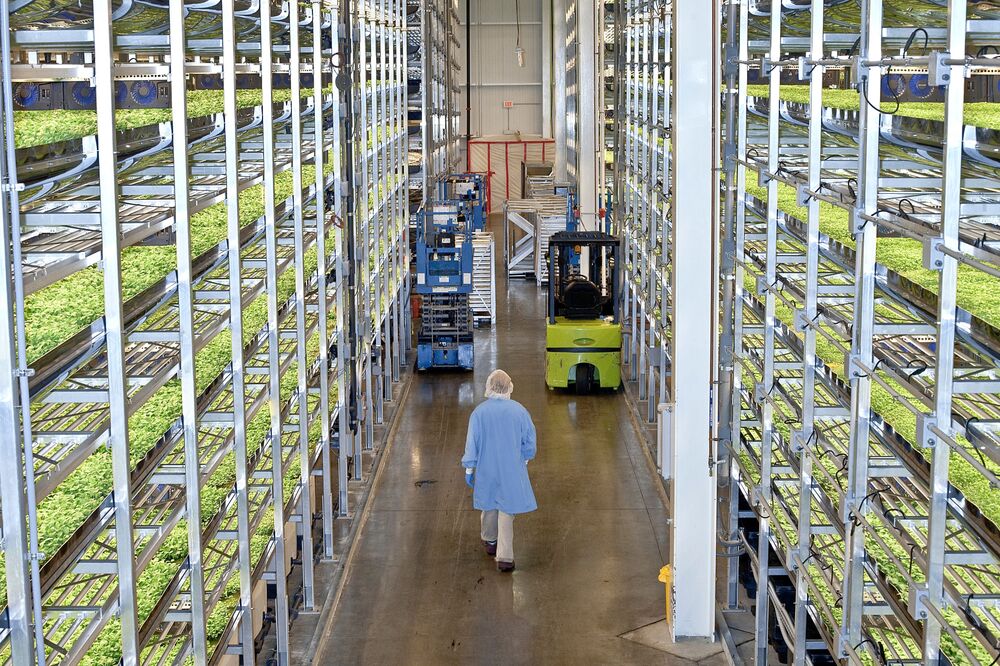
Its new facility in Keihanna Science City, known as Japan’s Silicon Valley, will grow 30,000 heads of lettuce a day on racks under custom-designed LED lights. A sealed room protects the vegetables from pests, diseases and dirt. Temperature and humidity are optimized to speed growth of the greens, which are fed, tended and harvested by robots.

Fixed Price

“Our system can produce a stable amount of vegetables of a good quality for sale at a fixed price throughout the year, without using pesticides and with no influence from weather,” Spread President Shinji Inada, 58, said in an interview at the company’s existing facility in Kameoka.
Inada won the Edison Award in 2016 for his vertical-farming system. He expects the new factory, called Techno Farm, to more than double the company’s output, generating 1 billion yen in sales a year from growing almost 11 million lettuces.

Unprofitable

About 60 percent of indoor-farm operators in Japan are unprofitable because of the cost of electricity to run their facilities, according to the Japan Greenhouse Horticulture Association. Most others only turn a profit because of government subsidies or by charging a premium to consumers for vegetables that are chemical-free. Spread sells lettuces for 198 yen a head to consumers, about 20 to 30 percent more than the normal price for conventionally grown varieties, according to Inada.

Pesticide Free

Consumers pay the premium because the pesticide-free vegetables are increasingly seen as an alternative to often more expensive organic foods, which must be grown outdoors in soil. Japan’s hot summers and high humidity also make organic plants more vulnerable to insects and diseases, said Yasufumi Miwa, an expert at the Japan Research Institute.

Cheaper Than Organic


“Producing organic vegetables requires farmers’ extra-hard work and that should be reflected in the prices,” said Takumu Okuma, spokesman for online food supplier Oisix ra daichi Inc. “Pesticide-free vegetables are seen as safe by consumers and accepted by them as a substitute for more expensive organic ones.”
Small-scale vertical farms have been operating in Japan since the 1970s, niche players that took advantage of high prices for fresh food in cities in a nation that imports about 60 percent of its food. But it wasn’t until 2010, that the sector began to expand rapidly with the adoption of energy-saving LED lights and a government program to support innovative farming with subsidies, according to the association.
Spread’s Inada, a former vegetable trader, founded his company in 2006 and opened his first facility the following year in Kameoka city in Kyoto prefecture. The company spent years refining systems for lighting, water supply, nutrients and other costs and the plant finally turned its first profit in 2013.

Techno Farm

Its new Techno Farm, expected to open as early as November, will push efficiency further, yielding 648 heads of lettuce a square meter annually, compared with 300 heads at its Kameoka farm and only 5 in an outdoor farm. It will use only 110 milliliters (4 ounces) of water a lettuce, 1 percent of the volume needed outdoors, as moisture emitted by the vegetable is condensed and reused.
Power consumption per head will also decrease, with the new factory using custom-designed LEDs that require about 30% less energy. A collaboration with telecoms company NTT West on an artificial intelligence program to analyze production data could boost yields even more.
Spread doesn’t disclose the cost of producing lettuce at its farms, but Japanese researcher Innoplex estimates the cost to make one head of lettuce at its existing Kameoka building is about 80 yen (71 cents), among the lowest in the world. Japan Research Institute expects production costs at the new Techno Farm would come close to parity with outdoor farms within about 5 years.
But extreme weather events and climate change, major disrupters of traditional agriculture, are making vertical farming competitive even sooner. Japan’s hottest-ever summer this year with heavy rains, typhoons and flooding, sent supermarket lettuce prices soaring to more than double the level at which Spread retails its products.

Climate Change

“Climate change is affecting food production almost everywhere, and the economics of growing and selling produce is affecting everyone,” said Dickson Despommier, emeritus professor of Public and Environmental Health at Columbia University, who has been promoting the idea of vertical farming since the 1990s. “If we don’t do something soon to reduce the rate of climate change, vertical farming may be our last hope of getting food on the table for all those who live in cities.”
Around the world, many existing vertical farms are located in climates that are inhospitable for vegetable farming and have high transport costs to import fresh produce, or in places where pollution concerns created a demand for “clean” food, such as in China.

Antarctic Lettuce

In Antarctica, where weather conditions prevent shipments of supplies for much of the winter, scientists at Germany’s Neumayer Station III harvested their first batch of indoor lettuce, cucumbers and radishes this year to feed the station’s staff. And in space, astronauts grow food on the International Space Station in a mini-farm nicknamed Veggie.
Some commercial ventures have targeted wealthy nations in the Middle East as prime candidates for vertical farms because of the high cost of importing fresh produce. Dubai’s Emirates Flight Catering plans to begin construction next month of a 130,000 square foot vertical farm to supply airlines in a joint venture with California-based Crop One Holdings. The $40 million facility is expected to deliver its first vegetables to airlines and airport lounges in December 2019.
Other high-rise farms have appeared in office towers or condos as part of the design. In Tokyo’s Ginza shopping area, stationary retailer Itoya tends a vertical farm on the 11th floor of its 12-story building to supply lettuces exclusively to its cafe, at a cost that would be uncompetitive with vegetables grown in outdoor farms.

Greenhouse Rivals

One of the biggest challenges to the wide-scale adoption of vertical farms is the rise of massive greenhouse-based operations outside cities that employ many of the same technologies, such as the U.K.’s Thanet Earth, which grows millions of tomatoespeppers and cucumbers a year under glass. While these farms need more land, they harness natural sunlight, reducing power costs. Thanet Earth describes itself as the country’s largest greenhouse complex.

In Japan, where the workforce is aging and many companies have relocated production overseas, vertical farms can also be built in idled factories.
JX ANCI, a wholly owned subsidiary of JXTG Nippon Oil & Energy Corp., plans to build an indoor farm in its Narita plant by 2020, using Spread’s system. And Mitsubishi Gas Chemical Co. has agreed with Farmship Inc., a Tokyo-based startup established by a former Spread employee, to build an indoor farm that would grow 32,000 lettuces a day in Fukushima prefecture.
The real race though, is to go global. Spread plans to export its farming system to more than 100 cities worldwide, competing with companies such as Crop One, Softbank-backed Plenty Inc. of the U.S. and Sanan Sino-Scienceof China. Inada said Spread has signed an agreement with a food producer in the UAE to supply its system and is holding talks with about 300 other companies and researchers.
“We are targeting countries where fresh vegetables cannot be produced because of scarce water, extremely low temperatures or other natural conditions,” Inada said. “Our mission is to provide infrastructure for vegetable production to anybody, anywhere in the world.”

Friday, November 02, 2018

A world of opportunities

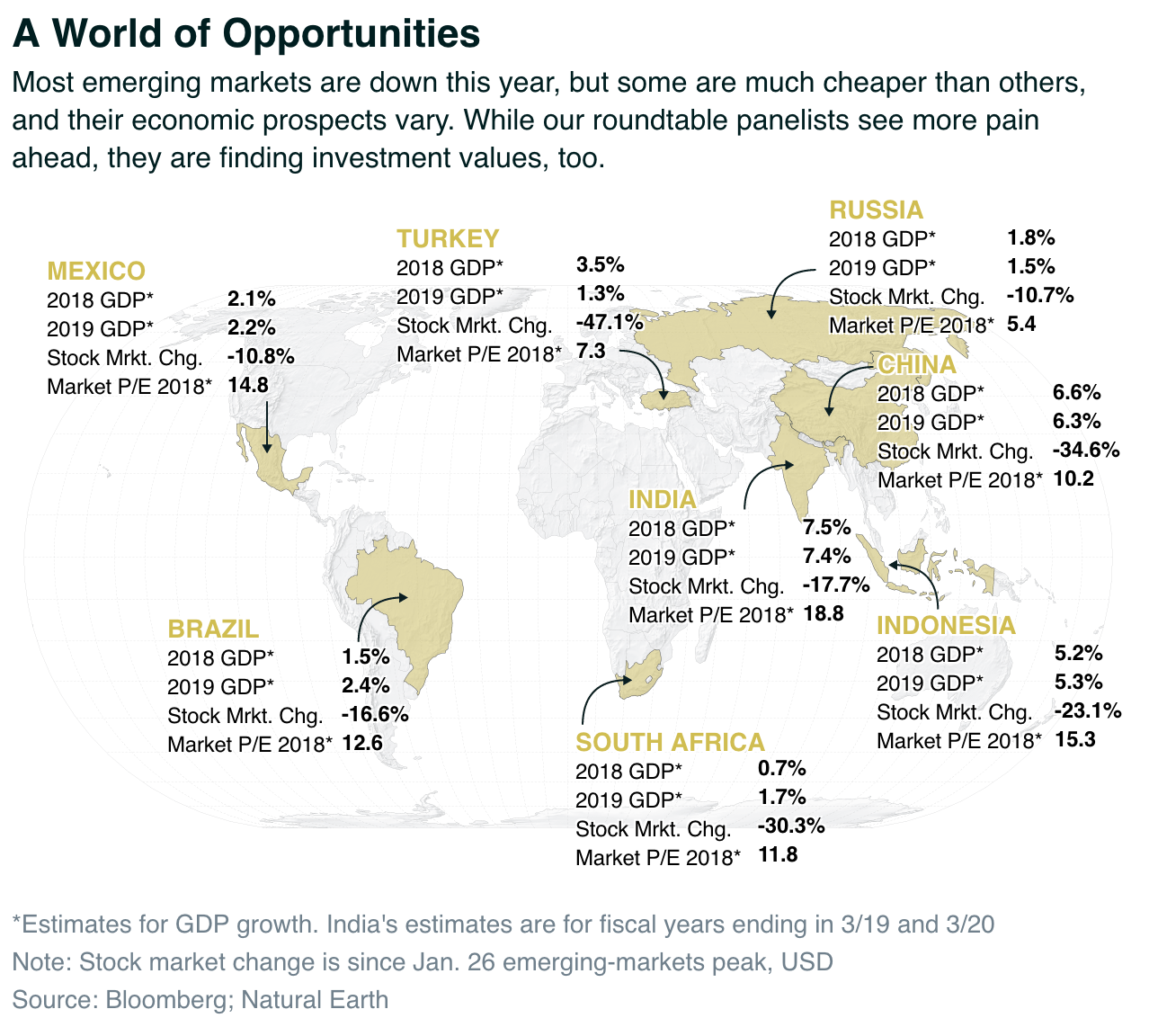
If you think U.S. stocks are volatile, you should see Emerging Markets. EM did well in 2017, but have seen their fortunes slip in 2018. Still, diversification means that some of your assets will be allocated to parts of
Here is Barron’s:
“Emerging markets have had a terrible, horrible, no good, very bad year. In other words, the stocks have sold off sharply, and the currencies have been hammered as U.S. interest rates rise and China’s growth slows. The benchmark MSCI Emerging Markets index is 23% below its January high, after rising 34% last year. China’s Shanghai Composite index has fallen 35%. Turkey’s lira has lost 37%, and the pain could spread.
Yet, the latest washout obscures the long-term attraction of these markets: Not only does 83% of the world’s population live in emerging markets, but almost half of this population is middle-class, and new industries catering to these hungry consumers are creating just the sort of change and growth investors crave.”
The discussion suggests that “With emerging-market stocks trading at steep discounts to U.S. equities perhaps now is the time to start bargain hunting, or at least drawing up a shopping list . . .
 

Thursday, November 01, 2018

Saudi Arabia’s might as an oil producer is being tested

Will it be able to fill the gaps left by smaller producers?

Oil Traders are inherently strong-stomached, but even for them October has been a woozy month. On October 3rd the price of Brent crude reached $86 a barrel, a four-year high. On October 23rd it slid to $76, on the news that demand might ebb, stockpiles rise and production increase. At the centre of this is Saudi Arabia, the world’s most powerful petrostate. Khalid al-Falih, the country’s oil minister, said on October 23rd that the kingdom was prepared “to meet any demand that materialises”. But that is not an easy task.
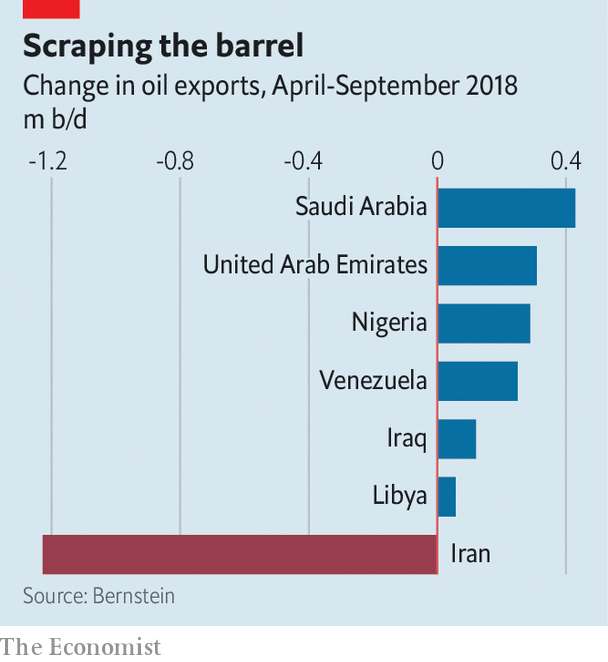
Exports from Iran have plunged and are due to fall further after November 4th, when new American sanctions take effect. Even as America’s crude production soars, President Donald Trump has demanded that the Organisation of Petroleum Exporting Countries (opec) boost output to lower prices. Saudi Arabia seems keen to appease him, both because it supports the sanctions and because of anger over the killing of Jamal Khashoggi, a journalist, in the Saudi consulate in Istanbul. But the gains from producing more are uncertain. Both opec and the International Energy Agency (iea) have cut their forecasts for oil demand in 2019.
Even if Saudi Arabia wants to fill the gap left by Iran, it is not clear that it can. That is in part because Saudi output is already so high. As Iranian exports have dropped since May, when Mr Trump announced the sanctions, Saudi Arabian exports have picked up. The kingdom is producing more than 10.5m barrels of oil a day (b/d); officials claim the capacity to produce around 12m. “They can reach about 11m barrels with relative ease,” explains Neil Atkinson, head of oil markets at the iea. Analysts debate how quickly—or whether—the country can ramp up to 12m b/d. “They have never actually proven they can do that,” says Ehsan Khoman of mufg, a bank.
Saudi Arabia may also be unable to counter weakness in smaller petrostates, where supply could drop unexpectedly. In the past six months Nigeria, Libya and Venezuela have helped to offset falling exports from Iran. But they are a volatile trio.


The result may be further dramatic swings in the market, with Saudi Arabia’s oil production put to the test. “It is the first time in modern history that countries have faced so many restrictions at the same time,” according to Mr Atkinson of the iea. Much depends on just how far exports from Iran sink—some countries are pushing for waivers from sanctions. Mr Falih remains confident that Saudi Arabia can help provide stability. But as it increases output, spare capacity may reach a record low by the end of the year. “The more they produce, the less there is in the tank for any additional supply outages,” says Mr Khoman. Get ready for a bumpy ride.

Violence and political unrest make production in Nigeria and Libya prone to big swings. The situation is more extreme in Venezuela where, thanks to political turmoil, production is about half of what it was in early 2016. Still, Venezuela produced 1.2m b/d in September. Exports actually increased by 250,000 b/d between April and September, according to Bernstein, a research firm, equivalent to more than half the rise in Saudi exports in that period. There is ample room for Venezuela’s output to drop further.