Indian bond investors scouring for bigger returns are snapping up securities tied to the nation’s equities.
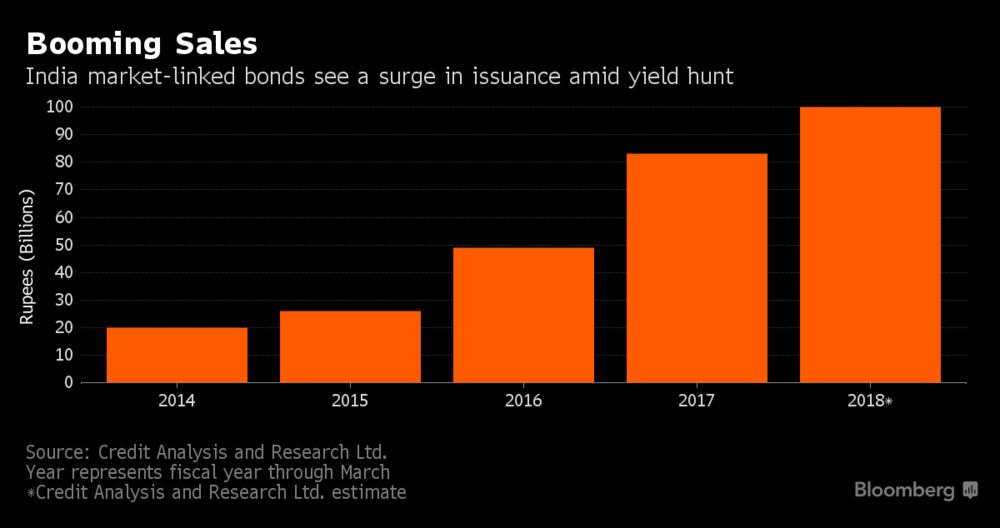
Faced with bank deposit rates at multi-decade lows and a rally that has sent shares to records, investors may buy 100 billion rupees ($1.6 billion) of market-linked debentures in the year to March 2018, the most in at least five years, according to Credit Analysis and Research Ltd.
Sales of equity-linked debt securities have surged in the past year as banks slashed interest rates on deposits after being flooded with funds due to Prime Minister Narendra Modi’s cash clampdown. State Bank of India cut the one-year bulk deposit rate by 175 basis points to 4.25 percent two weeks after the Nov. 8 currency ban. With few good options left, flows into stocks have accelerated, sending the NSE Nifty 50 Index to an all-time high last week.
“Investors can make 7.5 percent and a best effort of 9.5 or 10 percent a year, enhancing return versus a fixed-income product,” said Vivek Sharma, Singapore-based senior vice president for global asset management at Edelweiss Financial Services Ltd. “With rich valuations in Indian equities, these products will continue to be attractive. We expect 20 percent to 30 percent growth in the coming year.”
Demand for structured securities is rising as investors in many developed markets confront a new reality: sub-zero interest rates. In Japan, retail investors drove sales of bonds tied to the Nikkei 225 Stock Average to the highest in at least three years in January, according to Societe Generale SA. Securities linked to the Euro Stoxx 50 dominate such offerings, making up 50 to 60 percent of the total equity-linked notes, the firm said.
In India, sales of market-linked bonds, which are typically tied to the Nifty gauge, climbed 70 percent to 83 billion rupees in the year ended March, said Mukund Upadhyay, manager at the Credit Analysis. Edelweiss was the most prolific issuer, with 359 offerings, followed by Reliance Industries Ltd., India’s second-most valuable company, with 172 products, data from the agency show.
“These products were popular in the private wealth space and institutions hardly had any exposure. Recently, corporates have begun to make allocations,” Sharma said.
Tax Efficient
Issuers of market-linked debentures invest a pre-determined part of the amount in debt to protect principal and the remainder in a stock index to give investors a slice of the equity-market based return. These principal protected bonds with maturity of more than one year are more tax efficient, attracting a lower rate of 10 percent on gains versus other securities, said Upadhyay.
“From a risk-return perspective market-linked debentures have been one of the best performing,” Edelweiss’s Sharma said. “They give people the option to lock in returns.”
Year after year, Mexico places a multi-billion-dollar bet in a deal that big banks lust after. This is the untold story of how the “Hacienda hedge” happens.
The men huddled in the same first-floor conference room as always, only this time they’d decided to make their annual oil bet bigger and bolder than ever before. Fewer than a dozen representatives from three Mexican government ministries and Petróleos Mexicanos, the state energy company, were about to make a wildly contrarian play. If it paid off, the profits would be enormous. And if they were wrong? They would have spent a small fortune in vain.
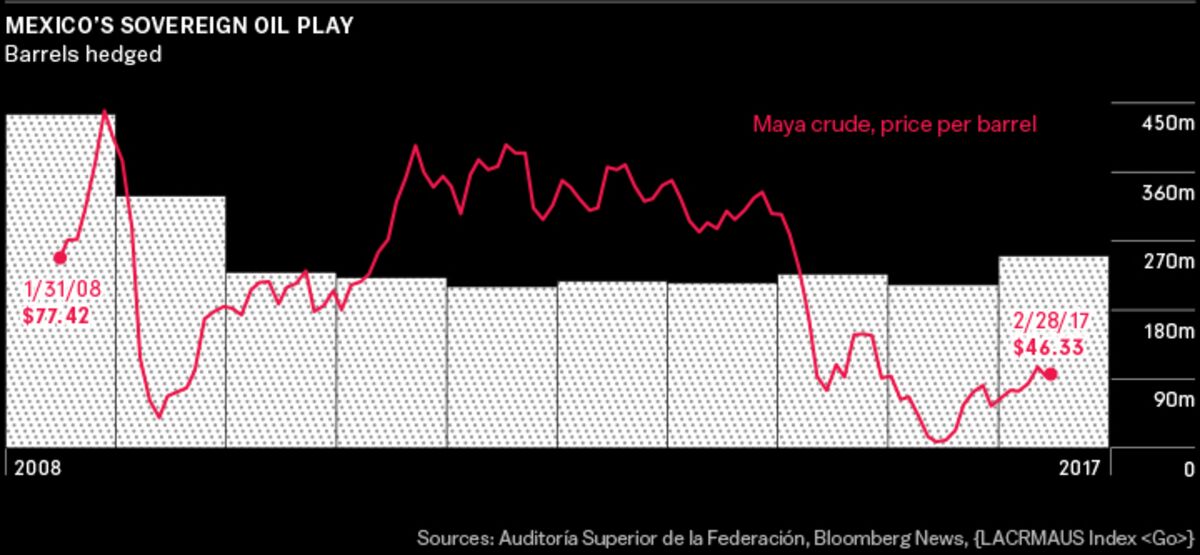
Almost seven months earlier, at the beginning of January 2008, the price of oil had flirted with $100 a barrel for the first time in history. It retreated to below $90 by the end of the month, but then, in early February, the price took off. West Texas Intermediate, the U.S. benchmark, reached a new high every month—$103.05, $111.80, $119.93, $135.09, $143.67—until finally, in early July, it hit $147.27 a barrel. Seemingly insatiable demand from emerging economies, including China and Brazil, encouraged outrageous chatter of $200 a barrel among the giddiest traders. Even those with bearish outlooks were fairly optimistic, figuring there would be a correction, not a crash.
Yet on July 22, 2008, just 11 days after oil reached its all-time high, this small group of Mexicans gathered to discuss their very different outlook in the ornate surroundings of Mexico’s finance ministry, the Secretaría de Hacienda y Crédito Público. The palace—located on the Zócalo, the capital’s vast main square—had been built centuries earlier atop what once was the home of conquistador Hernán Cortés. On the walls around the main entrance, gigantic Diego Rivera murals depict the country’s history.
When “the men from Hacienda,” as they’re known, headed back to their desks, their mission was to lock in, or hedge, Mexico’s oil revenue through a deal with Wall Street banks. Within minutes they began firing off messages to the oil trading desks of Barclays, Goldman Sachs, Morgan Stanley, and Deutsche Bank. Their instructions were to buy “put” options, contracts giving them the right to sell oil at a predetermined future price, at levels ranging from $66.50 to $87 a barrel. The banks receiving the orders had never seen an oil deal this big. The price tag for the options was $1.5 billion.
From Houston to New York to London, bankers worked against the clock to close the gigantic transaction. It amounted to 330 million barrels, enough to meet the annual oil imports of the Netherlands. Barclays, which was then muscling into the commodity big leagues, did the bulk of the buying with 220 million barrels. Goldman followed, at 85 million barrels.
Betting that oil prices were about to crash was an audacious wager, one made all the more remarkable by the individuals behind the deal—civil servants with unassuming titles such as “director general of fiscal planning.” In the lucrative oil business, a profession known for its generous compensation, these government employees were probably the worst-paid stiffs around. Yet the men from Hacienda—so called still, even though women are sometimes in the room—proved prescient in predicting a crash.
Everybody knew the world was tipping into a financial crisis at the time, but because of its excellent banking and political connections in the U.S., Mexico may well have had special insight into just how bad things would get. What’s more, as one of the world’s top oil exporters, the country generally has better information than, say, hedge funds, about where the market is heading. In 2008, that information led those in the room to believe global supply was well in excess of global demand.
Sure enough, as the banks executed the deal over a five-month period, oil prices tipped into free fall amid the worst financial catastrophe since the Great Depression. In 2009 oil prices would average less than $55, well below the average price of the options of $70.
The key to success behind this huge sovereign oil hedge was moving “quickly, very quickly,” says Gerardo Rodriguez. Undersecretary of finance and public credit at the time, he was one of those in the room; he’s now a managing director at BlackRock Inc.“At the start of the summer we saw that the financial crisis was spreading fast,” he says. “Despite that, oil prices were still high. They were even climbing. We told ourselves, ‘We need insurance, and we need to take advantage of $150 oil prices.’ ”
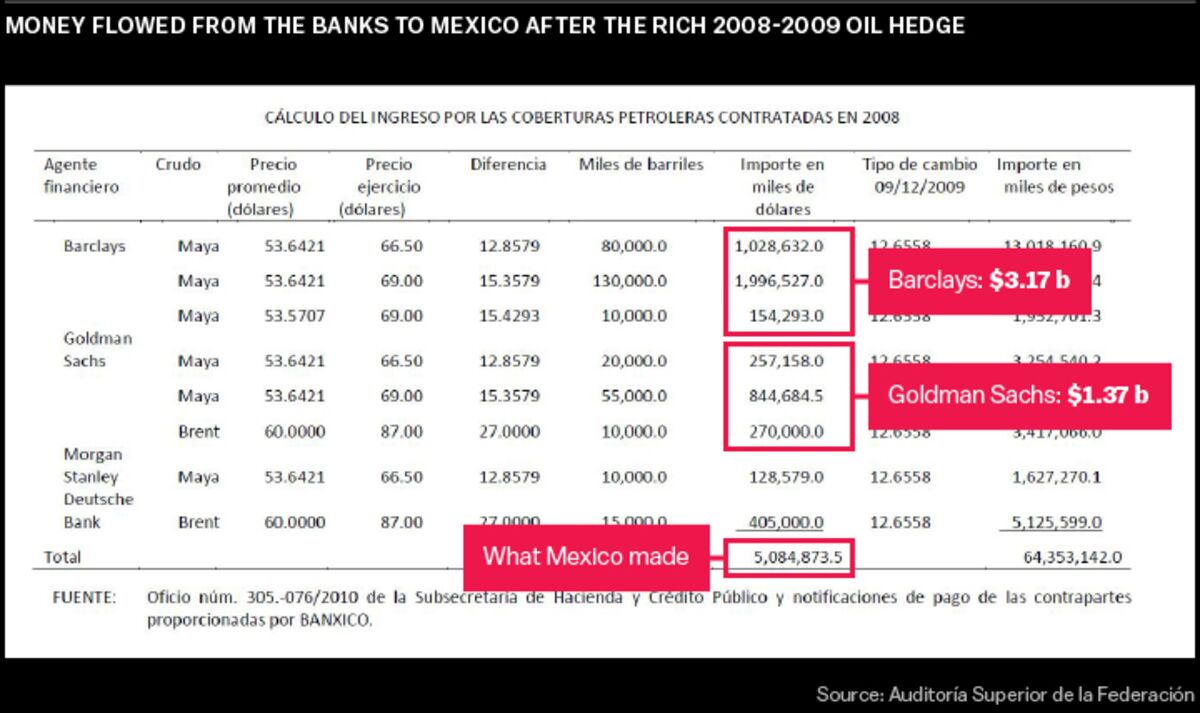
In December 2009 the four investment banks involved in the deal wired the proceeds of the wager back to Mexico. Official records tracking the money that landed in Account No. 420127 at state-owned Nacional Financiera bank show the tidy sum Mexico made: $5,084,873,500.
Oil hedges aren’t uncommon. Airlines do them to insure against rising prices; U.S. shale producers rely on them to lock in revenue. But no deal comes close to matching Mexico’s annual “Hacienda hedge.” “Mexico is the biggest annual oil deal,” says Goran Trapp, founder of boutique advisory firm Energex Partners and former global head of oil trading at Morgan Stanley. Over the last 10 years, the notional value of the hedge has added up to $163 billion. “It’s the deal that all banks wait for each year,” says Richard Fullarton, founder of commodity fund Matilda Capital Management and a former senior trader at Royal Dutch Shell and Glencore. “It’s so large that it can make or break their year.”
Despite its size, impact, and huge fees, the deal is one that few people, even in the energy industry or on Wall Street, know much about. Painstakingly, the world’s 12th-largest oil producer and its bankers have cloaked the program in secrecy to prevent others—namely trading houses and hedge funds—from front-running Mexico’s orders. “Minimizing its visibility is extremely important,” wrote Javier Duclaud and Gerardo García, two senior officials at Mexico’s central bank, in a 2012 report for the International Monetary Fund.
This is the untold story of how Mexico, as early as 1990, constructed what quickly became the world’s largest and best-concealed oil trade. Bloomberg Markets unraveled the secret history of the Hacienda hedge through dozens of interviews with current and former government officials, traders, brokers, bankers, and consultants, as well as a review of thousands of pages of previously unreported documents, some obtained through freedom-of-information requests in the U.S. and Mexico. Although some people agreed to speak on the record about the deal, others did so only on condition of anonymity because they were discussing a confidential government program.
Mexico’s oil hedge has real economic significance. Until fairly recently, the country relied on oil for about a third of its income, leaving it dangerously exposed to boom-and-bust price cycles. According to current and past government officials, the main purpose of the hedging is not to pad the country’s coffers but rather to protect the federal budget from fluctuations in oil prices.
What’s more, it’s a fiscally responsible exercise that reduces the country’s borrowing costs, says Fabián Valencia, a senior IMF economist in Washington who follows Mexico. “The hedge means Mexico pays about 30 basis points less on its sovereign debt,” he says. Hedging is like buying insurance, says Guillermo Ortiz, who was governor of the country’s central bank from 1998 to 2009: “You buy it hoping you won’t need it.”
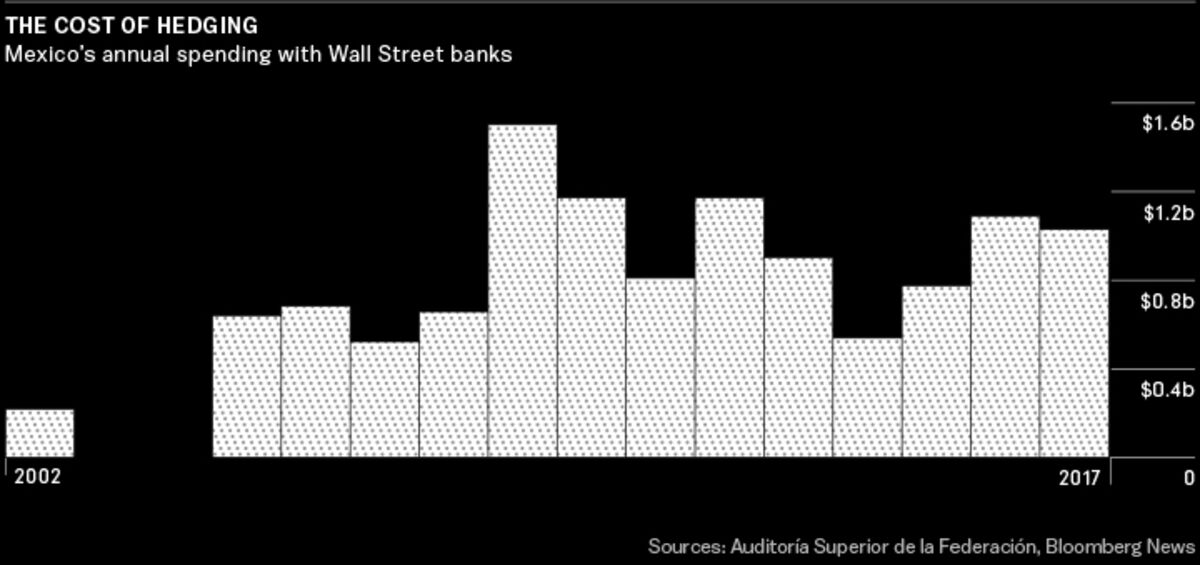
For its part, Mexico has shown a Wall Street-style wizardry in trading oil. It usually makes money on its hedges—sometimes a lot of money, as in 2008-09. From 2001 to 2017, the country made a profit of $2.4 billion; its hedges raked in $14.1 billion in gains and paid out $11.7 billion in fees to banks and brokers. (The banks have an additional incentive: They can make money by creating trades of their own that are linked to but separate from the hedge itself.)
So far, Mexico has managed to dodge some obvious risks inherent in deals of this magnitude. “If you get it wrong,” says George Richardson, a senior official at the World Bank, speaking of megahedges in general, “it’s a serious political problem.” The fat fees going to the banks may also end up looking wasteful and may even dissuade other oil-producing countries from engaging in hedges of their own, he says. “Is it worth it to pay the premium rather than, say, build a new hospital?”
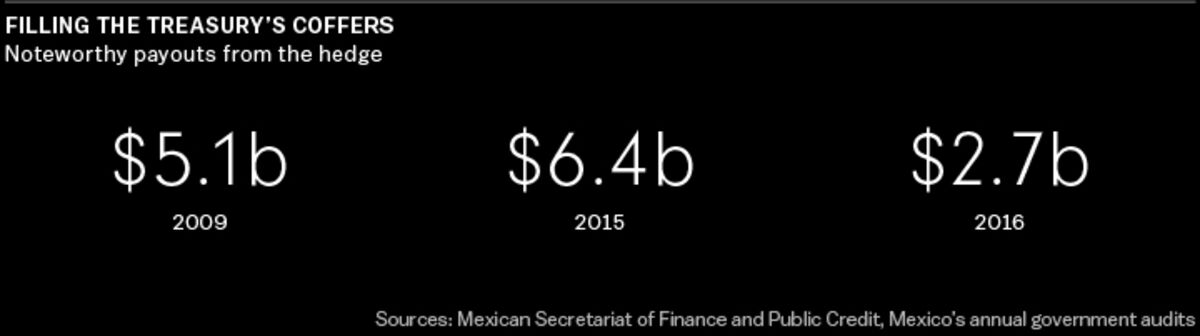
If anything, recent results have made the Mexican government look especially good. The country earned $6.4 billion in 2015 and $2.7 billion in 2016. For 2017, the jury is still out. Last summer, Mexico spent just above $1 billion buying put options with a floor price of $38 a barrel. If prices stay where they are now, hovering around $50 a barrel, the men from Hacienda won’t make any money, but if prices drop on average below $38 a barrel, they’ll start to. We won’t know the outcome until December.
Mexico first hedged oil in 1990, after Saddam Hussein invaded Kuwait and threw the petroleum-rich Middle East into crisis. Soon the United Nations had embargoed Iraqi and Kuwaiti crude, removing about 10 percent of the world’s supply from the market. Prices soared from a low of $15.06 a barrel in June of that year to $41.15 in October.
The Mexican treasury reaped the benefits of these fast-rising prices, but the government of Carlos Salinas de Gortari also sensed the boom wouldn’t last, not with the U.S. economy cooling and President George H.W. Bush preparing for war. According to Aldo Flores Quiroga, the country’s current deputy oil minister, the “thinking on the use of financial instruments of this kind has its origins in the 1980s, when Mexico was seeking to stabilize its fiscal stance.” In particular, the government had failed to anticipate the 1985-86 oil crisis, when Saudi Arabia flooded the market and prices tumbled. By 1990 the prospect that Washington could tap the brakes on oil prices by dipping into U.S. strategic petroleum reserves loomed large.
To make sure Mexico wasn’t again exposed to forces beyond its control, the Salinas government decided to bet on prices falling and enlisted Goldman Sachs. Stephen Semlitz, a rising star and head of energy trading at J. Aron & Co., the bank’s legendary in-house commodities unit, and Robert Rubin, Goldman’s co-chairman, who later became U.S. treasury secretary, proved instrumental in helping Mexico lock in a price of $17 a barrel for the first few months of 1991. The deal worked: Maya crude, Mexico’s benchmark, plunged as low as $9.75 a barrel that year. Despite the modest success of the Gulf War hedge, Mexico didn’t do it again for years, as oil prices remained relatively stable.
The country was again caught off guard in the late 1990s, however, when the Asian economic crisis crippled oil demand just as OPEC countries boosted production in a brutal attempt to gain market share. As a result, prices crashed. In December 1998, Mexico sold crude for as little as $5.68 a barrel to a U.S. refinery. Mexico, which isn’t a member of the Organization of Petroleum Exporting Countries, hadn’t anticipated the crisis and hadn’t hedged. In trader parlance, the country was naked.
The experience scarred a generation of government officials, who decided they could never leave themselves so exposed again. Thus began the modern Mexican hedge, which came into existence in the early 2000s after legislators passed a law allowing sufficient budgetary flexibility to accommodate the deals. In 2001, Mexico made a tentative showing, spending just $217.3 million on put options, a fraction of the approximately $1 billion a year it would spend later. In 2003 and 2004, with oil prices rising, the country opted not to hedge at all. (The Mexican government declined to comment for this story.)
The strategy came into its own in 2005, according to several officials familiar with the matter. Mexico has hedged every year since without interruption. Agustín Carstens, who later became head of the central bank, was finance minister when the big $5.1 billion payout came in 2009; some government officials also refer to the annual oil bet as “the Agustínian hedge.”
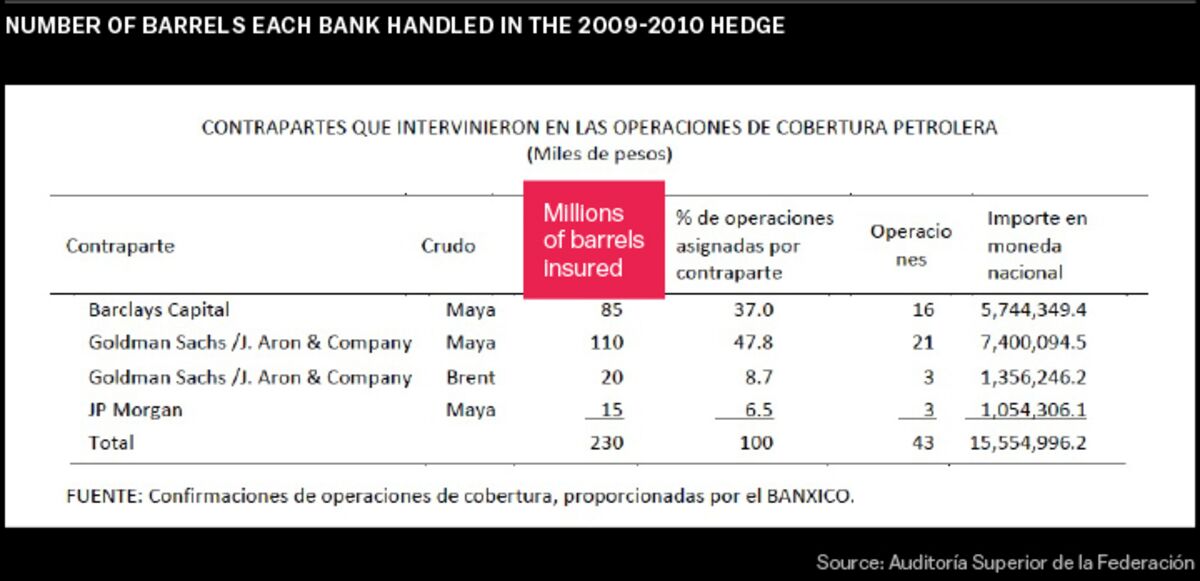
In the early 2000s, Goldman Sachs and Morgan Stanley, already known as “the Wall Street refineries,” continued expanding into oil. The Hacienda hedge became an especially important part of their business, say bankers with knowledge of the deals. Goldman kept a particularly firm grip on the deal it had helped to fashion a decade earlier. As recently as 2010, according to Mexican government documents, Goldman was handling 56.5 percent of all the barrels involved in the deal.
Lured by the large fees and the cachet of landing part of such a prestigious deal, other banks—Barclays, Deutsche, JPMorgan Chase—began angling in. Mexico has since widened the net even further, recruiting outfits such as Citigroup, HSBC, and BNP Paribas, according to government documents. For the 2017 deal, the country reached outside the banking industry for the first time and hired the trading arm of Royal Dutch Shell Plc.
In most recent annual hedges, Mexico has used from four to six counterparties. Current and former bankers involved in the deal say the lenders’ profits were $30 million to $80 million a year per bank. “The Mexican hedge is an extremely important part of the oil business of the banks,” says George Kuznetsov, head of research at Coalition Development Ltd., an analytics company that tracks investment houses. Nonetheless, while Mexico has spent an average of $1 billion a year hedging over the past decade, the banks’ slices of that rich pie have gotten smaller, as more and more lenders have entered the mix.
For some bankers, the deal’s overall profitability hides the danger of big one-time losses, according to people familiar with it. “Over the years, the hedge has built a mixed reputation with the banks,” Kuznetsov says. “There is a big potential you could lose.” Tellingly, some banks that were—or still are—active players in the oil market never touched the Mexico deal, including Société Générale, UBS, and Credit Suisse, according to government documents; Morgan Stanley decided on several occasions against participating. (All the banks featured in this story declined to comment.)
What’s more, U.S. regulations put into effect after the global financial crisis have introduced complications. Before 2008, banks kept the hedging risk in-house for weeks and even months, slowly offloading it to other clients without the need to go out into the broader oil futures market. For instance, a client other than the Mexican government—say, an airline seeking protection against rising prices—might take the other side of the Hacienda hedge.
After 2008, the rules of the game started to change. One example is the Volcker Rule, which prohibits banks from making certain speculative investments. The rule went into effect in July 2015. Its constraints on risk oblige the banks to get it off their books quickly. One way banks do this is by hedging in the futures market: They might take the other side of the hedge themselves, in effect selling futures within a mix of oil and refined products.
The Mexican government was so worried about the Volcker Rule that it dispatched a team of officials to Washington in October 2012 to lobby the U.S. Treasury, the Federal Reserve, and other agencies. A Mexican presentation seen by Bloomberg Markets argued, in effect, that the banks needed to be able to hang onto risk for longer—that a transaction “of the size and characteristics of Mexico’s oil price hedging program requires swaps dealers to take significant commodity risk for extended periods of time in order to provide liquidity to markets.”
For the banks, the ability to hedge their bets is crucial. Given their exposure, if the hedge is poorly executed and the market moves against them, they risk losses that could eat into a large chunk of their annual profits. Take 2009: Mexico made $5.1 billion that year, but at height of the oil price crash, the mark-to-market value of the hedge (equivalent to what the banks could have ended up paying to the Mexican treasury) was huge—“close to $10 billion,” according to the report by Duclaud and García, the Mexican central bank economists. “The execution of the hedging program is challenging, so particular attention must be placed on selecting counterparties,” they wrote.
The 2009 payments highlight the size of the potential impact for the banks if their own hedges don't work well, not that that happens often, according to bankers. That year Barclays paid Mexico roughly $3.1 billion, equal to more than a third of its pre-tax adjusted profit; Goldman Sachs, $1.3 billion; Deutsche Bank, $405 million, and Morgan Stanley, $128 million.
Until 2009, the Mexican government didn’t disclose any information about the Hacienda hedge. Since then, its practice is to disclose as little as possible. And the banks? They never publicly acknowledge their participation in deals like this. Still, for all the Mexican government’s efforts to keep its megahedge hidden, a detailed history of how the deal works can be gleaned from the thick, bound volumes of the legislature’s annual audit, the Auditoría Superior de la Federación. Among other insights, the thousands of pages reveal that Mexico’s current practice is to buy so-called Asian-style put options. That allows the country to hedge an average price rather than the price at the expiration of the contract, as is the case with “American-style” options.
While the Mexican government hedges every year, it doesn’t enter the market at the same time. According to the audits, it has started buying options as early as May and as late as August. In the early years, Mexico locked in the price of West Texas Intermediate, but that caused trouble because of WTI’s ever-changing price relationship with Maya, Mexico’s main crude export grade. Today, to avoid price variations from benchmark to benchmark, the hedge involves a combination of Maya—usually 80 percent to 90 percent of the total—and Brent, the world standard.
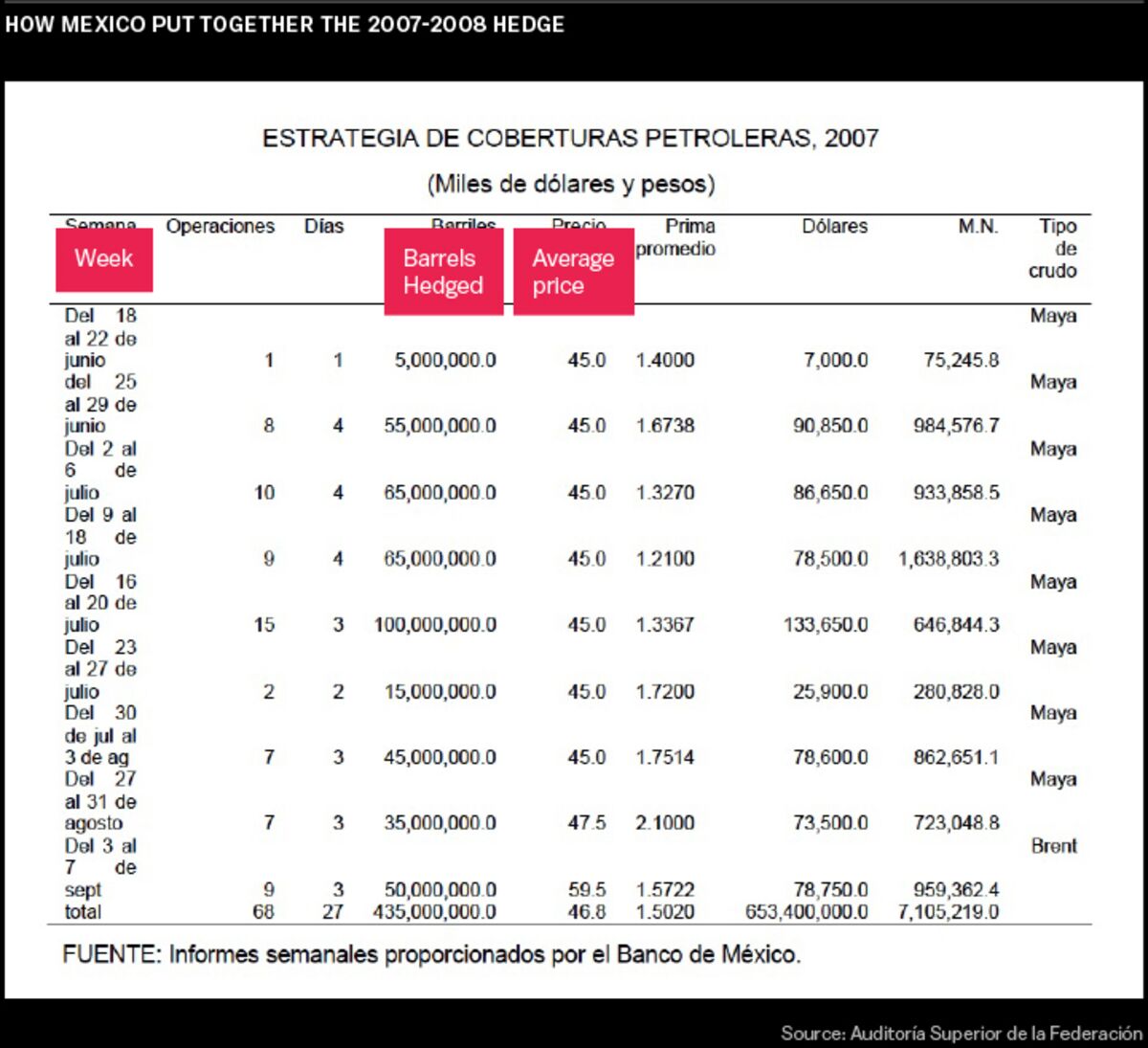
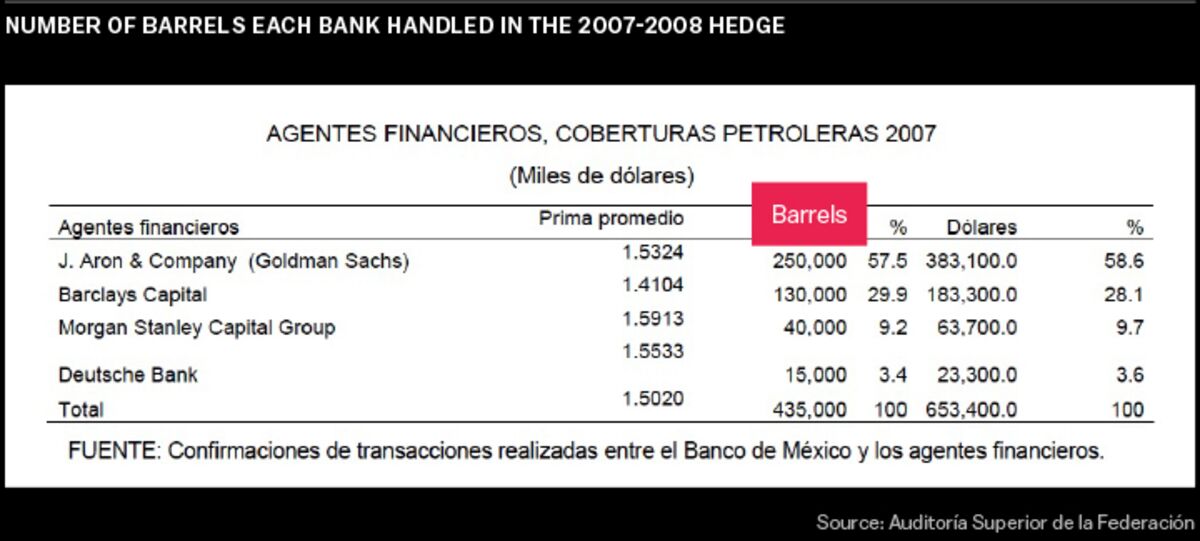
The audits confirm Mexico’s reputation in the oil market for shrewd trading and its keen desire to keep the deal quiet. No year epitomizes those characteristics as much as 2007, the year before the big deal that made $5.1 billion for Mexico. The men from Hacienda started early in 2007, hedging 5 million barrels during the week of June 18. With prices failing to decline, Mexico slowly built up its position, selling 185 million barrels in the next three weeks. In late July, with prices rising fast, it went all in, doing 100 million barrels in a single week. The wave of selling sent prices tumbling 10 percent. Mexico immediately vanished from the market, staying quiet for three weeks. The men from Hacienda didn’t return until the end of August, as prices rose again, quickly selling an additional 85 million barrels in 10 days. In total that year, Mexico sold 435 million barrels in 68 deals. Goldman Sachs handled the bulk of those orders—250 million barrels in total.
The audits also disclose something oil traders have long suspected: Mexico doesn’t trade just in the summer; it’s been in the market during the winter at least once. In the summer of 2013, Mexico, as usual, bought put options, securing a price of $81 a barrel. But contrary to its usual practice, the country reentered the market in January and February 2014, restructuring the deal at $85 a barrel.
Mexican officials have argued that the hedge, which runs annually from Dec. 1 to Nov. 30, doesn’t affect prices. However, bankers who are or have been involved in the deal, as well as oil traders who monitor it closely, say Mexico’s hedging, in fact, roils the market. That certainly happens when Mexico’s bankers sell futures to protect themselves, putting downward pressure on oil prices. If only because of its magnitude, the hedge is a fount of rumor, chatter, and volatility—particularly when Mexico is hedging and the market is falling, as in 2008 and again in 2014.
Despite Mexico’s success, no other oil-producing country has followed suit with similarly large hedges. Several nations, including Qatar and Russia, have come close to implementing a big hedging program through Morgan Stanley and Goldman Sachs, but they walked away at the last minute, according to people familiar with the talks.
For the massive Middle East producers, hedging appears to be a headache they’d just as soon avoid. With small populations and huge revenue, they instead self-insure, amassing their petrodollar reserves and saving during boom times by pouring money into their fat sovereign wealth funds. Saudi Arabia, for example, has since late 2014 used about $200 billion from its foreign exchange reserves to weather a period of low prices.
Poorer oil-producing countries don’t have that luxury, and that’s when oil hedging might look attractive. Ecuador, OPEC’s smallest member, is a case study in how an oil hedge gone wrong can cause a political storm. In early 1993, Quito decided to lock in oil prices through a series of relatively complex deals involving put options and swaps orchestrated in conjunction with Goldman’s J. Aron & Co.
Ecuador secured a floor of $14.88 a barrel for the year, handing the bank $12 million in fees. But the deal left the country exposed to pay more if prices turned out to be higher. To the surprise of the government, oil did indeed move in that direction, averaging $15.85 a barrel. As a result, Ecuador not only lost the $12 million it paid for put options that turned out to be worthless but also had to pay an extra $6 million to Goldman for the swap.
The political opposition to President Sixto Durán Ballén, according to an IMF review of the deal, blasted “the high losses to the country,” and Ecuadorean lawmakers appointed a special committee to investigate allegations of corruption against several officials involved in the hedge. (The panel concluded there was no wrongdoing.) Ecuador’s mistake may well have been to see the hedge as a bet rather than an insurance policy.
Mexico’s hedge has never triggered a political backlash of any real consequence. But that doesn’t mean the joyride can last forever. Oil is no longer the make-or-break revenue generator it once was. Last year it accounted for only 17 percent of total government revenue. And oil production is declining even as domestic demand is climbing—reducing net exports and hence the size of the deal.
In the hedge’s halcyon days, Mexico sold forward more than 450 million barrels of oil; this year it’s done only 250 million. Despite the budgetary stability the annual big bet has brought to this country of 122 million people, the sun may be setting, however slowly, on the hedge and the men from Hacienda who pull it off
Did India just pull off a monetary and political miracle?
Consider the sequence of events in its demonetization saga. In November the government made a high-risk, high-stakes economic intervention in the world’s largest democracy, with an objective to reduce corruption. Overnight, 86% of cash in circulation was voided. In a country almost 90% cash reliant, chaos ensued. As I said at the time, it was a case study in poor policy and even poorer execution.
Four months passed. The country emerged with few obvious scars. Although the impact on corruption remains to be seen, Prime Minister Narendra Modi’s government was rewarded with victory in midterm state-level elections, seen as a referendum on its unprecedented action.
Short of any singing, dancing, and costume changes, this sequence could have been taken from Bollywood, a movie industry widely known for its fantastical flights of fancy.
India’s demonetization experiment has generated some important thinking about cash, corruption, data, and the digital economy. Let’s consider some new takeaways:
Demonetization Is Not the Best Tool to Root Out Corruption
The original reason given for the drastic demonetization action was to expose the so-called “black” market, fueled by money that is illegally gained and undeclared for tax purposes. The existence of this parallel economy is a substantial drag on the Indian economy: According to recently released data, only about 1% of Indians paid taxes on their earnings in 2013. When the policy change was announced, people were given until December 30, 2016, to return 500- and 1,000-rupee notes to banks, or else risk losing the value of them.
According to a Bloomberg report, banks were estimated to have received 14.97 trillion rupees (around $220 billion) by the December 30 deadline, or 97% of the 15.4 trillion rupees’ worth of currency demonetized. While the actual value of the currency deposited is still to be formally accounted for, there is little doubt that most of the invalidated currency was returned. Sorting through the money deposited and figuring out its legitimacy will take time. These rates of deposits defied expectations that vast troves of undeclared wealth would not find their way back to the banks and that black marketeers would lose this money since they would not be able to deposit their undeclared cash without being found out. This didn’t happen, presumably in part because of people’s ingenuity: They found many ways to get their money back into banks, whether it was legitimate or not.
It would have been better to demonetize less-commonly-used large-denomination bank notes (Larry Summers wrote about the idea here). India invalidated the 500-rupee and 1,000-rupee banknotes (worth approximately $7.50 and $15, respectively), which represented 86% of all currency in use. These widely used currencies affected a very large swath of people, from all parts of the socioeconomic spectrum, including the poor.
Besides, when corrupt people need places to park their ill-gotten gains, cash normally is not at the top of their list. Only a tiny proportion of undeclared wealth is held in cash. In an analysis of income-tax probes, the highest level of illegal money detection in India was found to be in 2015–2016, and the cash component was only about 6%. The remaining was invested in business, stocks, real estate, jewelry, or “benami” assets, which are bought in someone else’s name.
Some legal experts have argued that demonetization violates the law. They say the sudden extinguishing of the public debt owed by the government to the holder of the bank note results in the government taking an individual’s “movable property” away without easy access to a replacement or compensation.
Public policy for rooting out corruption calls for a systemic approach, with carrots and sticks to motivate cultural, institutional, and behavioral change in the long term. Silver bullets, such as drastic demonetization, don’t work.
Innovation and Creativity Emerged Around Digital Payments
The unqualified winners of the demonetization period were the mobile wallet players, with the market leader, Paytm, claiming 170 million users, with a traffic increase of 435%, and a 250% increase in overall transactions and transaction value. Arguably, the surge in business for mobile wallets was natural, at least for the 17% of the population that owned a smartphone in early 2016.
Here, the government’s innovative capacity shone through. The government-backed payment app, BHIM, facilitated electronic transfers between bank accounts; users could enter their unique, 12-digit Aadhaar ID number to make payments. The easy-to-use system works on an ordinary flip phone — no internet-enabled smartphone required. In other words, it was an inclusive solution, and, if the service continues to improve, it stands a chance of scaling up to India’s large market.
Plus, there are plans to mandate digital payments at gas stations, hospitals, and universities, with cash transactions over $4,500 banned altogether. Indian Railways will no longer levy a service charge on tickets booked online, and the government is removing duties on point-of-sale devices and fingerprint readers.
Putting aside the policy missteps, these moves are a shot in the arm to the ecosystem around digital payments and consumer-and-context-friendly technology.
Data Quality and Context Still Matter — a Lot
Official estimates from India’s Central Statistics Office (CSO) on GDP growth have shown that the economy grew at 7% in the quarter ending December 2016. This was exactly what was predicted in the CSO’s advance estimate, before demonetization. That means demonetization had no impact whatsoever on the economy, which is surprising, given the widely reported experiences of the closings of small factories and businesses, workers losing their wages, and projects being postponed.
There are several problems with the CSO’s figures. First, there is a lag between the time when estimates are made and when actual data comes in. Much of this estimation is done on the basis of models relying on past data, which is much less reliable when an event such as demonetization occurs. Second, the informal sector plays a disproportionate role in the country’s economy; by one estimate it produces 45% of the output and employs 94% of the workforce. It is the sector on which it is hard to get reliable direct data. The informal sector is also primarily cash-reliant and bore the brunt of demonetization.
Finally, India does not have reliable national retail sales data, so statisticians have to use production figures to estimate consumer spending. To compound the estimation challenges, these production figures include data only for listed companies, thereby underrepresenting the unregistered companies and informal manufacturing producers — the ones that are directly affected by the cash ban.
Consider some additional data for the last quarter of 2016. Commercial vehicle output, rail freight, service tax receipts, and home appliance sales showed a slowdown, causing some economists to set the GDP growth forecast at 6.4% instead of 7%. Also:
The fast-moving consumer goods industry reported around 1%–2% reduction in volumes. Hindustan Unilever Ltd (HUL) and Nestlé, two of the biggest names in the industry, reported drastic declines in profits and revenues. HUL experienced a 4% decline in sales volumes, according to BW Disrupt.
Tractor sales to farmers flush with cash after a healthy rainy season were weaker: Volume rose only 18% in October–December, down from 28% gain the prior quarter, reports Nikkei Asian Review.
Passenger car sales grew 1% on the year for October–December, down from 18% growth a quarter earlier. Maruti, India’s largest car manufacturer, had a 3.5% increase in car sale volumes, down from 18.4% growth in the previous quarter, according to a recap on Scroll.in.
In the case of two-wheelers (think scooters), sales declined 22% in December 2016, compared to the prior December, marking the highest monthly contraction since 1997, as reported on Business Standard.
The official economy-wide data struggled to reflect the reality on the ground precisely because cash transactions are fragmented and defy accurate data capture.
The Rise of the “Big Narrative” Continues
Ultimately, the public did not judge the Modi government’s actions on the basis of arcane issues, such as the percentage of money deposited in banks, what percent of illegal assets are held in cash, or the intricacies of how GDP growth is calculated. Every person living in India had to experience some form of dislocation or inconvenience. Despite that, the message that carried the greatest weight was that the government was acting, and acting decisively, on behalf of ordinary people to fight corruption.
As for those questioning the wisdom of the policy, the prime minister’s comments at an election rally in the state of Uttar Pradesh said it all: “On the one hand are those [critics of the note ban], who talk of what people at Harvard say, and on the other is a poor man’s son, who through his hard work is trying to improve the economy.”
On March 11 Uttar Pradesh gave the prime minister’s party a landslide election victory. While we celebrate the age of big data, it may be “big narrative” that drives the most-profound decisions: We’ve witnessed it in the UK, in the U.S., and now in India. When people feel that you’re fighting for them, it seems even the most concrete evidence, be it data or history, wields less and less influence. The world will face another test of this theory soon with the French elections next month and the Dutch elections tomorrow.
Ultimately, the victory of narrative over data may be the takeaway from India’s demonetization saga. And that may qualify as a plot for a Bollywood blockbuster after all.
Aadhaar is a winner, the biggest killer-app India has designed in the modern age. We can’t let go of this advantage we created by blundering into it.
Despite misgivings in many quarters, especially about the security of the biometric data collected by the Aadhaar project and the possibility of abuse of privacy when the scheme is put to many uses by the government, the overall reality is that India has pulled off a coup of the kind seldom seen before.
Aadhaar, which now has the biometric data of over a billion Indians, is comparable to the kind of success achieved by Google, Apple, Facebook, Alibaba and Amazon. Even though it is a project pushed down many unwilling throats by government using unfair means, including the coercive power of a weak state, having gotten this far it makes more sense to seek benefits from it than to diss it.
Aadhaar is the greatest technology platform created by India, and the reason why one can compare it to Google or Facebook is simple: technology platforms enable the creation of growing networks that ultimately create huge value. The world over, platforms have valuations that are several times that of pure technology companies, because once users, software developers and companies start building their own usage and business models around you, you acquire enormous power. Nobody can say today that they won’t develop an app for Apple or Android, unless they don’t want to succeed in business. Tomorrow, using our billion-user database, India can insist on mobile phone companies and other platforms burning Aadhaar-authentication capability directly onto their hardware and software. It is our leverage with the Googles of the world, which are enormously powerful in the world of technology.
If, after addressing privacy and data security concerns adequately, the Unique Identification Authority of India (UIDAI) converts itself into a full-fledged technology company and not just a repository of IDs, and if it lists on Nasdaq, it is not inconceivable that it will be valued at $50-$100 billion over the next decade, especially if it charges for commercial applications. That is what converting a simple solution to give poor people IDs means when it becomes the core around which thousands of other businesses can be built.
Consider what all is already visible.
Reliance’s Jio could activate 100 million users using the Aadhaar e-KYC. It could not have done so in six months (without incurring huge costs) if there was a need to get millions of people to physically fill forms and authenticate their IDs and addresses. Aadhaar the platform enabled this.
Kotak Mahindra Bank has launched its 811 service, under which you can become a bank customer purely by signing into its app using your PAN and Aadhaar e-KYC. You can operate deposits upto Rs 1 lakh doing this.
IDFC Bank is an early mover in the use of Aadhaar-authenticated payments to merchants. No need for credit cards, cash, or even e-wallets. Just an Aadhaar fingerprint at the merchant end will do. On 14 April, Babasaheb Ambekdar’s birth anniversary, Narendra Modi launched Aadhaar Pay, a biometric-based payments system which will enable even the illiterate to operate a bank account and make payments using fingerprint scanners. IDFC Bank, which has already launched the service, says in two weeks it will get five lakh merchants on board for Aadhaar Pay. Clearly, at some point Aadhaar Pay can be burned into bank apps, or even downloaded as a payments app for use on any smartphone.
If you really come to think of it, Aadhaar may end up doing more for ease of doing business in India than all those measures announced for single-window clearances, reduction of licensing requirements or reducing bureaucratic delays. It will enable more and more businesses to build themselves around this database, levelling the field for all kinds of players, big or small, manufacturing or services.
Aadhaar is a winner, the biggest killer-app India has designed in the modern age. We can’t let go of this advantage we created by blundering into it.
Nandan Nilekani, the father of Aadhaar, has assured us that the data is secure. He told The Times of India in an interview that Aadhaar is “very secure. The agency collecting the data has no access to it as it uses the most advanced encryption technology. The data packet is encrypted at source. Even before the data you have given is written onto the disk, it is encrypted. You can’t open it. It’s a very, very secure system. The level of encryption that Aadhaar has is way above any other system today, including in the private sector. Plus security keeps getting enhanced.”
That’s reassuring. But there is still scope for misuse. Three things can be legislated to reassure citizens that Aadhaar is no licence to kill.
First, the provision that Aadhaar details can be shared on a joint secretary’s say-so is dangerous. Joint secretaries (JSs) are career babus, and it cannot be anyone’s case that they won’t bow to pressures from the top. The JS authorisation (apart from courts) should be replaced by a three-member panel’s authorisation. This panel could include a retired high court judge plus an eminent citizen with clear credentials on personal liberties.
Second, despite Nilekani’s assurances, data breaches do occur. From Yahoo to Google, from banks to credit card details, data leaks have occurred despite high security. We can’t prevent all leaks, given human mistakes or perverse incentives to do so. Let’s also remember, even Swiss bank account details have been leaked. So there must be a simple compensation process for people whose personal details (or financial positions) have been leaked or lost due to hacking or theft. The compensation must be immediate and the need for elaborate investigations and proof should not be required if a data leak is obvious.
Third, the provisions against misuse that is now part of the Aadhaar (Targeted Delivery of Financial and Other Subsidies, Benefits and Services) Act needs to be elevated to a separate law on data security and protection of privacy for any private data held by anyone – by government, corporation, or businesses. A Google or a State Bank of India or an income-tax department should be equally liable to compensate individuals for leakages of data that they are custodians to. And punishments, if the source of leakage or abuse of authority is discovered, should be exemplary.
It is easy to believe that Aadhaar data needs protection from breaches, but we forget that almost every business collects data about us all the time. Google knows what you searched for, your location and where you are going. So do many mobile companies. Your bank or credit card company knows where you had dinner last night, and what your monthly spends are on what kind of products.
We need privacy protection not only in Aadhaar, but in every business or public service that collects data from us, whether voluntarily or otherwise