About Me

My photo
An Investor and counsellor in Financial Market

Wednesday, June 24, 2015

Why the Saudis Are Going Solar

PRINCE Turki bin Saud bin Mohammad Al Saud belongs to the family that rules Saudi Arabia. He wears a white thawb and ghutra, the traditional robe and headdress of Arab men, and he has a cavernous office hung with portraits of three Saudi royals. When I visited him in Riyadh this spring, a waiter poured tea and subordinates took notes as Turki spoke. Everything about the man seemed to suggest Western notions of a complacent functionary in a complacent, oil-rich kingdom.

But Turki doesn’t fit the stereotype, and neither does his country. Quietly, the prince is helping Saudi Arabia—the quintessential petrostate—prepare to make what could be one of the world’s biggest investments in solar power.
Near Riyadh, the government is preparing to build a commercial-scale solar-panel factory. On the Persian Gulf coast, another factory is about to begin producing large quantities of polysilicon, a material used to make solar cells. And next year, the two state-owned companies that control the energy sector—Saudi Aramco, the world’s biggest oil company, and the Saudi Electricity Company, the kingdom’s main power producer—plan to jointly break ground on about 10 solar projects around the country.
The Saudis burn about a quarter of the oil they produce—and their domestic consumption has been rising at an alarming 7 percent a year.

Turki heads two Saudi entities that are pushing solar hard: the King Abdulaziz City for Science and Technology, a national research-and-development agency based in Riyadh, and Taqnia, a state-owned company that has made several investments in renewable energy and is looking to make more. “We have a clear interest in solar energy,” Turki told me. “And it will soon be expanding exponentially in the kingdom.”
Such talk sounds revolutionary in Saudi Arabia, for decades a poster child for fossil-fuel waste. The government sells gasoline to consumers for about 50 cents a gallon and electricity for as little as 1 cent a kilowatt-hour, a fraction of the lowest prices in the United States. As a result, the highways buzz with Cadillacs, Lincolns, and monster SUVs; few buildings have insulation; and people keep their home air conditioners running—often at temperatures that require sweaters—even when they go on vacation.
Saudi Arabia produces much of its electricity by burning oil, a practice that most countries abandoned long ago, reasoning that they could use coal and natural gas instead and save oil for transportation, an application for which there is no mainstream alternative. Most of Saudi Arabia’s power plants are colossally inefficient, as are its air conditioners, which consumed 70 percent of the kingdom’s electricity in 2013. Although the kingdom has just 30 million people, it is the world’s sixth-largest consumer of oil.
Now, Saudi rulers say, things must change. Their motivation isn’t concern about global warming; the last thing they want is an end to the fossil-fuel era. Quite the contrary: they see investing in solar energy as a way to remain a global oil power.
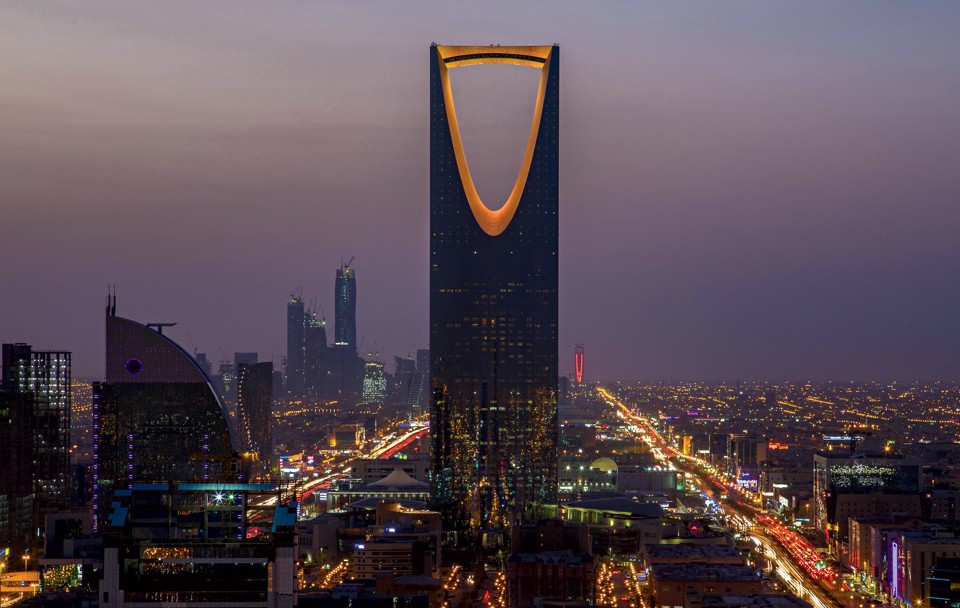

The skyline in Riyadh is a striking reminder of Saudi Arabia’s rapid growth and urbanization. In 1960, the city had just 155,000 inhabitants; today it has more than 5 million. (Mohammed Al-Deghaishim)
The Saudis burn about a quarter of the oil they produce—and their domestic consumption has been rising at an alarming 7 percent a year, nearly three times the rate of population growth. According to a widely read December 2011 report by Chatham House, a British think tank, if this trend continues, domestic consumption could eat into Saudi oil exports by 2021 and render the kingdom a net oil importer by 2038.

That outcome would be cataclysmic for Saudi Arabia. The kingdom’s political stability has long rested on the “ruling bargain,” whereby the royal family provides citizens, who pay no personal income taxes, with extensive social services funded by oil exports. Left unchecked, domestic consumption could also limit the nation’s ability to moderate global oil prices through its swing reserve—the extra petroleum it can pump to meet spikes in global demand. If Saudi rulers want to maintain control at home and preserve their power on the world stage, they must find a way to use less oil.

Solar, they have decided, is an obvious alternative. In addition to having some of the world’s richest oil fields, Saudi Arabia also has some of the world’s most intense sunlight. (On a map showing levels of solar radiation, with the sunniest areas colored deep red, the kingdom is as blood-red as a raw steak.) Saudi Arabia also has vast expanses of open desert seemingly tailor-made for solar-panel arrays.
Solar-energy prices have fallen by about 80 percent in the past few years, due to a rapid increase in the number of Chinese factories cranking out inexpensive solar panels, more-efficient solar technology, and mounting interest by large investors in bankrolling solar projects. Three years ago, Saudi Arabia announced a goal of building, by 2032, 41 gigawatts of solar capacity, slightly more than the world leader, Germany, has today. According to one estimate, that would be enough to meet about 20 percent of the kingdom’s projected electricity needs—an aggressive target, given that solar today supplies virtually none of Saudi Arabia’s energy and, as of 2012, less than 1 percent of the world’s.
The goal is not just to install solar panels across Saudi Arabia but to export them. Among the potential locations is the United States.

Some of Saudi Arabia’s most prominent industrial firms, as well as international electricity producers and solar companies big and small, have lined up to profit from what they see as a major new market. The fact that Saudi Arabia, an ardent booster of fossil fuels, has found compelling economic reasons to bet on solar is one of the clearest signs yet that solar, at least in some cases, has become a cost-effective source of power.

But the Saudis’ grand plan has been slow to materialize. The reasons include bureaucratic infighting; technical hurdles, notably dust storms and sandstorms that can quickly slash the amount of electricity a solar panel produces; and, most important, the petroleum subsidies that shield Saudi consumers from any real pressure to use less oil. The kingdom is a fossil-fuel supertanker, and though the captain knows that dangerous seas lie ahead, changing course is proving exceedingly hard.

Nasser Qahtani is an oilman through and through. On a credenza in his Riyadh office, he has a souvenir glass block that holds a shot of crude from Saudi Arabia’s biggest oil field. He spent about 15 years working at an Aramco petroleum-processing plant. And he has a master’s degree from Texas A&M University, which is why he has two Aggies coffee mugs on his bookshelf. “That’s for my easy days,” he told me one morning, pointing to the smaller one. “That’s for my tough days,” he deadpanned, pointing to the bigger mug.

Nasser has many tough days. Any shift away from oil threatens a host of entrenched powers, and as the vice governor of regulatory affairs for Saudi Arabia’s Electricity & Cogeneration Regulatory Authority, he spends much of his time trying to corral the competing constituencies to work together to modernize the country’s energy system.

Sipping Arabic coffee while sitting beneath paintings of the same three Saudi royals who adorned Prince Turki’s office wall, Nasser underscored the extent to which his country’s energy subsidies promote waste. In October, the World Bank estimated that Saudi Arabia spends more than 10 percent of its GDP on these subsidies. That comes to about $80 billion a year—more than a third of the kingdom’s budget. “In my opinion, that’s an accurate number,” Nasser said. “This is not sustainable.”

Also unsustainable is the opportunity cost of burning so much oil at home. Aramco sells oil to the Saudi Electricity Company for about $4 a barrel, roughly the cost of production. Even with the global price of oil down to about $60 a barrel as of this writing (a drop of about 40 percent since June 2014), Saudi Arabia forgoes some $56 on every barrel it uses at home. That gap will become far greater if, as many experts expect, the global price rebounds.
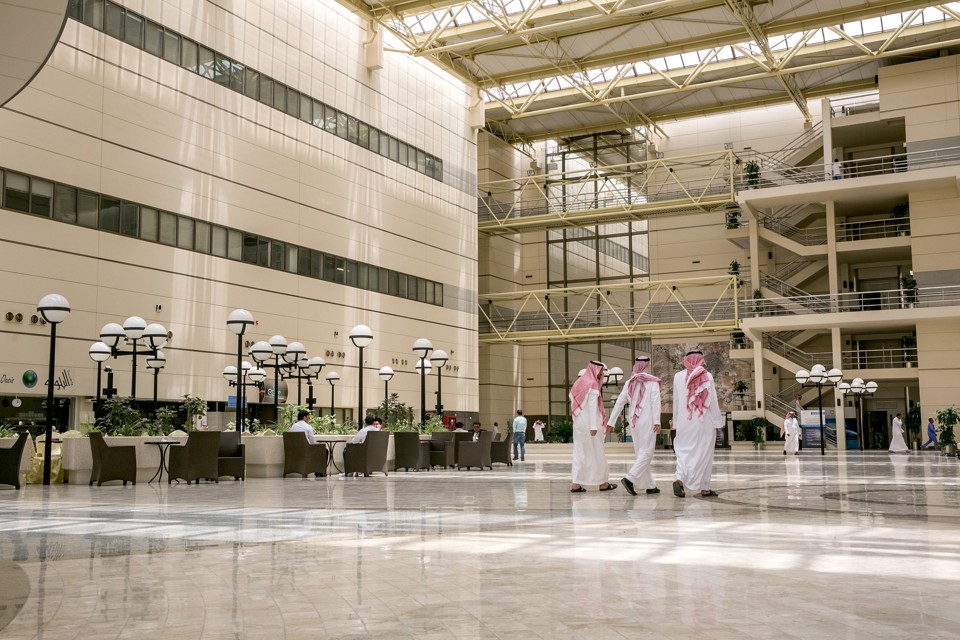
The King Abdelaziz City for Science and Technology, a national research-and-development agency based in Riyadh, is one of the key Saudi entities funding solar. (Mohammed Al-Deghaishim)

Saudi leaders carefully calibrate the kingdom’s output to keep that global price where they want it: high enough to fill Saudi coffers but low enough to avoid spurring competitive threats. For years, analysts have debated how much oil Saudi Arabia has in the ground, with some alleging that the kingdom is far less flush than it lets on. Saudi officials maintain that they face no immediate crisis, but they talk about the need to keep in check competitors such as the U.S. shale-oil industry. A serious reduction in the oil they have available for export would hinder their ability to fend off such threats.

Over roughly the past year, the government has toughened energy-efficiency requirements for air conditioners, imposed the country’s first-ever fuel-economy standards for cars, and begun to require insulation in new buildings. It’s moving to require that new power plants be more efficient than the ones they replace. And in March, Saudi Arabia signed a memorandum of understanding with South Korea to build the kingdom’s first two nuclear reactors, and possibly more.

What Saudi leaders don’t appear likely to do, at least anytime soon, is cut the fossil-fuel subsidies. Many Saudis view cheap energy as a birthright, and any increase in prices would be hugely unpopular. In a speech in February, the head of the central bank called for slowly reforming the subsidies, but he gave no indication of when. In the meantime, officials are looking to what once seemed an unthinkable solution: promoting renewable energy.

“The view initially was not to support renewables,” Nasser told me, explaining that Saudi officials feared “that if renewables were successful, we would not find customers for our commodity.” That view has changed—sort of. Should solar somehow begin to threaten the primary market for Saudi oil—as a transportation fuel—the kingdom’s calculus could shift back.

Few places better illustrate Saudi Arabia’s energy challenge than the country’s Red Sea coast. Along a stretch of black highway running north from the coastal city of Jeddah lies a string of new infrastructure. All of it is big. All of it is named for King Abdullah bin Abdulaziz al Saud, who died in January after leading the country for a decade. And much of it was built by Aramco, which, beyond being an international oil giant, is the Saudi government’s go-to player for getting things done. There’s the new King Abdullah Football Stadium, the new King Abdullah University of Science and Technology, the new King Abdullah Economic City, and the new King Abdullah Port. To the north of all this development, in the village of Rabigh, sits an enabler of growth: a massive, oil-fueled power plant.
Built by a Chinese firm and completed in 2012, the plant consists of two towering furnaces that produce electricity by burning heavy fuel oil. When I visited one morning this spring, a tanker sat at the pier, disgorging its liquid into one of the plant’s six circular storage tanks. Each tank holds about 14.5 million gallons of oil, which the plant typically burns in a week. In the sweltering air, the place stank like a Jiffy Lube, the kind of smell that sinks into your pores. Luai Al-Shalabi, a worker who lives in a dormitory there, told me the oily odor is ever-present: “All the time I feel it.”

Oil isn’t the only liquid this plant requires. It also needs freshwater—more than half a million gallons a day. The plant’s furnaces burn the oil, the heat boils the water, and the steam spins the plant’s turbines. All of that freshwater isn’t readily available in this desert kingdom; the Saudis have to make much of it out of saltwater.

Next to the power plant is a desalination plant. It’s small by Saudi standards; far bigger ones produce drinking water. Yet it still seems huge: a maze of tanks, tubes, filters, and pumps covering an area twice as large as a football field. The water the plant sucks in from the Red Sea contains about 40,000 parts per million of salt. By the time it comes out the other end, having been filtered and mixed with chemicals, its salt content is 25 parts per million. The process is a triumph of man over nature. And every step consumes electricity—which comes primarily from oil.

Solar power presents an alluring alternative. The kingdom first began experimenting with energy from the sun in the 1970s. In 1979, the same year that unrest in the Middle East sparked a global oil shock and President Jimmy Carter had solar panels installed on the White House roof, the United States and Saudi Arabia jointly launched a solar-research station about 30 miles northwest of Riyadh, in a tiny village called Al-Uyaynah, which at the time lacked electricity.
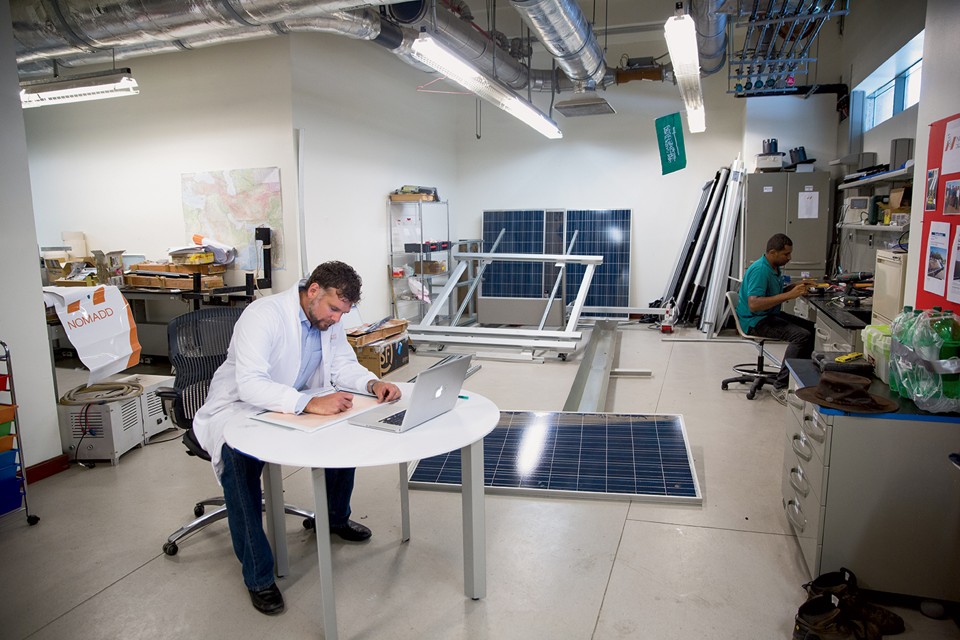
Georg Eitelhuber came to Saudi Arabia to teach high-school physics. A few years ago, he began developing a system to keep solar panels clean in the desert. (Mohammed Al-Deghaishim)
Work at this site languished in the 1990s and early 2000s but has picked up in the past few years. In 2010, the King Abdulaziz City for Science and Technology, the research agency that runs the station, built a small experimental assembly line there to manufacture solar panels. A year later, it more than quadrupled the line’s capacity. It plans to expand the facility again over the next several months, this time by a factor of eight.
Prince Turki told me that Saudi officials want to add another factory elsewhere in the kingdom; it will be one of the largest outside of China. The goal, he said, is not just to install solar panels across Saudi Arabia but to export them—a way, Saudi officials hope, to create high-paying tech jobs for the kingdom’s large population of young people. (Some two-thirds of Saudis are younger than 30.) Officials also want to bankroll solar installations in other countries, to boost the market for Saudi-made panels. Among the potential locations is the United States, where Turki envisions the kingdom undercutting other solar providers in part by tapping cheap development loans from Saudi banks.
But the factory at Al-Uyaynah shows how far the country has to go. The equipment comes mostly from Europe, and the solar cells—the square slices of silicon that make up a solar panel—are made in Taiwan. Often, as on the day I visited, the assembly line doesn’t produce much, because materials are stuck in transit. Once, a shipment of the plastic sheeting used to seal the backs of solar panels sat at a Saudi port for a month, and it melted.
The disconnect between aspiration and reality is even starker at the King Abdullah University of Science and Technology, one of the big projects along the Red Sea coast. The multibillion-dollar campus has both a world-class solar-research lab and some stupendously energy-inefficient amenities—including, in the middle of the desert, a hotel where I found my room chilled to about 62 degrees Fahrenheit and a nine-hole golf course fully lit for nighttime play.
The entire campus went up in about three years. It has a town square with a Quiznos sandwich shop, a Burger King, and a grocery store with an extensive selection of dates and nonalcoholic beer, all across the street from a towering white mosque. It has steel-and-wood offices and houses with red-tile roofs, both of which evoke suburban California. And it has a faculty of experts recruited from around the world.
The Saudis spend about $80 billion a year—more than a third of the kingdom’s budget—on domestic energy subsidies.
Among them is Marc Vermeersch, a Belgian physicist and materials scientist who arrived in January after spending several years in Paris heading up solar work at Total, the French oil giant. Vermeersch told me that although no expense was spared in setting up the university’s solar laboratory, the money wasn’t wisely spent. The lab includes half a dozen highly specialized printers—including one that cost about $1 million—that apply coatings to surfaces, a process important in researching futuristic solar-panel technologies. But because Saudi Arabia wants to ramp up solar power soon, Vermeersch and his colleagues are reconfiguring the lab to focus on nearer-term research, work he hopes will pay off in the next few years.
The university houses an incubator for technology start-ups, including a firm founded on the premise that there’s good money to be made in keeping solar panels clean in the desert. The company’s creator is Georg Eitelhuber, an Australian-born mechanical engineer who came to the university in 2009, the year it opened, to teach physics at a high school on the campus. “King Abdullah made me an offer I couldn’t refuse,” Eitelhuber told me kiddingly, in an Aussie accent.
In late 2010, Eitelhuber attended a ceremony at the university for which “a bunch of bigwig managers” gathered to christen experimental solar panels. But a dust storm had blown in, covering the panels and threatening to nix the photo op. With the temperature hovering at about 115 degrees and “everyone sweating bullets,” he said, “guys with squeegees” swept in to wash down the panels. Incredulous, Eitelhuber asked how solar panels are normally cleaned. “This is it,” he was told. “It was clear to me this was going to be the big new problem of a new industry in the Middle East.”
With seed funding from the university, he and some colleagues set about designing a waterless system. “The idea of using desalinated water that’s desalinated using oil,” he said, “is just a big green wash.” Five years later, his company has a late-stage prototype—a long metal rod with lines of brush bristles, powered by the panels—and several solar-panel manufacturers are testing the device. Eitelhuber plans to start installing it on solar farms next year.
Aramco is the most important player in the kingdom’s shift to solar power. The company’s initial forays have been tiny—a solar-panel array next to one of its office buildings, for example—but its plan to break ground on 10 or so bigger solar projects next year seems to represent the start of a more serious commitment. A high-ranking Saudi official told me he expects Saudi Arabia to develop an initial tranche of a few gigawatts of solar capacity over the next five years. The projects will be in places where the cost of conventional fuel is high, either because the sites are remote or because they use diesel. (Saudi Arabia has historically had to buy large quantities of diesel at international prices because its refineries can’t process enough to satisfy domestic demand.)
Even at these cherry-picked sites, solar power is likely to cost more than electricity from the existing conventional plants—but only because those conventional plants get oil at a subsidized price. This explains why the government, not the private sector, is making most of the investment in solar. Private companies are waiting for the government to offer up a slate of contracts that would, in effect, allow solar energy to compete with artificially cheap oil-fired electricity.
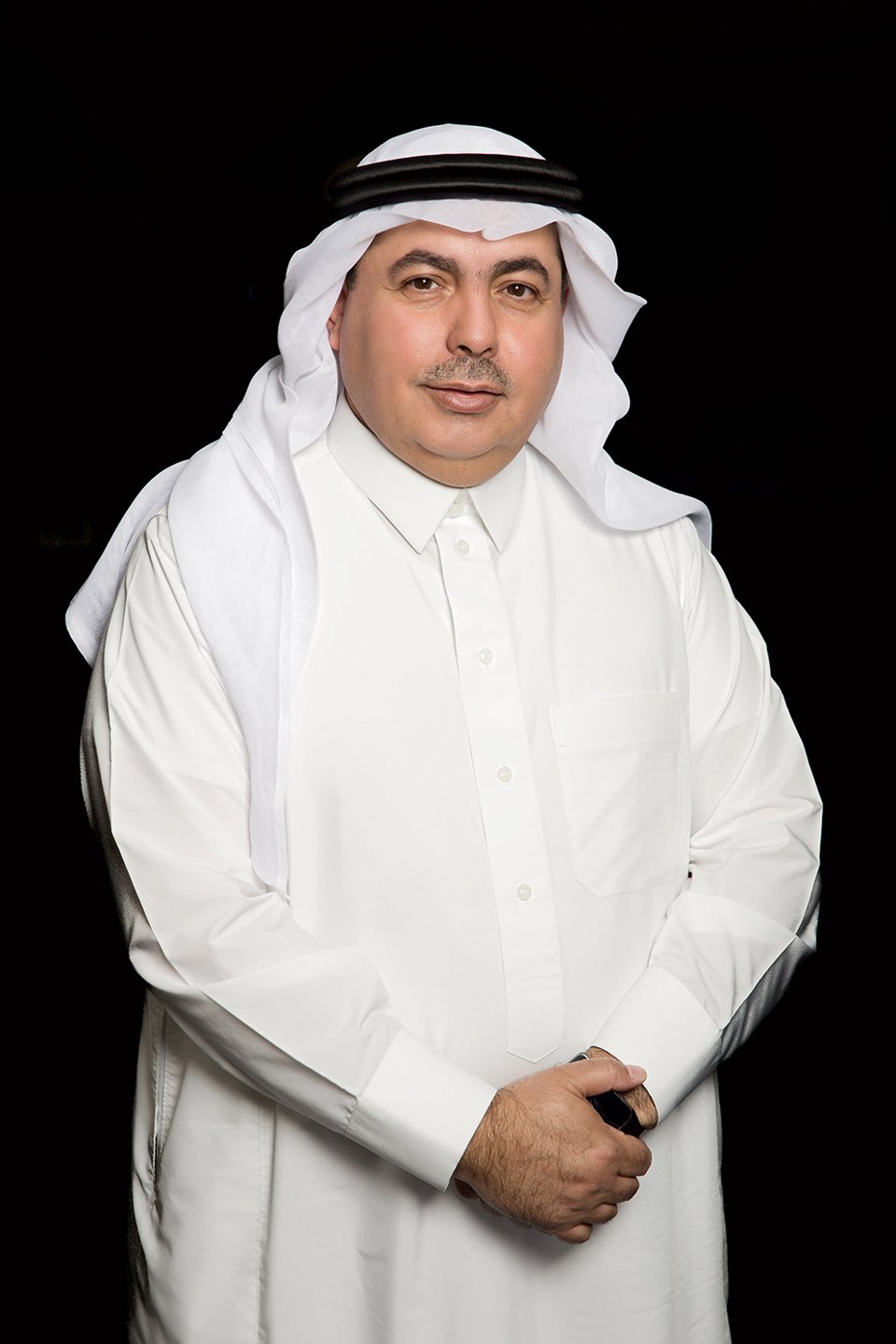
Prince Turki bin Saud bin Mohammad Al Saud is helping to lead the kingdom’s shift to solar power. (Mohammed Al-Deghaishim)
One of the biggest firms waiting in the wings is Acwa Power International, which is based in Riyadh and owns and operates power and desalination plants in the Middle East, Africa, and Southeast Asia. In the past few years, Acwa Power has signed contracts to produce solar power in several countries—places where the price of conventional electricity is higher than in Saudi Arabia.
Taqnia, a state-owned company, is finalizing a deal to provide solar energy for 5 cents a kilowatt-hour—a price that may be the cheapest in the world.
Earlier this year, it won a bid to build a solar farm in Dubai. The price at which Acwa Power agreed to sell electricity from that solar farm—5.84 cents a kilowatt-hour—turned heads among solar watchers the world over. It was heralded as signaling a new era of cost competitiveness. Paddy Padmanathan, Acwa Power’s president and CEO, told me he’s confident the company will make a healthy profit over the 25 years of the deal. “All of a sudden, renewables are becoming a very competitive proposition,” he said.
Acwa Power hasn’t yet developed any solar projects in Saudi Arabia. But Prince Turki told me that Taqnia, the state-owned company he chairs, is finalizing a deal to provide solar energy to the Saudi Electricity Company for 5 cents a kilowatt-hour—even less than the price Acwa Power recently agreed to in Dubai. “It’s the cheapest in the world that I know of,” Turki said.
That deal may be a tantalizing sign of things to come, but the goal Saudi Arabia announced three years ago of building 41 gigawatts of solar capacity remains a distant glimmer. In January, Saudi officials announced that they were pushing back the target date from 2032 to 2040—and even with the longer time frame, skeptics have dismissed the goal as a mirage.

Proving them wrong would require reshuffling an economic deck that the kingdom’s leaders have stacked for decades to favor petroleum. In that sense, Saudi Arabia’s energy challenge is a more extreme version of the one that faces the rest of the world. But if the kingdom’s leaders can find the political courage to act decisively, Saudi Arabia, of all nations, could become a model for other countries trying to shift away from oil.

Monday, June 22, 2015

This was given to Free flag subscribers on friday....

BUY PODDAR DEVELOPERS Script code 523628.
Target Rs 3000. in 2 years.
Few reasons can be as follows:

(i) Very high quality of earnings: The aggregate pre-tax ROE of the portfolio is 37% a year;
(ii) Exceptionally strong balance sheet quality: Of the 11 businesses, 8 have no net debt and the most leveraged business has interest cover of more than 3x;
(iii) Highly Scalable Businesses.
Poddar Developers qualifies on all counts. It is a very profitable business with very low debt. Also, it is a micro-cap with a market capitalisation of only Rs. 875 crore. So, you can imagine the extent of scalability that it has. The management, headed by Rohit Poddar, is very dynamic and clear-headed about the future path for the company.
To understand Poddar Developers’ business model, we have to look at four resources:
(i) Article in Forbes India which analyzes the prospects of the company and calls it “the next big realty thing given a 24.7 million unit shortage”. Rohit Poddar, the CEO, is quoted as saying “My business, in the years to come, won’t be judged as a realty business. It will be like any consumer business with a steady growth in top line and profits. The next year’s numbers will always be better than the previous”.
(ii) Feature on CNBC TV18 which explains the economics of low cost housing projects;
(iii) Advertorial which provides details of the mega township project in Badlapur;
(iv) Investors’ presentation dated May 2015 which sets out the “key strengths and differentiators” of Poddar Housing and provides details of the “Strong project pipeline providing near term cash flow visibility”.

Friday, June 19, 2015

Could China Use Aluminum Instead of Copper Wiring?

Could China Use Aluminum Instead of Copper Wiring?
A few weeks ago, China’s National Energy Administration (NEA) made an announcement that may have caught the interest of copper investors. According to Metal Bulletin (subscription), the NEA has released nationwide industrial standards for the use of low-voltage aluminum alloy cables.
The change, effective in September, means that China could use aluminum alloys instead of copper for some types of electrical wiring. A research note from Goldman Sachs (NYSE:GS) has been making the rounds, suggesting that a switch could mean big problems for copper demand.
As the Financial Times points out, China has ample aluminum supply, but needs to import most of its copper. Furthermore, copper is over three times more expensive than aluminum, making for an attractive price difference.
“An increased rate of substitution to aluminium alloy, from copper, is highly likely … the China price of copper is 3.4 times that of aluminium (and substitution becomes profitable at a ratio of 2.5/1),” the news outlet quotes the note as saying.
Aluminum issues
The low-voltage cables referred to by the NEA are mainly used to connect buildings to substations. Previously, such cables were made with copper as users were unsure about the quality of aluminum alloys.
And certainly, while aluminum wiring is sometimes used in planes due to the metal’s high conductivity to weight ratio, the use of aluminum in electrical wiring has had its issues.
For example, aluminum wiring has been linked to house fires. Aluminum was used extensively in electrical wiring for homes in Canada and the US in the 1960s and 70s, and while there are solutions to the safety problem, houses with aluminum wiring will still often garner more expensive home insurance.
Stefan Ioannou, mining analyst at Haywood Securities, noted that copper has greater tensile strength than aluminum while being less prone to thermal expansion. While he admitted that the much higher cost of copper is “one of the major offsetting considerations,” he still suggested that copper would be the better choice for larger electrical projects.
“[Copper's] physical properties are much more favorable for big grid infrastructure,” he said. “You still can use aluminum, but it’s not ideal from a physical point of view.”
Still, according to Goldman, China’s state power grid — and perhaps other consumers — is likely to make the switch now that industry standards for aluminum cables are in place. ”We estimate that between 100kt and 250kt (100,000-250,000 tonnes) of copper demand could be lost owing to this development in 2016, compared with our base case of 400kt China demand growth in 2016,” the firm states in its report.
Pressure on copper prices
Goldman Sachs has been holding to a rather bearish outlook for copper, setting its target price for the red metal at $5,200 per tonne. To be sure, there’s been plenty of pressure on the copper price lately. The red metal has fallen 11 percent since May 12, and recently hit a three-month low on the back of a strong US dollar. Spot copper closed at about $2.59 per pound on Wednesday.
Taking a look at other factors affecting the copper price, Ioannou pointed to concerns about how quickly China is moving ahead with its state power grid project. “Last year they only got through about 80 percent of what they hoped to, and if you look at the numbers this year … it sounds like they’re behind already again,” he said. “In terms of the physical consumption that we were anticipating this year from that project, it’s probably going to be less. That’s not to say they won’t consume all that copper to finish the project, it’s just going to take longer.”
On the inventory side of things, Ioannou noted that copper inventories in Shanghai have fallen 27 percent year-to-date and 40 percent in the past three months. However, he also noted that London Metal Exchange copper inventories have risen 78 percent so far this year, which could be a concern.
The upshot
The potential for China to use aluminum wiring is certainly interesting, but overall, Ioannou suggested that there are other, bigger considerations at play when looking at copper demand. To give one example, firms such as PricewaterhouseCoopers have focused on global copper supply rather than on Chinese demand, reiterating broader concerns that a lack of supply growth could lead to a supply deficit sooner rather than later.
Ioannou said that Haywood wouldn’t be surprised to see copper stay around its current level for now — around $2.50 to $2.75 — with the next possibility for an upward price move coming in the fall.

Wednesday, June 17, 2015

The World Is Facing Its Longest Oil Glut in at Least Three Decades


The world is on the brink of the longest-lasting oil glut in at least three decades and OPEC’s quest for market share makes it almost unavoidable.
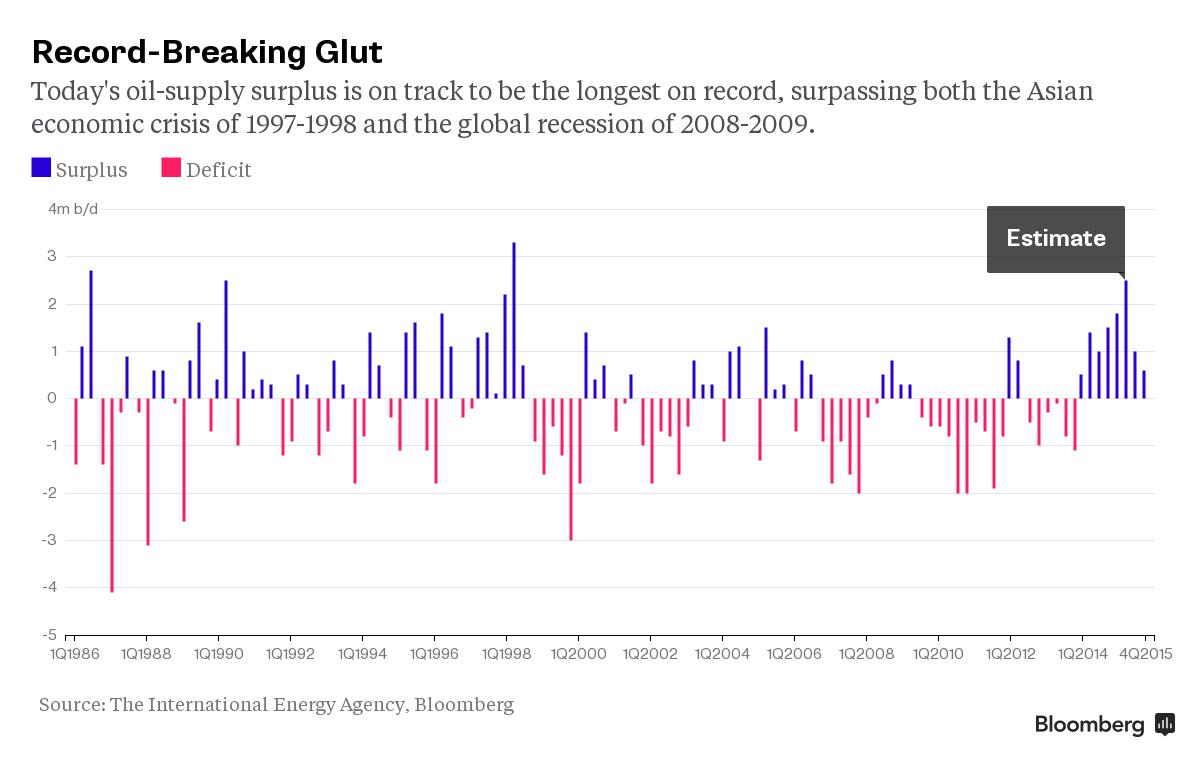
Record-Breaking Glut
Oil supply has exceeded demand globally for the past five quarters, already the most enduring glut since the 1997 Asian economic crisis, International Energy Agency data show. If the Organization of Petroleum Exporting Countries were to keep pumping at current rates it would become the longest surplus since at least 1985 by the third quarter, the data show.
There are few signs the 12-nation group will cut back. Saudi Arabia, OPEC’s biggest member, will probably increase production to intensify pressure on U.S. shale drillers, Goldman Sachs Group Inc. predicts. OPEC’s supplies may be swollen further this year if Iran reaches a deal with world powers to ease sanctions on its exports, Commerzbank AG says.
“It seems to be taking longer for the oil surplus to clear, and, even without the return of Iran, IEA data indicates it could last for the rest of the year,” said Eugen Weinberg, head of commodities research at Commerzbank in Frankfurt. “Any expectations the oversupply will be gone by 2016 don’t look justified at this stage.”
Brent crude for August settlement dropped 18 cents to $63.77 a barrel on the London-based ICE Futures Europe exchange at 10:17 a.m. London time. The benchmark has risen about 40 percent since reaching a six-year low of $45.19 on Jan. 13.
OPEC pumped 31.3 million barrels a day in May and will probably continue to pump around that level “in coming months,” the IEA said in a report on June 11. The agency doesn’t forecast OPEC production.

Global Oversupply

Producing at that level would imply a global oversupply of 1 million barrels a day in the third quarter and 600,000 barrels in the following three months, according to IEA projections for global demand and non-OPEC supply compiled by Bloomberg. That would be the eighth consecutive quarterly surplus, exceeding the current record of six quarters from 1997 to 1998.
The glut could swell further if Iran and world powers reach an accord on the Islamic Republic’s nuclear program by their June 30 deadline, Commerzbank predicts. The country could boost exports by 1 million barrels a day within seven months of sanctions being removed, Oil Minister Bijan Namdar Zanganeh said in Vienna on June 3.

Friday, June 12, 2015

Novartis Said to Explore Delisting of $380m Indian Unit

Novartis AG, the world’s biggest drugmaker by sales, is exploring a delisting of its Indian unit, people with knowledge of the matter said.
The Swiss pharmaceutical company is considering buying all the shares it doesn’t already own in Novartis India Ltd., which has a market value of about $380 million, according to the people. Novartis executives met investment banks in recent weeks to discuss the procedures if it decides to pursue the delisting, the people said, asking not to be identified as the information is private.
Novartis India markets prescription and over-the-counter medicines in the country. Its best-selling brand last month was the Galvus Met diabetes medication, according to data from Mumbai-based market research firm AIOCD Pharmasofttech AWACS Pvt.
A deal would allow Novartis to save on regulatory costs associated with the listing, the people said. An average of about $360,140 of Novartis India shares changed hands daily over the past year, data compiled by Bloomberg show. Deliberations are at an early stage, and there’s no assurance Novartis will go ahead with the delisting, the people said. Novartis owns a 75 percent stake in the Indian unit, the maximum allowed under local regulations, according to data compiled by Bloomberg.
A representative for Novartis India referred queries to its Basel-based parent company. Dermot Doherty, a spokesman for Novartis, declined to comment.

Thursday, June 11, 2015

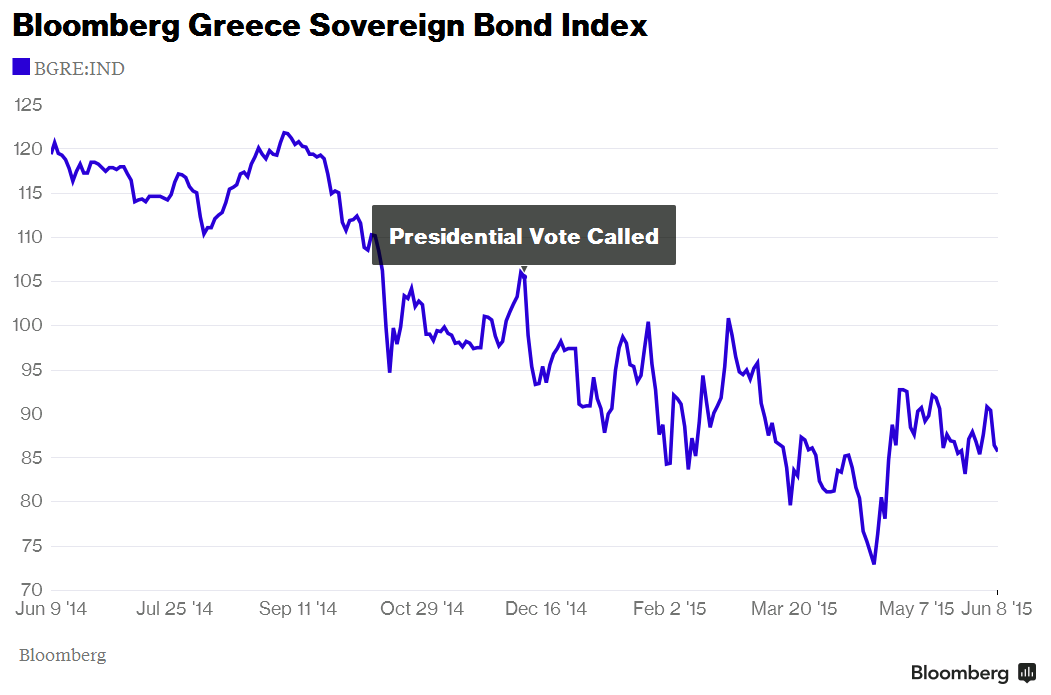
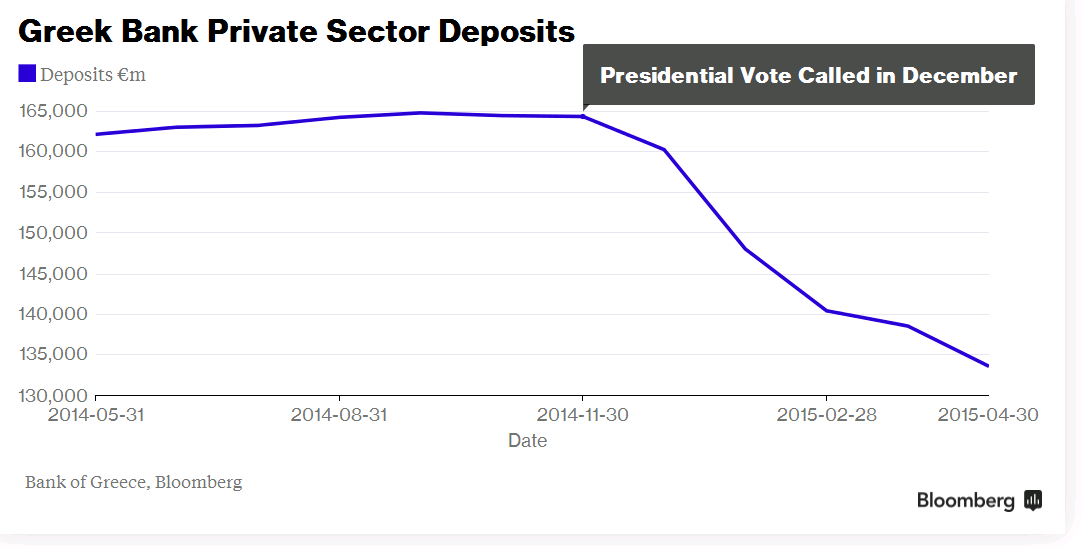
Six Charts Show Six Months of Economic Unraveling for Greece

Greece was in the early stage of an economic recovery when then-Prime Minister Antonis Samaras called a vote for a new president. The unraveling that followed shows just how fragile that recovery was.
Investors were the first to run for the hills, anticipating that the political stand-off would end in elections that would usher in Alexis Tsipras's anti-austerity Syriza party, and a confrontation with the country's bailout creditors.
Savers were not far behind, and with the economy drained of liquidity, Greece was officially back in recession by the end of March.


Already shorn of bond market access as Samaras's own efforts to seal deal to release more bailout funds floundered, the rout killed any lingering hopes that Greece could stand alone.
The point was not lost on Greeks with deposits at the country's banks. With savings fleeing, so dependence on the European Central Bank for funding rose, tightening creditors' grip on Tsipras's government after he replaced Samaras in January.


"We've got massive capital outflow, we've got a huge debt that's not sustainable, we've got a recession and there's no investment," said Gianluca Ziglio, a fixed-income strategist at Sunrise Brokers LLP. "It's a tragic situation from all points of view."


Still, Tsipras's government has held back on agreeing terms demanded by creditors longer than many anticipated. After the initial marking rout six months ago rout, see-sawing sentiment on whether or not a deal will be agreed has led to wild swings in theAthens Stock Exchange.


"The more time passes, the deeper is Greece descending into a costly renewed recession and the harder it will be for Greece to get a good deal," Holger Schmieding, chief economist at Berenberg, said in a note to clients on Wednesday. "Fortunately, contagion risks remain well under control."

Tuesday, June 09, 2015

Goldman: Chinese copper demand growth could halve.

China is finding more use for the aluminium its state-owned smelters often over-produce to keep people employed. And this structural shift creates a bad prognosis for Doctor Copper himself, Goldman Sachs forecasts.
Copper has won that medical moniker as it is viewed as a barometer of world economic health, much of which is powered by Chinese industrial demand.
But the red metal's role in global development, particularly China's, is about to change significantly, Goldman analysts led by Max Layton say.
They point out, in a research note reiterating their bearish view, that China's State Grid plans to replace copper with aluminium in power cables.
That sorts out a major Chinese problem.
Many Chinese cities have their own aluminium smelter, and production can be kept overly high to ensure GDP targets laid down by Beijing are met. The market is now over supplied, however, since the government applied the brakes to state investment in new infrastructure in an attempt to curb overcapacity and deflate a credit bubble.
But it also means, the Goldman team says, that:
as much as half of 2016 Chinese demand growth could be lost"
The Goldman team explains:
An increased rate of substitution to aluminium alloy, from copper, is highly likely...the China price of copper is 3.4 times that of aluminium (and substitution becomes profitable at a ratio of 2.5/1). Notably, China's State Grid stated in late 2014 that aluminium substitution of copper has significant importance because Chinese copper and aluminium resources are relatively unbalanced – copper resources are in severe shortage (reliance on imports >75%) but aluminium reserves are sufficient and domestic aluminium smelting capacities are oversupplied.
.
The bank's maths is based on its own forecast of demand, however. The analysts write:
We estimate that between 100kt and 250kt of copper demand could be lost owing to this development in 2016, compared with our base case of 400kt China demand growth in 2016.
Goldman targets $5,200/t for the copper price. (Three-month futures are at $6,015/t.)

Sunday, June 07, 2015

This is very interesting

Watch Four Years of Oil Drilling Collapse in Seconds


http://www.bloomberg.com/graphics/2015-oil-rigs/

Thursday, June 04, 2015

Why are more than 10 million homes vacant in India?

India housing


Some 12 million houses in India are lying vacant, according to one estimate

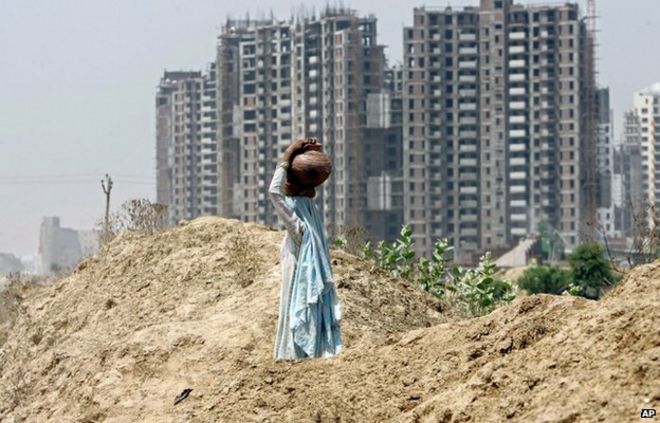
If you travel through the suburbs of the Indian capital, Delhi, you will see miles and miles of built homes with nobody living in them.
In fact, Anshuman Magazine, chairman and managing director of property consultancy firm CBRE South Asia, said in a recent article that "around 12 million completed houses" were "lying vacant across urban India".
A similar point is made by Akhilesh Tilotia in his book The Making of India - Gamechanging Transitions, where he states that India has more homes than households or families.
He writes that India's households increased by 60 million - from 187 million to 247 million - between 2001 and 2011. The number of houses went up by 81 million - from 250 million to 331 million - over the same period. In urban areas, there were 38 million new homes for 24 million new households.
And despite this, there is a huge shortage of housing in urban India. The latest official Economic Survey says there is a shortage of nearly 20 million homes in India.
So what is happening?

'Black money'

Many of these homes have been bought as investments by people who have "extra" money to invest.
A substantial portion - no one knows how much - of this is black money on which taxes haven't been paid. Hence, homes have been bought but nobody is living in them.
Further, most builders like catering only to the affluent population in India and home prices have gone beyond the reach of many of them too.
But the shortage in housing mainly hurts people at the lower income levels. A total of "95.6% [of housing shortage] is in economically weaker sections/ low income group segments", the Economic Survey points out.

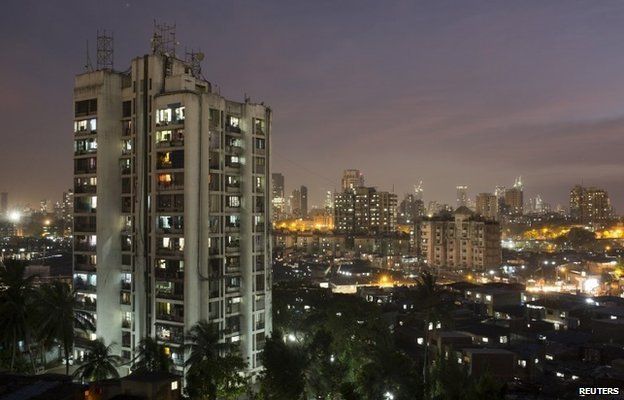
A high-rise residential tower is seen next to shanties in Dharavi, one of Asia"s largest slums, in Mumbai March 18, 2015. In Mumbai, the windows of new high-rise apartment blocks, old low-rise residential buildings and shantytown shacks portray the disparity in living conditions and incomes in the Indian city.
The average price of a home in Mumbai is more than $200,000

Mr Tilotia estimates that the demands of people who can afford to pay between 500,000 ($7,817; £5,055) and 1m rupees ($15,661; (£10,116) for a home are largely unmet by the builders.
A recent report by real estate rating and research firm Liases Foras points out that the average price of a home in the Mumbai Metropolitan Region, as of March, was 13m rupees ($203,602; £131,512).
The average price of a home in Bangalore and Delhi are 8.6m ($134,690; £87,000) and 7.4m rupees ($115,897; £74,860) respectively.
Given these high prices, it is not surprising that the housing demands of a large section of people are going unmet.

Slum population

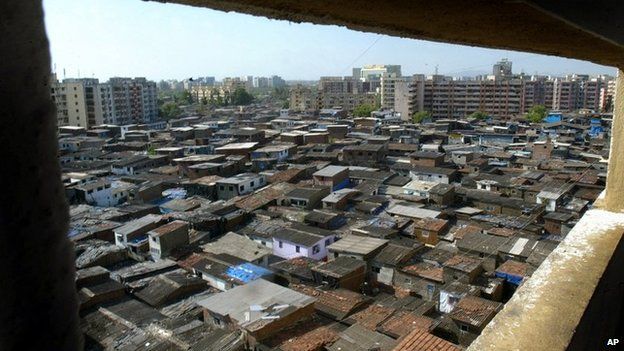
Hence, it is not surprising that as per the 2011 Census, 13.7 million households in Indian cities live in slums.
The number of people living in these slums is around 65 million and forms around 17.4% of the urban population.
Other estimates put the slum population living in Indian cities at a much higher level.

Mumbai slum
Some 65 million people in India live in slums

A 2012 report quotes S Parasuraman, director of the Tata Institute of Social Sciences in Mumbai, as saying: "Nearly 60% of Mumbai's slum population lives in 8% of land."
So what is the way out of this?
The government needs to start doing something about it sooner rather than later.
Maybe it can learn a thing or two from South Korea, which in the late 1980s built around 2 million homes of which around 0.9 million were built around the capital city of Seoul, as Mr Tilotia points out.
In order to do this, the government will have to first and foremost sort out the mess over acquiring land in the country.
Further, these homes will have to be built on the periphery of cities, backed up by a good transportation system, so that people can travel to work.
If all this is not done there will be more trouble ahead as more and more of India's population moves to its cities in the years to come.
As the Economic Survey points out: "Nearly 30% of the country's population lives in cities and urban areas and this figure is projected to reach 50% in 2030."
What this means is that if affordable housing doesn't become the order of the day, slums will continue to thrive in India. And that is not a happy thought.

Tuesday, June 02, 2015

Destructive calculus: How algorithms put jobbers out of job

It was a few minutes past 10 in the morning—the stock market had just opened. Nithin Srivastava's eyes glanced at the screen, absorbing the flickering numbers, his fingers rattling across the keyboard in an astonishing display of handeye coordination, banging out trading orders in rapid succession. In another 15 minutes, his day was pretty much done.


He'd made about Rs 30,000—an average performance in 2007. On exceptional days, he could even make as much as Rs 2-3 lakh. But the party would soon be over for jobbers and arbitrageurs like Srivastava. Not because of the financial crisis that would demolish markets around the world shortly but because algorithmic trading would make most of them redundant.


These days Srivastava manages awarehouse that stores almonds, having quit as an arbitrageur from BLB Securities in 2012. "Big brokers like BLB had 1,000-1,200 jobbers and arbitrageurs those days," he recalled. "Now they may only have a handful."


The keyboard skills needed to be successful at jobbing and arbitraging had to be honed over the years—market instinct combining with sheer typing ability. A junior scalper would not even get a sniff of hard cash until he was able to punch out orders in less than three seconds. The best in the business did this in oneand-a-half seconds.


"Years 2006 and 2007 were the best years for jobbers and arbitrageurs," said Chirag Mehta. "Those were the years when jobbers profited from price differentials (between NSE and BSE or between shares and futures) as high as 50-75 basis points," who currently trades with Touchline Securities.


A basis point is 0.01 percentage point.


Destructive calculus: How algorithms put jobbers out of job


The bull run nine years ago was great for this group. On a normal trading day, these men—and they were all men—made as much as Rs 40,000. In times of extreme volatility, this could surge to Rs 3 lakh.


"The market opened at 9:55AM those days. By 10:15, some of us would have made Rs 25,000-40,000," said Srivastava. "Some of those large brokers employed 300-500 pairs of arbitrageurs to derive maximum benefits of volatility."


Paired arbitrage refers to simultaneous buying and selling of instruments by two arbitrageurs to eke out profits arising out of a price differential between exchanges or instruments.


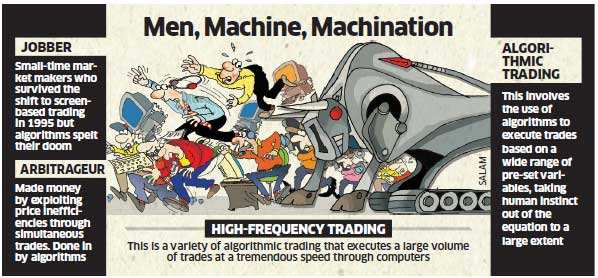
But by late 2007, superfast trading terminals loaded with complex algorithms, or algos, began making inroads into the Indian equities markets. The fastest fingers could not match the prowess of the algorithms, which executed millions of trades in milliseconds. Over time, with more and more institutional players signing up for algorithmic trading, price differentials between exchanges and products became nonexistent.


"Jobbers and arbitrageurs (initially) believed the situation would improve when markets turned around," said Suresh Mehta of Dhyan Stock Broking. "But when nothing happened till 2011-12, a good number of them moved on to other trades."


Mehta's company was forced to shut the division.


"At one point, we had over 1,000 jobbers and arbitrageurs on our rolls," Mehta said. "Today, we have none... We moved out of jobbing and arbitraging in 2011 as there was no point carrying on a lossmaking business."


D-Street to high sea


Their ranks haven't been completely wiped out but the numbers have dwindled to an estimated 2,000 from more than 30,000 in 2003-07. According to brokers, a large chunk of the tribe moved on to businesses such as real estate broking, diamond polishing, plywood and textiles. People with less appetite for entrepreneurship took up jobs as relationship managers and dealers.


Dinesh Kumar used to be a jobber with BLB Securities. He's now in the merchant navy. He has clear memories of the end of days.


"Our bad times started in 2008. Markets crashed in the third week of January. The bourses were flooded with sell trades. Turnover volumes dropped," he said. "Towards mid-2008, large brokers employed software and algos to squeeze small gains. This pushed us into deeper misery. By 2010, manual arbitraging had become a loss-making trade. We could not compete with the machines. By 2012, none of us were making any money."


Kumar got out in 2012, after getting the merchant navy break.
"What I am earning now is not even a fraction of what I made from trading in 2007," said Kumar, now 42.


Middle-aged jobbers, who only possessed good typing skills, stayed on doing 'BTST' (buy today, sell tomorrow) trades. On good days, BTST traders made profits of Rs 5,000-10,000. But taxes, broker charges and exchange fees, among other levies, ate into their earnings significantly.


"Algorithm trading dealt the first body blow to jobbers and arbitrageurs. Imposition of STT (securities transaction tax, in the FY2005 budget) moved them out of business," said Kapil Mohan, who's now empanelled with Vikabh Securities and manages the investments of a few Delhi-based investors.


"When times were good, jobbers earned commission and profit share from brokers. The entry of algo trading pushed jobbers and arbitrageurs to take up jobs with brokers at very low salaries," Mohan said.


When day traders transitioned from commissions to salaries, their earnings dropped significantly. Dealers and proprietary book traders earned about Rs 35,000-40,000 in monthly salaries— the sort of money jobbers blew up to celebrate big profit days during the bull run.


The few people still in the trade will decline further, said veteran Delhi-based broker BL Bagri.


"Algorithm trading was inevitable at that time—nobody could have done anything to prevent it from coming," Bagri said. "This trend of automation may continue for a long, long time. It will end whatever is left of manual arbitraging and jobbing."


Currently, algorithmic trading accounts for more than 40% of transactions in the Indian equities market. The rise of the machines is such that even cash-rich brokers aren't able to keep pace. Market intermediaries expect net algorithmic volumes to breach 60% by 2020.


The future


"There's no end to this fight for more trade execution speed. Brokers are forced to update their IT peripherals every three months to match speeds of their competitors. Competition exists even among colocated brokers," said Praveen Gupta, CEO of Symphony Fintech, a trading solutions provider.


In their bid to spread the cost of service and frequent technology updation, brokers have started opening up algorithmic solutions to retail investors at a marginally higher cost. About 5% of retail trades are made using algorithms.


"The concept of speed (high-frequency trading) may take a back seat in the coming years," said Gupta of Symphony Fintech. "We'll see more intelligent algos hitting the market over the next few years."


While brokers have embraced algorithmic trading, old-timers, conservative market participants and regulators have apprehensions about the unbridled power that they can unleash. Machine trading is said to have caused a number of crashes around the world. In 2014, a quant-based portfolio management services fund suffered losses due to malware and wrong 'factors' in the algorithm. "Algorithmic trading does not pose a lot of threat if good risk management practices are in place," said Vikas Khemani, CEO of Edelweiss Securities.


"It (algorithmic trading) is all about efficiency... Markets across the world are opening up to highfrequency intelligent trading."


As that happens, those who were first with the fastest finger will become a footnote in the history of India's stock markets.

Monday, June 01, 2015

Good investment

Arrow coated products have given stunning results with EPS of 19. This is likely to improve in coming quarters.
Our premium members have already entered at a lower price last week. 
One can buy with near target of Rs 660.