About Me

My photo
An Investor and counsellor in Financial Market

Monday, August 21, 2017

The Apocalyptic Vision of Stephen K. Bannon

apocalypse

History may not repeat itself precisely, but according to Steve Bannon, it sure does rhyme. And the rhyme we are soon to hear, according to the White House chief strategist, will echo epochal crises like the Great Depression, the Civil War, and the American Revolution.
As has been reported in several articles and interviews, Bannon is much enamored with the work of amateur historians William Strauss and Neil Howe, who, in their 1991 book Generations and their 1997 book The Fourth Turning, develop an elaborate and finely textured account of how history is structured in 80-100 year cycles.
Each cycle — or, as they call them, saecula — is divided into four "turnings." The first turning is a "High" (think the end of World War II through the 1950s), the second an "Awakening" (think the "Consciousness Revolution" starting in the 1960s), the third an "Unraveling" (think of the culture wars, which began in 1984) and the fourth a "Crisis" (think 2008 until "around 2026"). They liken the cycles of history to the seasons of the year: spring, summer, fall, and winter. According to Strauss and Howe's predictions in their 1997 book, we're now deep into a chilly winter from which a new spring may emerge ... or not.
"The Crisis climax is human history's equivalent to nature's raging typhoon, the kind that sucks all surrounding matter into a single swirl of ferocious energy. Anything not lashed down goes flying; anything standing in the way gets flattened. ... The climax shakes a society to its roots, transforms its institutions, redirects its purposes, and marks its people (and its generations) for life. The climax can end in triumph, or tragedy, or some combination of both."
Thus do Strauss and Howe hedge their bets, optimistic, pessimistic and everything in between. Bannon is less sanguine. Watch on YouTube his 2010 documentary, "Generation Zero" — a film that portrays a crisis whose imagery contains ominous dark clouds, crashing planes and jittery investors — and you will come away scared.
But fear may not be the best motivator to make America great again. In order to evaluate the influence that Bannon is exercising on the White House and the world, we need to better understand the specific message of Strauss and Howe's books.

The Model of Generations

Three concepts drive their model: generations, the saecula and a sequencing of archetypes. Let us take each in turn.
Generations are defined not just by their length — 20-21 years more or less — but also by their place in history.
"The war-ravaged European 'generation of 1914' and American Lost Generation mingled at many of the same Paris cafes. After World War I, when the United States became a global symbol of progress, the interest of Americans in generations began to surpass that of Europeans. Since then, no peer group has come of age in America without encountering a determined effort to name and describe it."
While Strauss and Howe identify no less than 24 Anglo-American generations going back to the 15th century, the focus of The Fourth Turning falls on the most recent five:
The Most Recent Generations, According to Strauss and Howe
The concept of the saeculum dates back to a political philosopher in the second century B.C., Polybius, who was the first to link a cyclical theory of historical time to the cycles of generations. The Fourth Turning is a long book because Strauss and Howe devote many pages to establishing the fixed rhythm of the saeculum by correlating historical events with generations and their archetypes all the way back to the Wars of the Roses (1459-87), the climax of the Late Medieval Saeculum.
"We should take solace that the saecular rhythm is only approximate. If it were precise, it would show human events to occupy the simple, inorganic domain of physical time, rendering our society hardly more interesting than an orbiting comet or a ticking metronome. Instead, the imprecise saeculum shows that society occupies the complex, organic domain of natural time. Nature offers numerous examples of this domain: the beating of a heart, the budding of a flower, the molting of a sparrow."

A Pattern of Archetypes

From the Greek myths to modern thinkers like Carl Jung and Joseph Campbell, archetypes have been used to explain the varieties of human behavior. The Myers-Briggs test is used to this day to classify different personality types based on such archetypes. While the characterization of each of the four archetypes is also imprecise — their descriptions are more literary than mathematical — the important point for Strauss and Howe is that their sequencing through a saeculum is always the same: "The labels vary, but the archetypal order (Prophet to Nomad to Hero to Artist) is always identifiable — and always the same."
By overlaying the patterns of each of these concepts — generations, saecula and archetypes — one atop the other as they unfold through history, Strauss and Howe reveal a moirĂ© pattern that is invisible when considering any one pattern alone.
"During a Crisis era, Prophets enter elderhood, Nomads midlife, Heroes young adulthood, and Artists childhood. During an Awakening era Heroes enter elderhood, Artists mid-life, Prophets young adulthood, and Nomads childhood. These constellations push the saeculum forward, since generations that are predictably shaped by history become, as they age, generations that predictably shape history. Thus does the scripted reappearance of archetypes govern time's great wheel."
Given the imprecision of both the length of a generation and the characterization of an archetype, there is a danger that the model is infinitely applicable as a kind of socio-historical astrology. By cherry-picking events and their interpretations, one can "prove" almost any prediction. But Strauss and Howe do an admirable job of amassing details and precise numbers, from history to pop culture, to make their case.
If Sigmund Freud was correct in claiming that dreams are the golden road to the unconscious, the popularity of different books, TV shows, and movies pave the road to the social unconscious.
"As the media standard for the typical American family changed from My Three Sons to My Two Dads, divorce struck 13ers harder than any child generation in U.S. history. ... In 1984, Americans were first noticing that the conventional family was no longer the norm and premarital teen sex no longer a rarity. A decade later, married couples with children had shrunk to only 26 percent of all households (versus 40 percent in 1970), and the share of sexually active fifteen-year-old girls had swollen to 26 percent (versus 5 percent in 1970)."

The Fourth Turning Foretold

After 271 pages of text establishing the cogency and consistency of their model, Strauss and Howe launch Chapter 10, "A Fourth Turning Prophecy." Given events that have already occurred since the book was published in 1997, their predictions aren't bad.
"Sometime around the year 2005, perhaps a few years before or after, America will enter the Fourth Turning. Any of a number of 'sparks' could ignite it. In retrospect, the spark might seem as ominous as a financial crash [read, 2008], as ordinary as a national election [read, Trump], or as trivial as a Tea Party [read, the Tea Party]."
They offer five brief scenarios for other "sparks" that could ignite the Fourth Turning: the first a secessionist movement by a state. As of 2014, one could count movements toward:
  • A 51st state called Jefferson made up of Northern California and Southern Oregon
  • A new state called Western Maryland
  • A new state called North Colorado
Their second, a global terrorist group (read, the Islamic State). Their third, a government shutdown. Their fourth, a communicable virus (like Ebola). Their fifth, growing anarchy throughout the former Soviet republics (read, Ukraine and Crimea).
As the Fourth Turning unfolds, "America's initial Fourth Turning instinct will be to look away from other countries and focus total energy on the domestic birth of a new order. ... The crisis mood will dim expectations that multilateral diplomacy and expanding global democracy can keep the world out of trouble."
"As each archetype asserts its new social role, American society will reach its peak of potency. The natural order givers will be elder Prophets, the natural order takers young Heroes. The no-nonsense bosses will be midlife Nomads, the sensitive souls the child Artists. No archetypal constellation can match the gravitational capacity of this one — nor its power to congeal the natural dynamic of human history into new civic purpose. And none can match its potential power to condense countless arguments, anxieties, cynicisms, and pessimisms into one apocalyptic storm."
So you can see where Bannon gets his script for his documentary film "Generation Zero." As Linette Lopez writes in Business Insider, "Bannon believes that the catalyst for the Fourth Turning has already happened: the financial crisis."

A Time of Glory or Ruin

As Strauss and Howe describe the further unfolding of the Crisis, their prose evokes the image of U.S. President Donald Trump: "The final Boomer leaders — authoritarian, severe, unyielding — will command broad support from younger people who will see in them a wisdom beyond the reckoning of youth." Though here it should be noted that most of the young voted against Trump. "In foreign matters, they will narrowly define the acceptable behavior of other nations and broadly define the appropriate use of American arms."
"In this environment 13ers could emerge as the leaders of a Crisis-era populism based on the notion of taking raw action now and justifying it later. A charismatic anti-intellectual demagogue could convert the ad slogans of the Third Turning into the political slogans of the Fourth. 'No excuses.' 'Why ask why?' 'Just do it.' Start with a winner-take-all ethos that believes in action for action's sake, exalts strength, elevates impulse, and holds weakness and compassion in contempt."
Sound familiar? But recall again that Strauss and Howe are not as pessimistic as Bannon seems to be. "With or without war, American society will be transformed into something different. The emergent society may be something better, a nation that sustains its Framers' visions with a robust new pride. Or it may be something unspeakably worse. The Fourth Turning will be a time of glory or ruin."
Contrast these non-committal words with what historian David Kaiser said to Time magazine: "Howe, too, was struck by what he calls Bannon's 'rather severe outlook on what our nation is going through.' Bannon noted repeatedly on his radio show that 'we're at war' with radical jihadis in places around the world."
Could Trump's fiery rhetoric about North Korea be the prelude to a climax of the current Crisis? Not according to the schedule in The Fourth Turning. "If the Crisis catalyst comes on schedule around the year 2005, then the climax will be due around 2020, the resolution around 2026."
Perhaps it is precisely Bannon's pessimism — his sensitivity to the imminence of disaster — that injects a note of moderation into his current stance. As Glenn Thrush and Peter Baker wrote in The New York Times on Aug. 9:
"The president's aides are divided on North Korea, as on other issues, with national security veterans like Defense Secretary Jim Mattis and Lt. Gen. H. R. McMaster, the national security adviser, on one side and Stephen K. Bannon, the president's chief strategist, and his allies on the other.
"While General McMaster and Mr. Mattis consider North Korea a pre-eminent threat that requires a tough response, Mr. Bannon and others in the nationalist wing argue that it is really just a subset of the administration's conflict with China and that Mr. Trump should not give more prominence to an unstable rogue operator like Mr. Kim."

Friday, August 18, 2017

Your credit data is at risk as hackers seek to bully startups

After infiltrating your bank account and email, the next big high for a rogue hacker is combing your credit history — data that capture your earnings, defaults, loans, and some of the well-kept financial secrets. 

Early August one of the credit score management companies in India, Creditseva, was alerted by a European cyber security firm that credit history of close to 40,000 borrowers stored in Creditseva server has been leaked. The overseas firm assured that given a chance it would fix the problem. 

The hassled two-year old Hyderabad-based company looked around for gaps in the system, but did not find — or so it claims — any chinks or any evidence that the confidential information has landed on wrong hands. 


But before the company could brush it off, a London-based blogger ran a piece talking about the breach and a large data loss. Soon some of the bankers and ethical hackers in India were whispering about it despite the company denying it. 

When contacted, Creditseva chief executive officer Satya Vishnubhotla said, “There has been no data breach”. 

He explained how the company had ordered an internal audit of all its database after receiving the mail and even looked into Amazon Cloud where they have their data stored and found all folders secured. 


Indian companies or banks, even those listed abroad, have rarely admitted they have been hacked. Nonetheless, another question, which hints at a different kind of threat, has cropped up: Besides actual attacks and real cyber threats, are Indian businesses exposed to bullying by shady security professionals who scare them — with the capability of even hacking into a system — to generate business? 

Your credit data is at risk as hackers seek to bully startups


In a blog post on a social media site, Steven Tong — managing director of Startup Bootcamp Asia, an investor in Creditseva-—said: “Running a startup is hard but it gets harder when so called security ‘consultants’ contact you about engaging their services because they ‘found’ a security breach in your system and then ‘leak’ news of it to ‘journalists’ when you refuse to pay up and engage their services. This happened to one of our portfolio companies and it can happen to you too. Beware!” 


It’s a message that startups may make a mental note of: While security is an important aspect of business in the fintech space and there have been incidents of cyber heists, startups have to balance expense between security measures and expansion of business. 


“As a part of our continuous internal checking mechanisms over the last year, we have got ISO audit done, even had onboarded security specialists NII Consultants last year,” said Satya. “Post this incident, we are planning to get another security auditor to check our systems.” 


The company had just raised $360,000 in April. The 10-member strong organisation has around 1 lakh customers who have used its services. 

The dilemma for a company would be to distinguish between a hoax call and a genuine alert. Cyber attacks can take multiple forms and malwares can be stealthy. There have been incidents where cyber worms, after penetrating a company’s system, lie dormant for six months before crawling from terminal to terminal to wreak havoc. 


Most companies, particularly small businesses, may be clueless about the enormity of a problem or assess the seriousness of a threat. 

“Some companies are quick to act...after spotting a breach they work almost round the clock to plug it. Once the problem is resolved, they are free to assure clients and investors that there have been no attacks or leak. Only banks have to follow mandatory reporting of breaches to RBI. But such reports are never in public domain,” said a local security firm.

Thursday, August 17, 2017

There Is Only One Empire: Finance

Any nation-state that meets these four requirements is fully exposed to a global loss of faith in its economy, debt, a balance of payments and currency.
There's an entire sub-industry in journalism devoted to the idea that China is poised to replace the US as the "global empire" / hegemon. This notion of global empire being something like a baton that gets passed from nation-state to nation-state is seriously misleading, in my view, for this reason:
There is only one global empire: finance. China and the US both exist within the Empire of Finance. Virtually every mercantile nation with access to global markets lives, works and thrives/dies within the Empire of Finance. Every nation that allows capital to flow into its economy is subservient to the Empire of Finance. Every nation with capital and debt markets exposed to (or dependent on) global financial flows is just another fiefdom in the Empire of Finance.

China has thrived within the Empire of Finance by creating more debt and at a faster rate of expansion than any other fiefdom. China has brought 20 years of future growth and income forward, and eventually that vein of "wealth" runs out as time advances into the strip-mined future.
The same can be said of all nations that have borrowed heavily from future growth and income to fund consumption/GDP "growth" today.
The Empire of Finance has few requirements for hegemony in its realm, but they are big ones.
1. If you want your national currency to act as a global reserve currency (or the global reserve currency), you must run permanent large trade deficits to export your currency in size to the rest of the world. This is the essence of Triffin's Paradox, which I have covered many times.
2. Your national currency must float freely in the global marketplace and be liquid enough to trade $1 to 2 trillion per day in global foreign exchange (FX) markets.
3. Your sovereign debt/bonds must float freely in the global credit/debt marketplace and be liquid enough to trade in size (tens of billions of dollars) daily.
4. Global capital must be free to flow in and out of your currency, debt, assets, and economy without restriction. (Ease of capital flow is the core of liquidity, risk management, and profitability.)
Any nation-state that meets these four requirements is fully exposed to a global loss of faith in its economy, debt, a balance of payments and currency. The Empire of Finance is a harsh master; any nation-state that wants to secure the privileges of hegemony must first be willing to accept the risk of full exposure to skittish global markets and capital flows.
Nothing wipes out "wealth" quite as quickly or effectively as a currency meltdown resulting from a sudden loss of faith / risk-averse capital exodus. Such a loss of faith or fear of loss quickly kills a nation's ability to float more debt on the global marketplace.
There's an irony in all this talk of empire: only nation-states that operate within the unforgiving global Empire of Finance can establish hegemony in that Empire, but only nations that become autonomous autarkies (i.e. self-sufficient and independent of global markets, resources, credit, capital, etc.) can thrive outside the global Empire of Finance.
There's only one global empire, that of Finance. If you want global hegemony, you must accept the dominance of global finance and pay tribute. If you don't want to submit to the empire, then you cannot be a global hegemon.
When the Empire of Finance collapses under the weight of its debt, perverse incentives, exploitation, and inequality, the financial system of every nation-state within the Empire of Finance will collapse, too. Being the hegemon within the collapsing system won't protect the hegemon from collapse. Every nation-state that has submitted to the Empire of Finance will collapse.
These charts are snapshots of an unsustainable global financial system.
china debt breakdown
Debt is outracing "growth" everywhere, including China:
china debt to gdp
To the moon, baby! There's no upper limit on debt—until there is.
global debt 2016
There's no limit on the sale of claims on future energy, income and "wealth"—i.e. bonds:
global bond market 1990 to 2016
The global economy, by one (flawed) measure (GDP):
global economy pie chart
As for hegemony and empire—be careful what you wish for. Life outside the financial bubble is much more contingent and risky than life inside the bubble—until it pops.

Wednesday, August 16, 2017

We're Definitely Not in a Housing Bubble

In 2005 and 2006, Financial Sense regularly warned that US housing was in a bubble. Now, with the national average above the 2006 peak (see below), does that mean we are in a bubble again?
housing bubble
This was the subject of our recent FS Insider interview with Rick Sharga, a leading expert at the largest online real estate marketplace in the world, Ten-X.
"We're definitely not in a bubble. We have a handful of markets that are frothy and probably have hit an affordability wall of sorts but the fact of the matter is, while prices nominally have surpassed the 2006 peak, we're not talking about 2006 dollars. We've had 9 years of inflation to factor into home prices today...and, in fact, if you really dug into the analysis what you would find is that home prices today have basically recovered to about where they were in 2004."
This is true. If you look at a chart, inflation-adjusted home prices are exactly where they were in the first half of 2004.
real home prices
But, then again, doesn't that mean that we could be just a year or two away from entering one? Not necessarily—it all depends on the growth rate.
From 2002 to the final peak in 2006, home prices were consistently growing 7.5% or greater every year and even jumped to as high as 16% on a year-over-year basis during the blow-off phase in 2005. Currently, home prices are appreciating around 6.5% each year. That's still pretty good, but still below bubble-level growth rates.
home price yoy
Could home prices head lower from these levels? Certainly, that's a possibility, though Ten-X believes we aren't likely to see a slowdown in prices until supply picks up relative to demand. Right now, there is about 4 months of existing inventories available and demand is still fairly robust. This is another important difference between the housing bubble period and today. The supply of homes skyrocketed in 2006, which eventually cratered prices.
home prices supply
Two other important differences Rick points out are lending standards and affordability. We all remember "NINJA" loans, right? No Income, No Job or Assets. During the housing bubble, lending standards were the loosest they've been in our lifetimes. It didn't matter if you qualified or not. Lenders were handing out mortgage loans like free candy at a time when the spread between home prices and incomes was the widest it's ever been.
Though 2012-2013 was probably the best time to buy from an affordability standpoint, home prices, Rick pointed out, are still quite affordable relative to median incomes and mortgage rates. Keep in mind, affordability will vary from region to region. 
housing affordability
Bottom line: Rick's assertion that we are "definitely not in a (housing) bubble" lines up with the data.

Monday, August 14, 2017

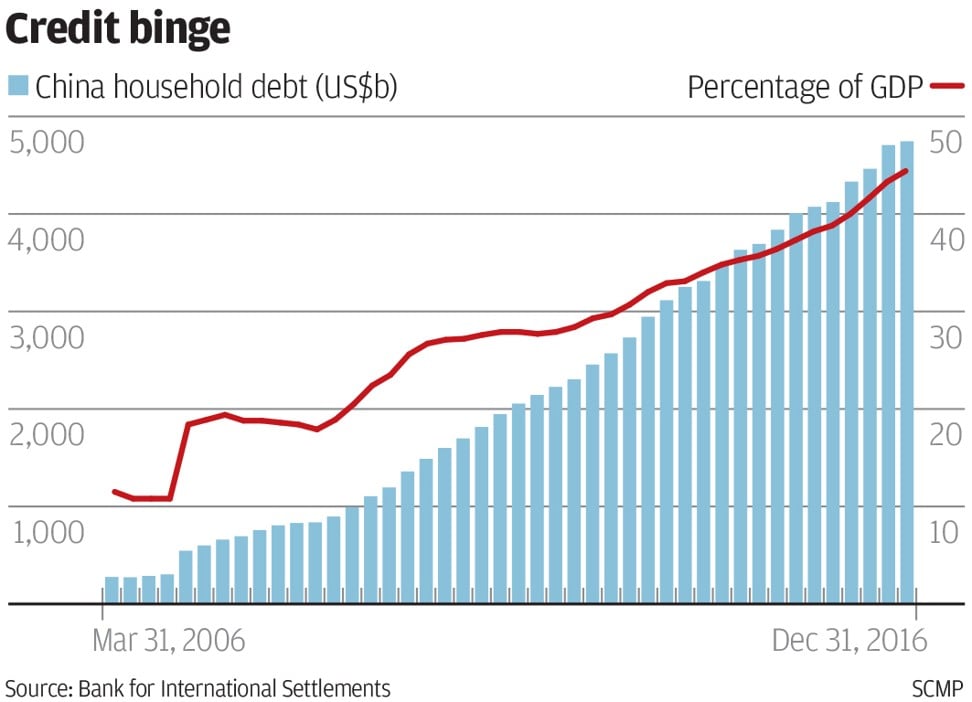
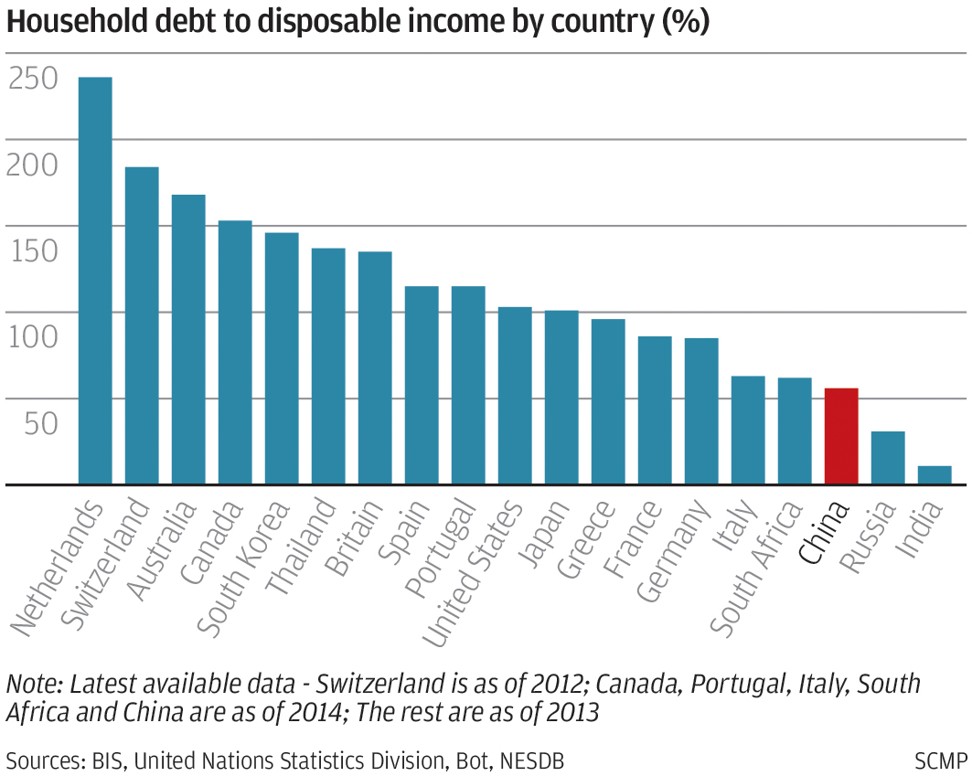
China’s banks swap 1 trillion yuan of debt into stocks, extending financial life line to state debtors

China’s banks converted more than 1 trillion yuan (US$149.2 billion) of debt into stock holdings in more than 70 state-owned enterprises, in the government’s largest debt-to-equity swap effort to bail out the country’s most indebted borrowers, according to the official China New Agency, citing a notice by the state planning department.
The scheme, signed between Chinese banks and companies in the steel, coal, chemicals and equipment manufacturing industries, has helped to lower the aggregate debt ratio in these industries, the agency reported, citing the National Development & Reform Commission (NDRC).
SCMP Graphics
China’s 2016 corporate debt soared to about 170 per cent of gross domestic product (GDP), from 100 per cent in 2008, according to the Bank of International Settlements. At double the average of other economies, the aggregate debt of China’s state-owned enterprises (SOEs) and private companies stood at US$15.7 trillion last year.

The government is anxious to reduce the debt owned by the moribund state sector to shield the country’s financial system from the risks of defaults, while the economy’s growth pace slows.
The idea of swapping banks’ debts into equity holdings was raised by China’s Premier Li Keqiang during the National People’s Congress in March last year. It wasn’t a new idea. The scheme was used during the 1990s to clean up the books of China’s state banks.
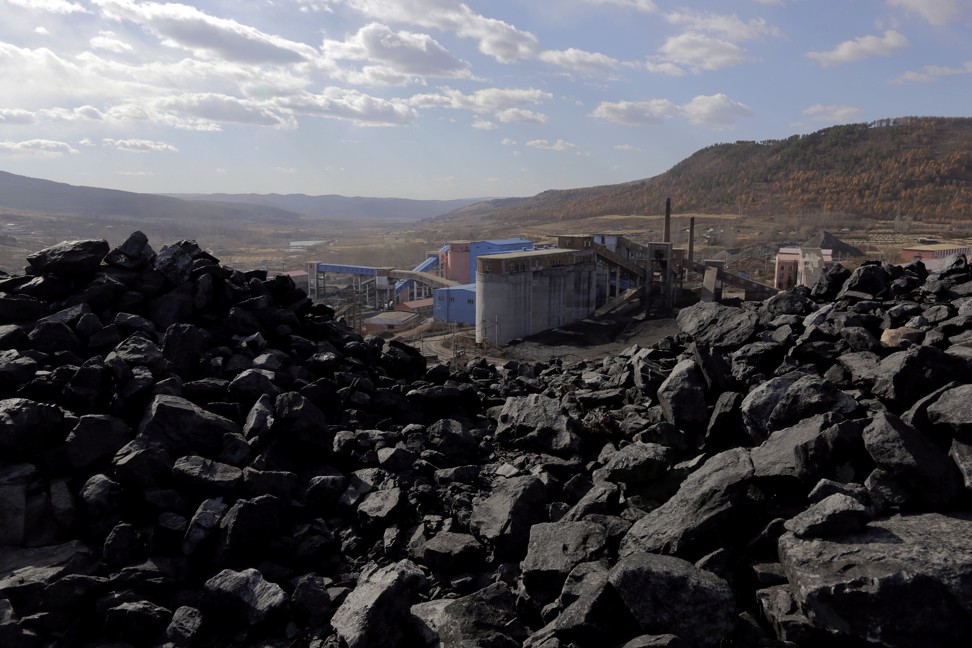
A general view shows Pinggang coal mine from the state-owned Longmay Group on the outskirts of Jixi, in Heilongjiang province. Photo: Reuters
What’s different this time is the debt-to-equity swap would proceed under market principles, giving banks and financial institutions a bigger say in choosing the indebted companies whose borrowings were to be swapped, and in fixing the financial terms of the swaps. This was done to avoid channelling funds into so-called zombie companies that were inefficient and destined for bankruptcy.

Still, the swaps were complicated by a set of draft rules released by the China Banking Regulatory Commission (CBRC) a day before the NDRC announcement, which left more questions than answers regarding the details of the exchange.
SCMP Graphics
“The scheme had been unrolling since last year, and we are concerned about what the new rules mean to the existing deals,” said Chen Shujin, chief financial analyst at Huatai Financial.
For example, some banks have channelled fund they raised through wealth management products from retail investors into the debt-to-equity swap programmes. It isn’t immediately clear whether that practice is allowed under the CBRC’s latest draft rules, Chen said.
Investors are keen to know more details, including how the shareholding structure of the target company will be changed, and the risk weightings brought by the investment for banks, she added.
The largest shareholder, which holds more than 50 per cent stake in a debt-to-equity swap unit should be a locally incorporated commercial bank. Other qualified shareholders (non-bank financial institutions) include less than 42 brokers, around 20 insurance firms, and some trust firms, according to the draft rules.
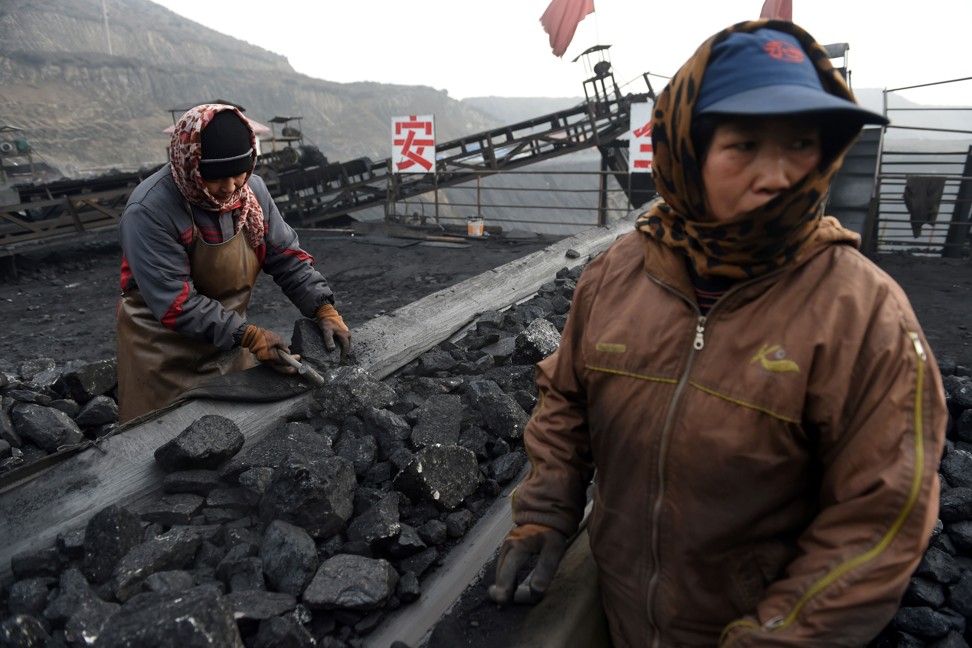
This November 20, 2015 photo shows workers sorting coal on a conveyer belt near a coal mine in Datong, in China's northern Shanxi province. Photo: SFP
“According to the latest draft rules, banks will hold more than 50 per cent stake of the unit that handles the swap, which means they will have a bigger say for the projects,” said ING Bank NV’s economist Iris Pang. “That’s a good sign. It partly eases the concern of the market that banks would be under pressure from local governments if they are just minority stake holders.”

Improving corporate leverage has helped China’s bond defaults to slow in 2017, according to a report by Goldman Sachs.

Based on industrial profits, earnings improvements are spreading further downstream, relieving the corporates’ debt stress, it said.
“The median level gross debt-to-EBITDA, a measure of profitability, fell to 2.1 times at the end of 2016, the first reduction after five years of increases, while net debt-to-EBITDA fell to -0.2 times,” the report said.

Friday, August 11, 2017

How crisis-hit economies become investment darlings.

”Basket-cases”? ”Frontier economies”? How about ”phoenixes”?
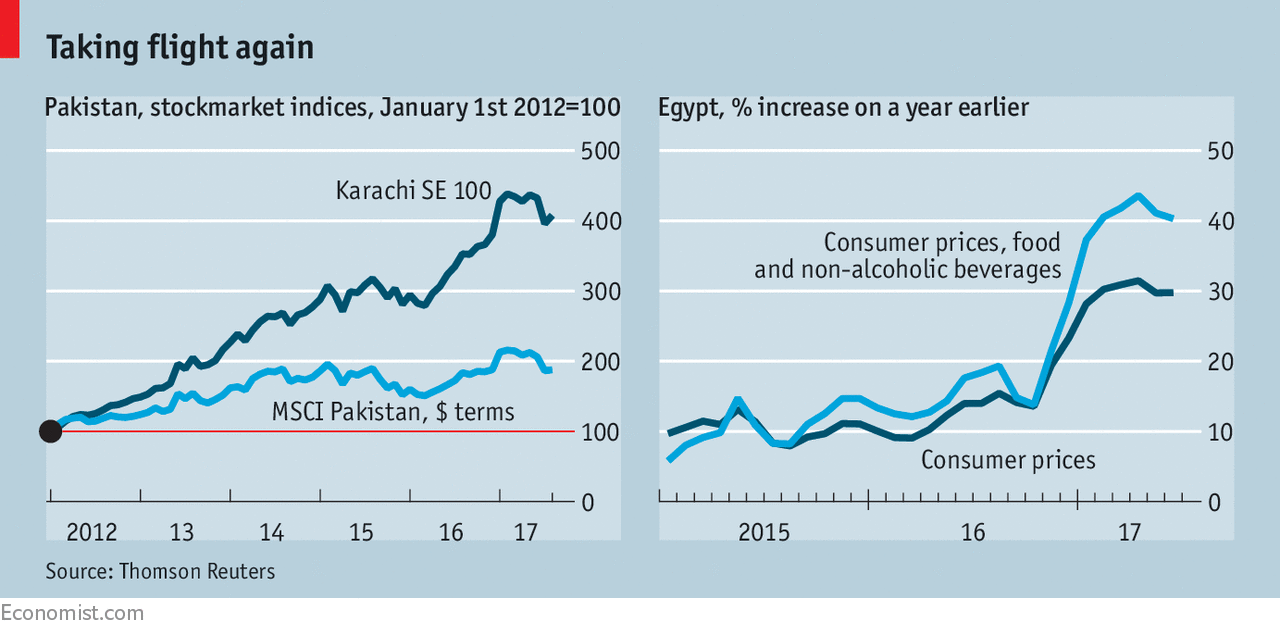
NAWAZ SHARIF is the ex-prime minister of Pakistan again. His third stint in the job ended on July 28th after the Supreme Court disqualified him from office. Yet he could justifiably claim that he left Pakistan’s economy in a better state than he found it. When Pakistan last went to the polls, GDP had been growing at around 3%, a dismal rate for a poor country with a burgeoning population. Inflation was above 10%. The budget deficit had ballooned. A crisis loomed. Four years on, inflation is in the low single digits. The budget deficit has shrunk to a little above 4% of GDP. The GDP growth rate is closing in on 6%. Investors too have taken notice. Since 2012, Pakistan’s stockmarket capitalisation has doubled in dollar terms (see chart).
Pakistan is not Sweden. It remains at the wrong end of global rankings of security, corruption and human development. At the last count, almost 30% of the population were living in poverty. Yet a crisis-prone economy has at least been put on a steadier footing. In the process, Pakistan has become something of an investment darling. It is thus a template for a particular kind of turnaround, one that reflects an upgrade in macroeconomic policy.
Bounce-back stories of this kind are quite rare, because the reforms needed are initially painful. They are typically found in what are called “frontier markets”, which lie beyond even emerging markets at the riskiest edge of the investment universe. Not all such markets will follow the path taken by Pakistan. A more apt description for one that has come back from the near-dead to a tolerable life might be “phoenix economy”.
Which places fit the bill? The spectrum runs from disaster zones, such as Zimbabwe (or even Venezuela), which might one day bounce back; through early-stage recovery stories that may yet falter, such as Argentina, Egypt and perhaps Nigeria; to graduates, such as Pakistan or the Philippines, which has been “flavour of the month for about ten years” in the words of one frontier investor. Not much unites such economies beyond a history of bad management. But there are some common themes. Politics are usually unstable. The army lours over Pakistan, Egypt and Nigeria, for instance. And phoenixes tend to go through the same three phases: a crisis, or “ashes” stage, as trouble comes to a head and capital flees the country; a “response” stage, where a politician grasps the reform nettle, often with IMF support; and a third “rebirth” stage, as capital is lured back by the prospect of economic recovery.
Start with the ashes. Circumstances will differ from country to country but the general pattern is quite similar. The economy hits a financial constraint: sometimes it is the budget deficit; more often the trade deficit. Investors become loth to offer financing. Interest rates shoot up. The flow of foreign capital dries up or—worse—capital begins to flee. The currency is propped up by intervention: foreign-exchange reserves are run down to sustain the illusion that it is worth more than it really is. Reserves grow thin. Hard currency is rationed, creating shortages of essential imports. The economy falters.
The triggers for crisis vary. A weak spot in Pakistan, for instance, was its reliance on oil imports to fuel much of its electricity supply. When the price of crude rose above $100 a barrel in 2013, the cost of the government’s fuel subsidies blew out its budget deficit. In Egypt the constraint was its current-account deficit, which widened from 0.8% of GDP in 2014 to 5.6% by 2016. The descent in the oil price hit fees from the Suez canal and crimped the value of remittances from oil-rich neighbours. Security fears led to a drop in revenue from tourism.
The second stage of a turnaround sees the realisation that orthodox exchange-rate, monetary and fiscal policies are required. This usually means allowing the currency to fall, cutting the budget deficit by trimming wasteful subsidies, and using monetary policy to control inflation rather than to finance the government.
It is not enough for senior technocrats to argue for such changes. The head of government must back the reforms. Andrew Brudenell, of Ashmore, a fund manager, says that once an example is set from the top, the effect trickles down to other institutions. A big plus is a high-profile champion for policy changes, such as Mauricio Macri, Argentina’s president, who was elected on a platform of economic reform. Often the IMF will be brought in to lend hard-currency reserves and policy advice. Egypt began a three-year IMF programme last November. Pakistan signed up to its most recent one in September 2013.
That is often the cue for the rebirth, during which capital flight goes into reverse. Attracting capital back is “somewhere on the scale between pretty important and absolutely crucial”, says Paul McNamara, of GAM, a fund-management firm. It takes a while to shrink a big current-account deficit, even with a cheaper currency. Capital inflows are thus needed both to finance the residual deficit and to rebuild foreign-exchange reserves.
The first people to tempt back are those citizens who shifted money offshore ahead of the crisis. The lure of high interest rates (needed to curb inflation) and the diminished currency risk that follows a big devaluation will tempt others, too. For instance, foreign investors now hold almost a quarter of Egypt’s treasury bills, according to JPMorgan Chase. Tax amnesties are another way to tempt money back. Argentina raised $117bn in 2016-17 in that way.
The hope is that within, say, two years of the crisis, inflation has peaked, the economy is growing at a decent rate and the current-account deficit is manageable. That then provides a platform for more reform and a period of crisis-free economic growth. But lots can go wrong.
A danger is that hardship and social unrest derail the reform process. Cuts to subsidies on top of big devaluations in both Argentina and Egypt have pushed up inflation rates to 22% and 31% respectively. In Egypt food-price inflation is close to 40% (see chart). Even so, in both places the economy is starting to pick up steam. Optimists hope Nigeria is in the very early stages of another turnaround, but there have already been a few false dawns. Nigeria bounced back impressively from a slump in the price of oil, its principal export, in 2009. Its reform champion was Lamido Sanusi, the central-bank governor, who won plaudits for taming inflation and cleaning up the banks. The stockmarket boomed. But the reforms dried up. Mr Sanusi was sacked. By 2016, Nigeria’s economy was deep in trouble again.
There are risks even for graduates of the phoenix-economy school. Once a modicum of stability returns, the impetus for further reform often fades. Take Pakistan. Since it reached the end of its IMF programme last year, there has been a slackening of fiscal and monetary discipline and a re-emergence of old problems in its power companies. The prospects for faster growth now rest on Chinese investment in a 3,000km (1,875-mile) China-Pakistan Economic Corridor, or CPEC. But that also puts Pakistan in a familiar spot: a reliance on foreign capital, which can turn out to be fickle and expensive. Trouble would take a while to surface. By then, investors may be talking about the big turnaround in Zimbabwe or Venezuela.

Thursday, August 10, 2017

Genetic testing threatens the insurance industry

Insurers worry about adverse selection; the insured worry about discrimination
IF A genetic test could tell whether you are at increased risk of getting cancer or Alzheimer’s, would you take it? As such tests become more accessible, more and more people are saying “yes”. The insurance industry faces a few headaches as a result.
Once used only for medical reasons, basic predictive genetic tests can now be ordered online for a few hundred dollars. One company, 23andMe, in California, has collected some 4,000 litres of sputum since 2007, enlightening 2m people on their ancestry, health risks and what they may pass on to offspring. In April it received regulatory approval to screen for risk factors connected to ten diseases and genetic conditions, including late-onset Alzheimer’s and Parkinson’s. The ruling could open the floodgates for others to sell direct to consumers.
“Information is power”, argue many who take such tests. But insurers fear that without equal access to such information, they will lose out to savvy customers. Consumer groups, on the other hand, fear that if underwriters did have access to such information, people with “bad” genes might find themselves unfairly excluded from cover. Either way, the scientific advances could well disrupt insurance significantly.
Unlike diagnostic genetic tests, predictive ones are conducted on people without symptoms. The best-known example was provided by Angelina Jolie, an actress who discovered she had a gene mutation that markedly raised her risk of breast cancer. She underwent a double mastectomy.
Tests might influence financial as well as medical decisions. A person at increased risk of dying young may want to buy life insurance. Someone likely to contract cancer may buy cancer or critical-illness cover, which pays a lump sum upon diagnosis. Because predictive tests—unlike diagnostic ones—often need not be disclosed, the customer can secure an advantage over a future insurer.
So underwriters warn that predictive genetic testing could well lead to adverse selection. The New York Times recently reported on a woman who bought long-term care insurance after testing positive for ApoE4, a mutation of a gene related to increased risk of Alzheimer’s. The insurer had tested her memory three times before issuing the policy, but could not know about the genetic result. Robert Green, at Harvard University, found that people told they have the mutation were five times more likely to buy long-term care insurance than those without such information.
Asymmetry of information—when the customer knows more than the insurer—is the industry’s nightmare. If predictive tests further improve and become more common while non-disclosure rules stay in place, some insurance products might eventually die out. Either insurers would go belly-up, or premiums would become prohibitively expensive. Hence, argue some insurers, if the customer knows something relevant about their health, so should the insurer.
But tests might also help insurers. Christoph Nabholz, from Swiss Re, a reinsurance giant, is most excited about tests that spot early signs of cancer or cardiovascular disease. For life and health insurers, who want to keep people alive and well, such information could be invaluable. Discovery, a South African health insurer, plans to offer customers a test that maps part of their genome. The focus is on “actionable data”, where medical intervention or lifestyle change could mitigate risk, explains Jonathan Broomberg from Discovery.
This might help people who are already insured. But it worries those seeking new policies, who fear that underwriters may use predictive information to discriminate. Some might lose access to insurance. This raises ethical questions about when, if ever, genetic discrimination is acceptable. Moreover, since the relative role that genes play in the development of diseases is still being studied, some people might be unfairly and wrongly penalised.
Unpredictability rules
So regulations today often protect consumers from the mandatory disclosure of predictive tests. But the rules are patchy. In Britain the industry has agreed to a blanket moratorium, renewable every three years, on using predictive genetic information. The sole exception is Huntington’s chorea, where a test of one gene is infallible and has to be disclosed to an insurer for life cover worth more than £500,000 ($662,000). In America the Genetic Information Nondiscrimination Act bans health insurers (and employers) from using such results, but is silent on other types of insurance. In several countries life insurers may already ask for disclosure of predictive genetic tests for policies over a certain value.
But testing is rarely cut-and-dried. Ronnie Klein from the Geneva Association, an insurance-industry think-tank, says that, unlike Huntington’s, most illnesses stem from a number of factors, including lifestyle and environment, and a combination of genes. For example, although the ApoE4 allele increases the risk of Alzheimer’s, many without it still get the disease.
Some regulators, such as Germany’s, have outlawed direct-to-consumer tests. But nothing stops Germans from ordering from abroad, and, just as it became normal for life insurers to ask for family history, so insurers will surely eventually have access to relevant genetic information. The question will be what they are allowed to do with it. When blood tests for AIDS first appeared, insurers also fretted about adverse selection. Many jurisdictions ruled they could not be used for calculating health premiums, as these were a basic good, but could be used for life policies. As genetic testing spreads, society and insurers may face many similar difficult assessments.